Fact-checked by the ZeroinDaily editorial team
Quick Answer
Teachers are swapping out projectors, textbooks, and lab equipment for augmented reality classroom technology across K–12 and higher education. Adoption has grown by 83% since 2022, with platforms like Google Expeditions AR, Merge EDU, and Anatomage now used in over 40,000 U.S. schools to deliver immersive, standards-aligned instruction.
Updated August 2026
Augmented reality classroom technology isn’t experimental anymore. It’s actively replacing aging smartboards, static textbooks, and outdated science labs in schools across the United States. According to the MarketsandMarkets 2024 AR in Education report, the global AR education market is projected to reach $19.6 billion by 2030, driven almost entirely by classroom deployment at the K–12 and postsecondary levels.
The shift is picking up speed because the tools have finally caught up with what educators actually need. Teachers who once waited years for reliable edtech now have affordable, curriculum-mapped AR platforms ready to deploy on tablets and smartphones they already own.
Key Takeaways
- AR classroom adoption has grown 83% since 2022, with platforms like Merge EDU now active in over 40,000 U.S. schools.
- The global AR education market is projected to reach $19.6 billion by 2030, according to MarketsandMarkets’ 2024 report.
- A meta-analysis of 68 studies in Computers and Education found AR instruction improves learning outcomes by an average of 31% over traditional methods.
- Districts pairing AR tools with structured professional development see adoption rates 2.4 times higher than those that skip teacher preparation, per RAND Corporation research.
- Approximately 30% of rural U.S. schools fall below CoSN’s recommended 1 Gbps connectivity threshold, limiting AR access for large numbers of students.
- Virtual science labs through platforms like Labster save districts an average of $3,800 per classroom annually while eliminating safety risks from chemical and biological materials.
What Is AR in the Classroom?
Augmented reality classroom technology layers digital content onto the real physical world through a device camera, things like 3D models, animations, and interactive data, without replacing that world entirely. This is what separates it from virtual reality, which requires full immersion in a synthetic environment.
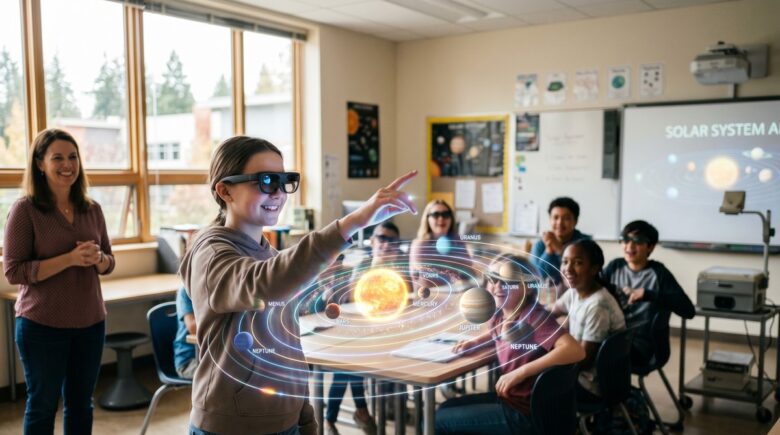
In a classroom context, this means a student points a tablet at a printed worksheet and watches a human heart inflate into a beating 3D model above the page. It means a biology class dissects a virtual frog without a single scalpel. Platforms like Merge EDU, CoSpaces Edu, and zSpace have built entire curriculum libraries around this kind of interaction.
AR vs. VR in Education
AR is a lot more practical for classroom use than VR. Students keep their physical surroundings visible, which cuts down on motion sickness and still allows for group collaboration. VR requires individual headsets costing $300–$1,500 per unit; most AR experiences run on a standard school-issued iPad or Chromebook.
AR isn’t a fix for everything. Schools with poor Wi-Fi infrastructure, outdated tablets, or teachers without dedicated professional development time will struggle to see the gains documented in research settings. The technology is only as good as the implementation behind it.
AR runs on existing school tablets, making it accessible to the roughly 50 million K–12 students in U.S. public schools without requiring costly new hardware, unlike VR, which demands individual headsets and dedicated setup time.
What Outdated Tech Is AR Replacing?
AR is most visibly replacing static textbooks, overhead projectors and smartboards, and physical science lab equipment. Each swap cuts cost, boosts engagement, and clears away logistical headaches that have frustrated teachers for decades.
Physical textbooks have an average replacement cycle of 7 to 10 years, which means millions of students are learning from outdated content. AR-linked curricula update digitally, so a lesson on the solar system reflects the latest NASA data rather than a 2015 printing. Publishers including Houghton Mifflin Harcourt and McGraw-Hill have already embedded AR triggers directly into new print editions.
Science Labs and Dissection Alternatives
Physical dissection kits, chemical reagents, and vintage anatomical models are expensive to maintain and carry real safety risks. Anatomage, used in over 4,000 medical and high school classrooms, provides a full-body AR table that lets students perform virtual autopsies with no biological waste or liability. Labster extends the same logic to chemistry and physics simulations.
Replacing Smartboards and Projectors
Smartboards average $3,000–$5,000 per unit and require dedicated wall space and calibration. AR experiences delivered through a shared class device or individual tablets cut that overhead out entirely. Districts including Los Angeles Unified School District (LAUSD) and Chicago Public Schools have begun phasing out projector-based instruction in STEM classrooms in favor of tablet-based AR workflows.
| Technology Being Replaced | AR Replacement Tool | Average Cost Savings Per Classroom |
|---|---|---|
| Physical Textbooks | Merge EDU / CoSpaces Edu | $1,200/year |
| Science Lab Equipment | Labster / Anatomage | $3,800/year |
| Smartboards / Projectors | zSpace / Google AR Tools | $2,500 upfront |
| Printed Worksheets | Quiver Education / Metaverse | $400/year |
| Anatomy Models / Specimens | Complete Anatomy (3D4Medical) | $2,100/year |
Districts using platforms like Labster for virtual science labs report average savings of $3,800 per classroom annually, while eliminating the safety risks associated with chemical and biological materials. AR is replacing textbooks, smartboards, and lab equipment all at once, not one category at a time.
How Do Teachers Use AR Day-to-Day?
Most teachers get into AR through curriculum-mapped apps tied to lesson plans they’re already running, then gradually move toward building their own experiences. Adoption follows a pretty predictable path: start with pre-built content, then explore no-code creation tools once comfort grows. District-approved platform subscriptions typically provide the structure that makes both steps possible.
Merge EDU is among the most widely adopted platforms because it maps directly to Next Generation Science Standards (NGSS) and Common Core. A teacher assigns an AR object, a volcanic eruption model, for instance, directly through Google Classroom or Canvas. Students scan a physical Merge Cube with any tablet camera to interact with the model in three dimensions.
Take a 7th-grade science teacher in a district with 1:1 Chromebooks and a reliable 1 Gbps connection. She can deploy Merge EDU’s NGSS-aligned earth science module in a single planning period. Her 150 students explore a 3D volcano model on devices they already carry, and the annual subscription costs the department about $1,200, less than replacing one aging smartboard.
No-Code AR Creation for Educators
Platforms like CoSpaces Edu and Metaverse let teachers with zero coding background build custom AR experiences in under 30 minutes. A history teacher can create an AR walkthrough of ancient Rome that students explore from their desks. A math teacher can build a 3D graph that students manipulate with their fingers.
Professional development remains the real bottleneck here. The RAND Corporation research on edtech teacher readiness makes clear that meaningful adoption hinges on structured training. Districts that pair AR rollouts with professional development see implementation rates up to 2.4 times higher than those that just hand out devices and hope. That gap is large enough that skipping training effectively negates much of the technology investment.
For schools already using AI-driven tools in other departments, the transition tends to go smoother. Educators familiar with platforms covered in resources like AI tools that save time often bring that same digital-first mindset to classroom AR adoption.
According to RAND Corporation research, districts pairing AR tools with structured professional development see adoption rates 2.4 times higher than those that skip teacher preparation. That gap is large enough that skipping PD effectively negates much of the technology investment.
Does AR Improve Student Outcomes?
The research base has grown large enough to move past anecdote. AR instruction produces measurable gains in retention, engagement, and test performance, particularly in STEM subjects where spatial reasoning matters most.
A peer-reviewed study published in the journal Computers and Education analyzed 68 studies across K–12 and higher education and found that AR-based instruction improved learning outcomes by an average of 31% compared to traditional methods. Gains were largest in biology, chemistry, geometry, and geography.
Engagement and Attendance Data
Engagement is usually the first thing schools measure. Schools piloting zSpace AR workstations reported a 40% reduction in off-task behavior during STEM lessons, according to an independent evaluation by WestEd. Student-reported interest in STEM careers also increased by 22% after one semester of regular AR use.
That engagement-to-retention pipeline matters for long-term outcomes. Students with higher in-class engagement consistently outperform peers on standardized assessments. This carries real weight for districts measured against Every Student Succeeds Act (ESSA) benchmarks, where STEM proficiency rates directly affect school funding classifications.
The broader pattern holds across sectors: digital tools that reduce friction and increase interactivity consistently beat passive alternatives. The same principle applies whether you’re reviewing digital banking trends reshaping money management or looking at AR tools reshaping classrooms.
A meta-analysis of 68 studies in Computers and Education found AR instruction improves learning outcomes by an average of 31% over traditional methods, with the largest gains in STEM subjects requiring spatial reasoning.
What Are the Main Barriers to AR Adoption?
Device access and bandwidth are the two obstacles most likely to stall AR deployment before it even starts. For under-resourced districts, both are genuine constraints, not minor inconveniences.
While most AR platforms run on standard tablets, schools in lower-income districts often lack a 1:1 device ratio. The FCC’s E-Rate program funds broadband and some device costs for eligible schools, but hardware gaps persist. Approximately 15% of U.S. public school students still lack consistent access to a personal classroom device, according to 2024 data from the National Center for Education Statistics (NCES).
Districts that can’t schedule at least two half-day professional development sessions per teacher each year should think twice before adopting AR. Without ongoing training, the initial excitement fades and teachers drift back to familiar methods, leaving expensive subscriptions unused.
Internet Bandwidth Requirements
Many AR applications need reliable high-speed internet, which is a real challenge in rural districts. CoSN (Consortium for School Networking) recommends a minimum of 1 Gbps per 1,000 students for immersive edtech. Roughly 30% of rural schools fall below this threshold, according to a 2023 EducationSuperHighway connectivity report.
Here’s a practical go/no-go threshold: if your school’s connection can’t sustain at least 1 Gbps per 1,000 students, put money into infrastructure before rolling out AR. On a sluggish network, the immersive effect breaks down fast, and students disengage even quicker than they would with a static textbook.
Curriculum Alignment and Assessment
Teachers also point to difficulty aligning AR activities with standardized assessments. Most AR platforms generate engagement data but not the rubric-mapped performance data administrators actually need. That gap is narrowing, though: Merge EDU released an NGSS-aligned assessment dashboard in late 2024, and zSpace integrated with Schoology and Canvas LMS for grade passback around the same time.
Budget planning for edtech shares a lot of structural similarities with other institutional financial decisions. District technology coordinators navigating multi-year AR procurement may find frameworks from resources like cloud storage cost planning for organizations useful when structuring multi-vendor contracts.
About 30% of rural U.S. schools fall below CoSN’s recommended 1 Gbps connectivity threshold, directly limiting how many students can access augmented reality classroom technology at scale. For those districts, connectivity investment has to come before platform adoption, not alongside it.
Frequently Asked Questions
What is the best AR app for classroom use in 2025?
Merge EDU is the most widely adopted AR platform for K–12 classrooms, used in over 40,000 schools and mapped to both NGSS and Common Core standards. Labster leads in secondary and postsecondary science labs, while zSpace is preferred in districts with dedicated STEM lab spaces.
How much does AR implementation cost per classroom?
Entry-level AR using existing tablets with free or low-cost apps like Quiver Education can cost under $500 annually. Full-scale deployments with platforms like zSpace or Anatomage range from $8,000 to $25,000 per room, including hardware, licensing, and professional development.
Can AR be used effectively across all grade levels?
Yes. AR tools are available from kindergarten through postsecondary education. Quiver Education targets K–5 with coloring-page-based AR, while Anatomage and Complete Anatomy serve high school AP Biology and college anatomy courses. Interaction complexity scales with the curriculum.
Can teachers build AR lessons without coding?
Yes. Platforms like CoSpaces Edu and Metaverse offer no-code authoring tools. Educators can build complete AR experiences in under 30 minutes using drag-and-drop interfaces, and both integrate with Google Classroom and support student-created AR projects.
Are there federal funds for AR classroom technology?
Yes. Title IV-A of the Every Student Succeeds Act (ESSA) funds technology purchases, including AR hardware and software, for eligible districts. The FCC’s E-Rate program covers broadband infrastructure that supports AR deployment. Many states also offer STEM-specific grants that include AR and VR tools.
How is AR different from VR in schools?
AR overlays digital content onto the real classroom environment, allowing students to stay aware of their surroundings and collaborate with peers. VR replaces the environment entirely, which limits group interaction and can cause motion sickness with prolonged use. AR also runs on existing devices, making it a lot more cost-effective for schools.
Which subjects benefit most from AR instruction?
Biology, chemistry, geometry, and geography show the largest documented gains, according to the meta-analysis in Computers and Education. These subjects lean heavily on spatial reasoning, where 3D interaction outperforms static diagrams or text descriptions. Subjects built around reading, writing, or abstract reasoning show smaller, though still positive, effects.
What are the main downsides of AR in the classroom?
The most consistent downsides are teacher confidence gaps, bandwidth requirements, and the limited ability of most platforms to generate rubric-mapped assessment data. Schools with unreliable internet, older devices, or no professional development budget will likely see results fall short of what the research shows. AR is also less effective for subjects centered on discussion, writing, or close reading.
How do teachers manage behavior during AR activities?
Most educators report that engagement actually cuts down on off-task behavior. An independent evaluation by WestEd found a 40% reduction in off-task behavior during AR-based STEM lessons. The main challenge is transition time: moving students in and out of AR requires clear routines, especially with younger grades. Schools that build structured entry and exit procedures tend to implement more smoothly.
Are there equity concerns with AR classroom technology?
Yes, and they’re significant. The roughly 15% of U.S. public school students who lack consistent access to a personal classroom device, per NCES data, are effectively locked out of most AR experiences. Rural schools with connectivity below CoSN’s 1 Gbps threshold face the same barrier. Without deliberate effort to close device and bandwidth gaps, AR adoption risks widening the achievement gap it could otherwise help close.
What role do standards play in AR classroom adoption?
Standard alignment matters a great deal. Platforms like Merge EDU map directly to Next Generation Science Standards (NGSS) and Common Core, helping teachers fold AR into curricula they’re already teaching. National standards help ensure that AR content supports state-mandated learning objectives and lines up with assessment frameworks.
How does AR support inclusive education?
AR can improve accessibility by offering multiple sensory pathways to learning: visual, spatial, and interactive. For students with learning differences or physical disabilities, it provides non-traditional ways to explore content. The National Institute of Standards and Technology (NIST) notes that digital twin frameworks, like those underpinning AR, can improve system performance and reduce inefficiencies in education technology infrastructure, helping equity and inclusion in the process.
Develops technical guidance and contributes to standards to help manufacturers (noting particular challenges for small and medium-sized enterprises) identify digital twin requirements, manage data effectively, create validated models, and improve interoperability and trustworthiness for operations optimization and cost reduction.
says National Institute of Standards and Technology (NIST).
Sources
- MarketsandMarkets, Augmented Reality in Education Market Report 2024
- RAND Corporation, Edtech Teacher Readiness Research Report
- CoSN (Consortium for School Networking), Broadband Connectivity Standards for Schools
- WestEd, Independent Evaluation of AR-Based STEM Instruction
- EducationSuperHighway, 2023 State of Connectivity in U.S. Schools Report
- NIST, Digital Twins in Advanced Manufacturing
- NIST, Digital Twin Testbed
- NIST, Manufacturing Digital Twin Standards
- National Center for Education Statistics (NCES)