

Key Takeaways
- Renters insurance averages $15-25 per month and covers your belongings, liability, and temporary housing if your apartment becomes uninhabitable.
- Your landlord’s insurance covers the building structure. It does not cover a single thing you own inside your unit.
- Replacement cost coverage is worth the small premium increase over actual cash value. The difference matters enormously when filing a claim.
- Bundling renters insurance with auto insurance typically saves 10-20%, making an already cheap policy even cheaper.
In This Article
- Why You Need Renters Insurance (Even If You Think You Don’t)
- What Renters Insurance Actually Covers
- What It Does Not Cover
- Replacement Cost vs. Actual Cash Value: The Choice That Matters Most
- How Much Coverage Do You Actually Need?
- Six Ways to Lower Your Premium
- How to File a Claim Without Getting Shortchanged
Why You Need Renters Insurance (Even If You Think You Don’t)
I’ll cut straight to the scenario that changed my mind about renters insurance when I was 24. My upstairs neighbor left their bathtub running, went to work, and my entire apartment ceiling caved in while I was at the office. Came home to a soaking wet disaster zone. Laptop destroyed. Bed ruined. Half my wardrobe unwearable. Probably $8,000 in personal property damage in one afternoon.
Guess what my landlord’s insurance covered? The ceiling. The drywall. The structural repair. As for my laptop, my clothes, my furniture, my displaced living situation for the next two weeks? That was entirely my problem. Because here’s the thing almost no renter understands until it’s too late: your landlord’s insurance protects their building. Period. It doesn’t cover a single thing you own inside that building.
The Insurance Information Institute reports that only about 57% of renters carry any insurance at all, compared to 93% of homeowners. The gap is staggering, and the reasons people give are almost always wrong. “I don’t own enough stuff to insure.” Really? Walk through your apartment right now and mentally total up your electronics, furniture, clothing, kitchen appliances, and anything else you’d need to replace from scratch after a fire. Most people land somewhere between $15,000 and $30,000 and are genuinely shocked by the number.
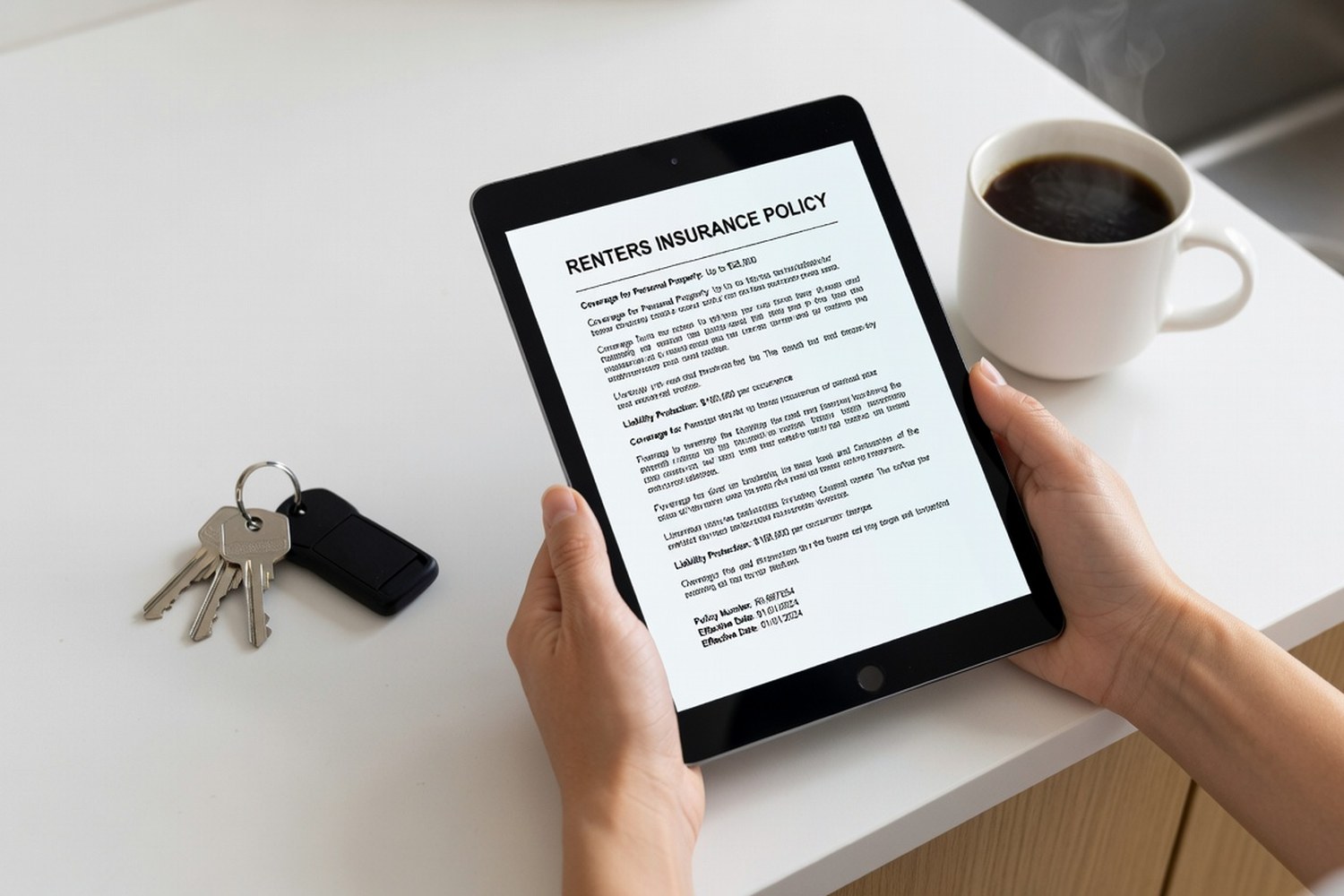
What Renters Insurance Actually Covers
A standard renters insurance policy — what the industry calls an HO-4 form — bundles three types of protection into one monthly payment. Understanding each piece helps you buy the right amount of coverage instead of guessing.
Personal property coverage is the core of the policy. It protects your belongings against a list of specific “perils” that typically includes fire, smoke, lightning, theft, vandalism, water damage from burst pipes, windstorms, and a few others. If your apartment gets broken into and your TV, laptop, and jewelry are stolen, personal property coverage pays to replace them up to your policy limit.
Liability coverage is the part most people don’t think about until it saves their financial life. If someone gets injured in your apartment — trips on your rug, gets bitten by your dog, slips on your freshly mopped floor — liability coverage pays their medical bills and legal costs if they sue. Standard policies include $100,000 in liability, which sounds like a lot until you realize that a single dog bite lawsuit averages over $50,000 in settlements according to the Insurance Information Institute. If you have any assets to protect, bumping liability to $300,000 costs only a few dollars more per month.
Loss of use / additional living expenses covers the cost of living somewhere else if your apartment becomes uninhabitable. Hotel stays, restaurant meals above your normal food spending, even laundry costs. When my ceiling collapsed, this is what paid for two weeks in an extended-stay hotel while the landlord dealt with repairs. Without it, I’d have been on someone’s couch or eating through my emergency fund. Speaking of which, our emergency fund guide explains why this backup matters even when you have insurance.
What It Does Not Cover
Standard renters insurance has some important gaps, and ignoring them can create a false sense of security. Know what’s excluded before you need to find out the hard way.
Floods are not covered. This surprises people every single time. A burst pipe inside your building? Usually covered. Water coming in from outside during a rainstorm or flood? Not covered under a standard renters policy. If you live in a flood-prone area, you need separate flood insurance through the National Flood Insurance Program or a private flood insurer. First-floor apartments and basement units are especially vulnerable even in areas that aren’t officially designated as flood zones.
Earthquakes are not covered. If you’re in California, the Pacific Northwest, or any seismically active region, earthquake coverage is a separate policy or endorsement. It’s not cheap — but neither is replacing everything you own after a major quake.
High-value items have sub-limits. Most standard policies cap payouts for jewelry at $1,500 to $2,500, and similar limits apply to collectibles, musical instruments, and fine art. If your engagement ring alone is worth $5,000, the standard policy won’t fully cover it. You’ll need a “scheduled personal property” endorsement (sometimes called a floater or rider) that covers specific expensive items at their appraised value. It typically costs $1-2 per $100 of value annually.
Roommate belongings need their own policy. Your renters insurance covers you and your belongings. Unless your roommate is listed on your policy (which some insurers allow and others don’t), their stuff isn’t protected. Each person in a shared apartment generally needs their own policy. This is particularly important for anyone managing shared living expenses — our monthly budgeting guide can help structure those shared costs cleanly.
💡 Pro Tip
Read the “exclusions” section of your policy before you buy, not after you file a claim. It takes ten minutes and prevents nasty surprises. If something important to you is excluded, ask your agent about adding an endorsement.
How actual cash value and replacement cost coverage compare on real-world claims.
Replacement Cost vs. Actual Cash Value: The Choice That Matters Most
This is the single most important decision you’ll make when buying a renters policy, and the difference in outcomes is enormous. Let me illustrate with a scenario that happens constantly.
You bought a laptop three years ago for $1,200. It gets destroyed in a kitchen fire. With an actual cash value (ACV) policy, the insurer calculates what that three-year-old laptop is worth today — accounting for depreciation, wear, and the fact that a newer model has replaced it. Your payout? Maybe $400 to $500. Good luck buying a comparable laptop with that.
With a replacement cost value (RCV) policy, the insurer pays what it costs to buy a similar laptop new, right now. That’s $1,200, or whatever the current equivalent costs. You get enough to actually replace what you lost, not a depreciated fraction of it.
The premium difference between ACV and RCV policies is typically $5-10 per month. Over a year, you’re paying an extra $60-120 for coverage that could pay out thousands more on a single claim. Every financial planner I know — myself included — recommends replacement cost without hesitation. The math just works overwhelmingly in your favor.
One wrinkle: some RCV policies pay the ACV amount upfront and then reimburse the difference once you actually purchase the replacement item. So you might get $500 initially and then another $700 after you show the receipt for the new laptop. Keep that in mind for cash flow planning — having our emergency fund in place covers you during that gap.

How Much Coverage Do You Actually Need?
Here’s a fifteen-minute exercise that will give you a reliable answer. Walk through every room in your apartment with your phone and take photos of everything. Open every closet, every drawer, every cabinet. Then sit down and estimate replacement costs — not what you paid, but what it would cost to buy each item new today.
I know this sounds tedious. Do it anyway. The Consumer Financial Protection Bureau recommends this inventory approach specifically because people consistently underestimate their total belongings value by 30-50%. Your brain rounds down. It forgets the jacket you bought last winter, the kitchen gadgets in the back of the cabinet, the power tools in the closet.
Most renters land between $20,000 and $50,000 in personal property coverage. A furnished one-bedroom apartment typically needs $25,000-$35,000. A two-bedroom with a home office and more accumulated stuff might need $40,000-$50,000. Students in a dorm or minimal studio can often get by with $10,000-$15,000.
For liability, $100,000 is the standard default. If you own any financial assets — savings, investments, a car — bump it to $300,000. The additional cost is usually less than $2 per month, and it protects you from lawsuits that could otherwise wipe out everything you’ve been building. If managing multiple financial priorities feels overwhelming, our piece on overcoming financial anxiety has practical strategies for making these decisions without stress paralysis.
💡 Pro Tip
Store your home inventory photos in the cloud, not just on your phone. If your apartment burns down and your phone is inside, a local-only inventory does you zero good. Google Drive, iCloud, Dropbox — pick one and back it up.
Six Ways to Lower Your Premium
Renters insurance is already cheap — we’re talking about the cost of two or three coffees per month. But if you want to squeeze that number even lower, here are the most effective levers.
Bundle with auto insurance. This is the single easiest discount available. Most major insurers offer 10-20% off when you carry both renters and auto policies with them. On a $20/month renters policy, that’s $2-4 saved monthly — not life-changing, but free money is free money.
Raise your deductible. Increasing your deductible from $500 to $1,000 can cut your premium by 15-25%. The trade-off is obvious: you pay more out of pocket before insurance kicks in. If you have an emergency fund that can absorb a $1,000 surprise, the higher deductible makes financial sense because you’re self-insuring the small stuff and saving on premiums for the catastrophic coverage that actually matters.
Ask about security discounts. Deadbolt locks, smoke detectors, fire extinguishers, burglar alarms, and smart home security systems all qualify for premium discounts at most insurers. A monitored alarm system alone can knock 5-15% off your rate. If your building already has these — many do — make sure your insurer knows about them.
Maintain good credit. In most states, insurers use credit-based insurance scores as a pricing factor. A solid credit score can save you significantly. Our guide on boosting your credit score covers the specific actions that move the needle fastest.
Skip coverage you don’t need. If you don’t own jewelry worth more than $1,500, you don’t need a jewelry rider. If you live on the third floor in a non-flood zone, skip the flood add-on. Tailor your policy to your actual situation rather than buying every optional coverage an agent suggests.
Shop around every renewal. Loyalty doesn’t pay in insurance. Get quotes from at least three insurers every time your policy renews. Lemonade, State Farm, USAA (if you’re eligible), and Progressive are all competitive in the renters market. A 15-minute comparison can save $50-100 annually with zero change in coverage.
How to File a Claim Without Getting Shortchanged
When something bad happens, the last thing you want is to fumble through the claims process. Here’s the step-by-step playbook that maximizes your chances of a full, fair payout.
Document everything immediately. Before you clean up, before you throw anything away, photograph and video every piece of damage from multiple angles. Capture wide shots of the room and close-ups of individual damaged items. This evidence is your leverage throughout the entire claims process. If police are involved (theft, vandalism), file a report and get the case number — insurers require it.
Contact your insurer within 24 hours. Most policies have a prompt-notice requirement. Waiting days or weeks to report a loss can give the insurer grounds to reduce or deny your claim. Call, file online, or use the app — whatever gets it on record fastest.
Submit a detailed inventory of lost or damaged items. This is where your pre-loss home inventory pays for itself a hundred times over. For each item, provide the description, approximate purchase date, original cost, and estimated replacement cost. Receipts, credit card statements, and Amazon order histories all serve as proof of ownership and value. The more documentation you provide, the harder it is for an adjuster to lowball you.
Don’t accept the first offer without reviewing it. Insurance adjusters are professional negotiators whose job includes controlling payouts. Review their itemized settlement carefully. If they’ve depreciated items more aggressively than reasonable, or missed items from your inventory, push back with your documentation. You have every right to dispute a settlement amount — and most insurers expect you to.
Protecting your possessions is just one piece of a solid financial foundation. If you’re building out your full financial safety net, our guide on choosing the right health insurance covers another critical protection most young renters need to get right, and our credit card rewards guide can help you earn cash back on the premium payments themselves.
References
- Insurance Information Institute. (2025). “Facts + Statistics: Renters Insurance.” https://www.iii.org
- FEMA. (2025). “National Flood Insurance Program.” https://www.fema.gov
- Consumer Financial Protection Bureau. (2025). “Renters Insurance Resources.” https://www.consumerfinance.gov
Keep Reading
If you found this guide helpful, check out these related articles: