Fact-checked by the ZeroinDaily editorial team
Quick Answer
The most costly currency exchange travel mistakes include using airport kiosks, accepting dynamic currency conversion, and withdrawing cash in small amounts. In July 2025, airport exchange bureaus charge spreads of 8–12% above the mid-market rate, while avoiding these five errors can save travelers $150–$400 on a typical two-week international trip.
Currency exchange travel mistakes drain travel budgets silently — most travelers never see the fees itemized on a receipt. According to Wise’s exchange rate research, the average traveler loses $100 or more per trip to hidden conversion markups alone. These costs are entirely avoidable with the right strategy before and during travel.
With international tourism at post-pandemic highs in 2025, knowing how currency markets and banking fees intersect is no longer optional — it is a core travel skill.
Are Airport Currency Exchanges Really That Expensive?
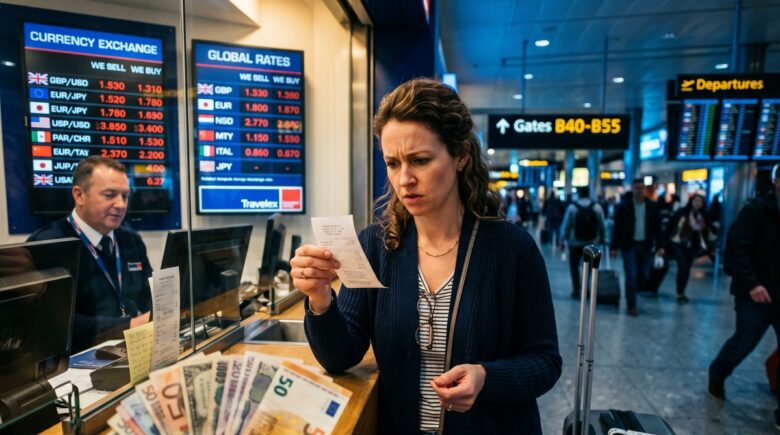
Yes — airport currency exchange booths are consistently the most expensive place to convert money. They exploit traveler urgency and charge spreads of 8–12% above the interbank mid-market rate, compared to 0.5–2% at online-first providers like Wise or Revolut.
Major airport operators such as Travelex and Currency Exchange International (CXI) post rates that appear competitive but embed their margin directly into the exchange rate itself — not as a visible fee. A traveler converting $500 USD to euros at an airport kiosk may receive 40–60 euros less than the mid-market equivalent.
The practical fix is straightforward: withdraw local currency from an ATM at your destination or use a no-foreign-transaction-fee card for the first day. If you must exchange cash before departure, use an online currency service that ships to your home address at near-interbank rates.
Key Takeaway: Airport currency bureaus charge spreads of 8–12% above the mid-market rate, according to Wise’s fee transparency data. Converting $500 at the airport instead of an ATM can cost travelers $40–$60 in hidden markup alone.
What Is Dynamic Currency Conversion and Why Should You Refuse It?
Dynamic currency conversion (DCC) is a service offered at card terminals that converts a foreign transaction into your home currency at the point of sale — and it is almost always a trap. The merchant’s terminal applies a conversion rate that typically includes a 3–7% markup on top of the mid-market rate, a margin that goes directly to the merchant’s payment processor.
When a terminal in Paris asks “Would you like to pay in USD?” the correct answer is always no. Always choose to pay in the local currency. Your card issuer’s rate — especially on a travel rewards card — will almost always be better than DCC. The Consumer Financial Protection Bureau (CFPB) has acknowledged DCC as a common source of opaque consumer fees in cross-border transactions.
DCC is particularly aggressive at hotels, tourist-area restaurants, and rental car desks. Train yourself to look for the currency option before you tap or swipe. If a terminal defaults to your home currency without asking, ask the merchant to reprocess the transaction in local currency.
“Dynamic currency conversion is one of the most profitable — and least transparent — fees in international retail payments. Cardholders who always pay in local currency can save hundreds of dollars per trip without changing any other behavior.”
Key Takeaway: Dynamic currency conversion adds a 3–7% markup to every transaction where you accept it. Always select local currency at any card terminal abroad — this single habit eliminates one of the most common currency exchange travel mistakes with zero cost.
Does Withdrawing Small Amounts at ATMs Cost More?
Yes — making multiple small ATM withdrawals is significantly more expensive than fewer, larger ones. Most international ATMs charge a flat fee of $3–$5 per transaction, and your home bank may add a separate foreign ATM fee of $2–$5 on top of that.
On a 10-day trip where a traveler withdraws cash five times in small amounts, those fees alone can total $25–$50 — before any exchange rate spread is applied. The solution is to plan cash needs in advance, withdraw larger amounts less frequently, and use a bank that reimburses international ATM fees. Charles Schwab Bank and Starling Bank (for UK travelers) are widely cited for their fee reimbursement policies.
Which Banks Offer the Best International ATM Access?
According to NerdWallet’s analysis of international banking fees, Charles Schwab’s High Yield Investor Checking account reimburses all ATM fees worldwide with no foreign transaction fee. Citibank also offers fee-free withdrawals at its global ATM network across more than 20 countries.
For travelers who rely on apps, Revolut and Wise offer fee-free ATM withdrawals up to set monthly limits — typically $200–$350 per month — before a small percentage fee applies. Pairing one of these accounts with a backup traditional bank card covers most travel scenarios efficiently. If you are planning a longer trip, our guide to planning a gap year abroad without going broke covers international banking strategy in more depth.
Key Takeaway: Each unnecessary ATM withdrawal abroad can cost $5–$10 in combined fees. Using a fee-reimbursing account like Charles Schwab’s Investor Checking or limiting withdrawals to 2–3 larger transactions eliminates this recurring currency exchange travel mistake entirely.
| Exchange Method | Typical Fee / Spread | Best Use Case |
|---|---|---|
| Airport Kiosk | 8–12% above mid-market | Emergency only — avoid if possible |
| Hotel Desk | 7–10% above mid-market | Avoid entirely |
| Local Bank ATM | 1–3% + $3–$5 flat fee | Standard option — withdraw in bulk |
| Schwab / Starling ATM | 0–0.5% (fees reimbursed) | Best for frequent cash use |
| Wise / Revolut Card | 0.35–1% mid-market rate | Best for card purchases and ATM up to monthly limit |
| Dynamic Currency Conversion | 3–7% markup added | Never — always decline |
Are You Paying a Foreign Transaction Fee on Every Purchase?
Many travelers use their standard debit or credit card abroad without realizing it carries a foreign transaction fee of 1–3% on every international purchase. This fee applies to all transactions billed in a foreign currency — from a coffee in Tokyo to a hotel stay in Lisbon.
According to the CFPB’s consumer guidance on foreign transaction fees, these charges are disclosed in card agreements but are rarely noticed by cardholders until they review a statement. On a trip with $2,000 in card spending, a 3% foreign transaction fee adds $60 in pure overhead — with no benefit to the traveler.
The fix is to carry at least one travel-optimized card with no foreign transaction fee. Cards from Chase Sapphire Preferred, Capital One Venture, and American Express Gold all waive this fee. For a full comparison, see our guide to the best travel credit cards for frequent flyers in 2026. Pairing a no-fee card with a fee-reimbursing ATM account eliminates the two largest recurring currency exchange travel mistakes simultaneously.
Key Takeaway: A standard 3% foreign transaction fee costs $60 on $2,000 in travel spending. Cards like Chase Sapphire Preferred eliminate this fee entirely, making them essential for any international traveler who wants to avoid this common currency exchange travel mistake.
Does Timing Your Exchange Actually Save Money?
Yes — exchange rates fluctuate daily, and converting currency when rates are unfavorable is one of the most underappreciated currency exchange travel mistakes. Major currency pairs like USD/EUR and USD/GBP can move by 2–5% over a 30-day window, which is meaningful on large conversions.
The Bank for International Settlements (BIS) reports that daily FX market turnover exceeds $7.5 trillion per day, making exchange rates highly sensitive to macroeconomic announcements, interest rate decisions from the Federal Reserve and the European Central Bank (ECB), and geopolitical events. Travelers who plan large conversions — such as funding a month-long trip — can benefit from monitoring rates two to four weeks in advance.
Free tools like Google Finance, XE.com, and Wise’s rate tracker allow travelers to set alerts when a target rate is reached. For budget-focused travel planning, combining rate monitoring with strategies from our article on saving money on trips, flights, and hotels creates a comprehensive approach. Also consider that some hidden travel costs like transfers and insurance are magnified when exchange rates are unfavorable — timing one conversion well can offset those costs.
Key Takeaway: Major currency pairs can shift 2–5% in 30 days. Using a rate alert tool like XE.com’s rate tracker costs nothing and can save $50–$150 on a $3,000 conversion — one of the easiest currency exchange travel mistakes to eliminate with a small investment of planning time.
Related reading: 5 Common Wi.
Frequently Asked Questions
What is the cheapest way to exchange currency when traveling abroad?
The cheapest method is withdrawing local currency from an ATM using a bank account that reimburses international ATM fees — such as Charles Schwab’s Investor Checking. For card purchases, using a card with no foreign transaction fee at mid-market rates (like Wise or Revolut) is nearly as cost-effective.
Should I exchange money before or after I arrive at my destination?
Exchange a small emergency amount before you leave — enough for a taxi or meal on arrival. Do your main withdrawals at destination ATMs, which typically offer better rates than pre-trip airport or bank exchanges. Avoid exchanging large sums at your home airport.
What does it mean to always pay in local currency abroad?
Paying in local currency means declining dynamic currency conversion (DCC) at card terminals. When a merchant offers to charge you in your home currency, the rate applied includes a hidden 3–7% markup. Always select local currency so your card issuer applies its own, typically lower, conversion rate.
Are prepaid travel money cards worth it?
Prepaid travel cards from providers like Wise or Revolut are worth it for frequent travelers who plan ahead. They allow you to lock in exchange rates, spend in local currencies with minimal fees, and avoid foreign transaction fees. They are less useful if you need emergency cash quickly or travel to countries with limited card acceptance.
How do I avoid currency exchange travel mistakes on a family trip?
Set up one dedicated travel account with no foreign transaction fees and fee-free ATM withdrawals before departure. Budget daily cash needs to minimize ATM visits, decline all dynamic currency conversion prompts, and check rates weekly in the month before travel. Our guide to international travel with kids on a budget covers family-specific financial planning in detail.
Does using a credit card abroad give you a better exchange rate than cash?
Generally yes — cards from major networks like Visa and Mastercard use rates close to the interbank mid-market rate, which is better than what most exchange bureaus offer. The key is ensuring your card has no foreign transaction fee. If it does carry that fee, the advantage narrows or disappears entirely.
Sources
- Wise — How Exchange Rate Markups Work
- Consumer Financial Protection Bureau (CFPB) — What Is a Foreign Transaction Fee?
- NerdWallet — Best Banks With No Foreign Transaction Fees
- Bank for International Settlements — Triennial Central Bank Survey: FX Turnover
- XE.com — Currency Rate Tracker Tool
- Chase — Sapphire Preferred Card Benefits Overview
- Charles Schwab — High Yield Investor Checking Account