Fact-checked by the ZeroinDaily editorial team
Quick Answer
To sleep on long-haul flights without business class, combine a 160-degree reclining seat with melatonin taken 30 minutes before your target sleep time, noise-cancelling headphones, and a lumbar pillow. Economy passengers can reliably achieve 4-5 hours of quality sleep using these layered strategies.
Updated July 2026
Learning to sleep on long-haul flights in economy is a solvable problem, not a luxury reserved for lie-flat seats. According to the Sleep Foundation’s guide to in-flight rest, disrupted sleep rhythms from overnight flights raise fatigue risk and make preparation critical for any traveler crossing more than eight time zones.
With ultra-long-haul routes like Singapore Airlines’ New York to Singapore service now exceeding 18 hours, the stakes for economy passengers have never been higher.
Key Takeaways
- Window seats in twin-row configurations on aircraft like the Boeing 787 and Airbus A350 give you a wall to lean against and remove aisle disturbances entirely.
- Melatonin timed to your destination’s local bedtime, not departure time, is the most clinically supported non-prescription tool for resetting your circadian rhythm, per NHS guidance.
- Noise-cancelling headphones from brands like Bose or Sony cut ambient engine noise by up to 30 decibels, which researchers at Flinders University link to faster sleep onset in noisy environments.
- Flights over 8 hours carry elevated deep vein thrombosis risk, according to the World Health Organization, making 15-20 mmHg compression socks a health essential rather than a comfort extra.
- Alcohol suppresses REM sleep by up to 24%, per the American Academy of Sleep Medicine, and should be avoided for at least four hours before your planned sleep window.
- The CDC recommends adopting your destination’s sleep and waking routine immediately upon crossing more than three time zones.
Which Seat Gives You the Best Chance to Sleep?
Seat choice matters more than most passengers assume. Window seats in twin-row configurations on aircraft like the Boeing 787 and Airbus A350 are ideal. They eliminate aisle foot traffic and give you a solid surface to lean against. Check SeatGuru before booking so you avoid rows where recline is blocked, like exit rows or seats near galley walls.
On a 15-hour flight from London to Sydney, a window seat in row 25 on a Boeing 787 offers a 160-degree recline. A middle seat in a three-person row on that same flight might only recline 135 degrees. That 25-degree gap matters a lot when you’re trying to string together four hours of sleep.
Skip the last row entirely. Recline there is often fixed at zero degrees because of proximity to the lavatories. Bulkhead seats have their own problem: no under-seat storage, which means stowing your bag overhead before you settle in. That extra step cuts into your flexibility and can wake you during boarding or turbulence.
Best Seat Positions for Sleep
The middle seat in a three-seat row is the worst option for sleep, full stop. Window seats on either side of twin-seat rows, common on Boeing 787 and Airbus A350 aircraft, give you a wall to lean against without a seatmate climbing over you to reach the aisle.
Key Takeaway: Window seats in twin-row configurations on aircraft like the Boeing 787 deliver the best economy sleep environment. Avoid fixed-recline rows, some seats recline 0 degrees, making sleep nearly impossible on flights exceeding 10 hours.
Does Melatonin Actually Help You Sleep on a Plane?
Melatonin is a widely recommended supplement for resetting your circadian rhythm on long flights. The UK National Health Service advises taking it roughly 30 minutes before your intended sleep window, not before takeoff, but aligned to destination bedtime. Sleep expert Lindsay Browning, who studied insomnia at Oxford University and now runs Trouble Sleeping, frames the timing question simply:
“Think about the place you’re going to and ask yourself, would you be eating at that time?”
Take a flight from New York to Tokyo, a 13-hour time difference, as a working example. You’d want to take melatonin at 9 p.m. your time, which lines up with 10 a.m. in Tokyo. That’s roughly when you’d normally be eating there, regardless of what the flight’s own meal schedule says.
Prescription sleep aids like zolpidem (Ambien) are used by some frequent flyers but carry risks: residual sedation, memory impairment, and potential interactions with cabin pressure effects on blood oxygen. The Aerospace Medical Association advises against first-time use of any sedative on a flight without prior ground testing.
Non-Pharmaceutical Tools
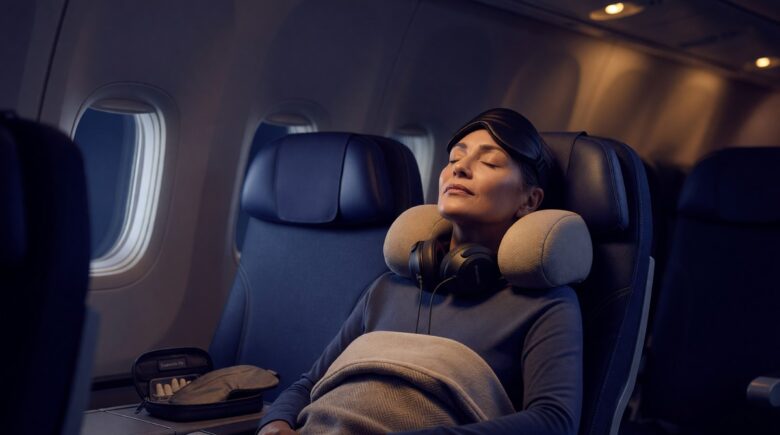
Noise-cancelling headphones from brands like Bose or Sony reduce ambient engine noise by up to 30 decibels, which sleep researchers at Flinders University have linked to faster sleep onset in noisy environments. Pair these with a contoured memory foam neck pillow, not the standard U-shape, which fails to hold the head upright during forward head-drop.
“The first things I would advise travelers to pack in their amenity kit are earplugs (or noise-canceling headphones), and an eye mask. It’s crucial to limit the stimuli on the plane since they can easily interrupt sleep.”
Key Takeaway: Melatonin timed to destination bedtime is a clinically supported sleep aid for long-haul economy travelers, according to NHS guidance. Noise-cancelling headphones add a further 30dB reduction in disruptive ambient sound.
What Should You Pack in an Economy Sleep Kit?
A purpose-built sleep kit reduces friction between you and unconsciousness. The essentials weigh under 600 grams combined and fit in a single packing cube, so there’s really no reason to skip any of them.
| Item | Purpose | Estimated Weight |
|---|---|---|
| Contoured neck pillow | Prevents forward head-drop | 180g |
| Silk sleep mask | Blocks cabin lighting fully | 40g |
| Noise-cancelling headphones | Reduces engine noise by 30dB | 250g |
| Melatonin | Circadian rhythm reset | 10g |
| Compression socks | Reduces DVT risk on 8+ hour flights | 60g |
| Electrolyte tablets | Counters cabin dehydration | 30g |
Compression socks deserve special mention. The World Health Organization identifies flights over 8 hours as carrying elevated deep vein thrombosis risk. Compression socks rated at 15-20 mmHg maintain circulation and reduce leg discomfort, a common reason passengers wake prematurely.
Sleep expert Lindsay Browning also points to posture as an underrated factor in why economy passengers wake up sore.
“You’re trying to keep your spine fairly neutral, but of course it is slumped in the chair and you’ll find it curved. It can be painful or uncomfortable and this could wake you up, so you might find a pillow behind your back can be helpful.”
Her comments, reported by TIME, explain why a lumbar pillow earns a spot in any sleep kit despite adding a bit of bulk to your carry-on.
A set of 15-20 mmHg compression socks from brands like Sigvaris or Medi runs about $28, less than a single airport meal upgrade. On a 12-hour flight from Los Angeles to Dubai, skipping them raises your risk of swelling and waking up with sore legs, particularly if you’re wedged into a cramped seat for most of the journey.
It’s worth being honest about the limits here, too. A reader with a 620 credit score and an $8,000 travel goal, saving for a family trip to Southeast Asia, would likely be turned down for a premium travel card with a $200 annual fee. Even if approved, that card’s lounge access and seat upgrades, at roughly $30 per visit, would only cover about $60 across two visits against a $200 fee. The math only works if you’re flying at least four times a year, which most casual travelers aren’t. For everyone else, seat selection and a proper sleep kit are the better use of that money.
Key Takeaway: A complete economy sleep kit weighs under 600 grams and costs less than a single airport meal upgrade. Compression socks rated 15-20 mmHg address the WHO-identified DVT risk on flights exceeding 8 hours, making them a health essential, not a comfort luxury.
When Should You Sleep on a Long-Haul Flight?
Align your sleep window to your destination’s local night cycle from the moment you board. This is the core principle of chronotherapy, the science of timing behaviors to biological clocks, and it’s one of the most effective strategies to prevent jet lag after landing. The CDC recommends that anyone crossing more than three time zones adopt the sleep and waking routine of their destination, eat smaller meals, avoid alcohol since it disrupts sleep, and use caffeine and exercise strategically rather than reflexively.
Jeff Kahn, co-founder and CEO of Rise Science, suggests starting the adjustment before you even reach cruising altitude:
“If you haven’t started to adjust your schedule before your flight to align with the time zone of your destination, you can start to shift your schedule on the plane. Set your watch to the time in your destination’s time zone when boarding the plane, and try to sleep (or not), eat, and get sunlight accordingly.”
His comments appeared in Condé Nast Traveler.
On eastbound flights, sleep as early as possible after boarding. On westbound routes, delay sleep as long as tolerable. CDC guidance on shift-work circadian adjustment recommends light exposure management as a complement: avoid bright screens for 60 minutes before your target sleep onset.
Alcohol and Caffeine: What to Avoid
Cabin air at cruise altitude has humidity as low as 12%, per data from Airbus. Alcohol amplifies dehydration and measurably reduces sleep quality on top of that, suppressing REM sleep by up to 24% according to research published by the American Academy of Sleep Medicine. Avoid both alcohol and caffeine for at least four hours before your planned sleep window, a rule that lines up with the CDC’s broader jet lag advice above.
If you’re building a longer travel itinerary, the principles in slow travel methodology can reduce the number of long overnight flights you need altogether, which is a structural fix for the sleep problem rather than another gadget or supplement.
Key Takeaway: Timing sleep to your destination’s night cycle, a strategy backed by both CDC jet lag guidance and sleep scientist Jeff Kahn, reduces jet lag severity more than any supplement. Alcohol suppresses REM sleep by up to 24%, per the American Academy of Sleep Medicine, avoid it entirely during the 4 hours before your in-flight sleep window.
Can You Control the Cabin Environment for Better Sleep?
You have more control than most passengers realize. Cabin temperature, lighting, and hydration are all partially within your influence, and they directly determine how quickly you fall asleep and how long you stay asleep. None of this replaces a genuinely flat bed, worth saying plainly, but it closes a meaningful part of the gap.
Request a blanket immediately after boarding before supply runs short. Set your personal air vent to low, not fully closed, to maintain gentle airflow without drying your nasal passages. Use a saline nasal spray to counteract the low-humidity cabin environment, which Lufthansa and Emirates both cite as a primary passenger comfort complaint on routes over 10 hours.
Clothing and Posture
Wear loose, layered clothing. Tight waistbands and restrictive jeans measurably increase discomfort during seated sleep. A lumbar support pillow, or a rolled blanket placed in the lower back, maintains spinal alignment and reduces the lower-back ache that wakes most economy passengers within two hours of dozing off, the same issue Lindsay Browning flags above when she describes the spine curving in a slumped economy seat.
For families managing sleep on long flights with children, the planning strategies in our guide to international family travel address cabin logistics specific to traveling with young passengers.
Key Takeaway: Cabin humidity on long-haul flights drops as low as 12%, lower than most deserts. A saline nasal spray, a lumbar pillow, and a personal air vent set to low airflow are the 3 zero-cost environment hacks that most economy passengers skip, according to Airbus cabin design documentation.
Frequently Asked Questions
What is the best seat to sleep in economy class?
A window seat in a twin-seat row, such as those on Boeing 787 or Airbus A350 aircraft, is the best economy sleep seat. It provides a surface to lean against and removes aisle-disturbance entirely. Avoid the last row of any cabin section, where recline is often fixed at zero degrees.
How much melatonin should I take to sleep on a long-haul flight?
Take melatonin roughly 30 minutes before your target sleep time, following the general dosing guidance on the NHS melatonin page. That sleep time should align with your destination’s local night, not your departure time. Start with the lowest effective dose on a short flight before using it on an ultra-long-haul route, and check with a doctor or pharmacist if you’re unsure what dose fits your situation.
Does alcohol help you sleep on planes?
No. Alcohol reduces REM sleep quality by up to 24%, per the American Academy of Sleep Medicine. At altitude, dehydration effects are amplified by cabin humidity as low as 12%, making alcohol consumption before sleep counterproductive. Drink water instead, at least 250ml per hour of flight.
How do I avoid jet lag after a long-haul flight?
Align your sleep and wake times to your destination’s time zone from the moment you board, as recommended by the CDC’s jet lag guidance. Use melatonin timed to destination bedtime and manage light exposure, avoid bright screens for 60 minutes before sleep. This chronotherapy approach is echoed by sleep scientist Jeff Kahn, who recommends setting your watch to destination time the moment you board.
Is it safe to take sleeping pills on a long flight?
The Aerospace Medical Association advises against first-time sedative use on flights due to risks including residual sedation and impaired emergency response. If a doctor has already prescribed you a sleep aid and you’ve tested it on the ground, the risk profile is lower. Never combine sedatives with alcohol in-flight.
What should I wear to sleep better on a long-haul flight?
Loose, layered clothing is best. Avoid tight jeans, restrictive waistbands, or inflexible shoes. Compression socks rated 15-20 mmHg improve circulation and reduce leg discomfort, a common cause of premature waking on flights over 8 hours. Bring a light merino or fleece layer, as cabin temperatures can drop significantly after lights-out.
Should I eat before trying to sleep on a plane?
Time your meals to your destination’s schedule rather than the flight’s meal service, if your goal is sleep. Sleep expert Lindsay Browning frames it as a simple mental check, asking yourself whether you’d normally be eating at that hour in your destination city. Skipping a heavy in-flight meal service that falls at your destination’s bedtime can make it easier to fall asleep on schedule.
Do noise-cancelling headphones actually help you sleep on a plane?
Yes. Noise-cancelling headphones from brands like Bose or Sony cut ambient engine noise by up to 30 decibels, and sleep researchers at Flinders University have linked reduced ambient noise to faster sleep onset. Certified sleep coach Alex Savy lists earplugs or noise-cancelling headphones alongside an eye mask as the first items to pack in any in-flight sleep kit.
Is it worth paying for premium economy just to sleep better?
Premium economy adds recline and legroom, but the seat-selection and sleep-timing strategies in this guide close much of the comfort gap at a fraction of the cost. A window seat in a twin-row configuration, paired with melatonin, headphones, and a lumbar pillow, delivers most of the sleep benefit without the fare premium, though a premium economy seat still helps on flights over 14 hours where recline matters most.
How many hours of sleep can you realistically get in economy on a long flight?
With the strategies in this guide, most travelers can reach 4-5 hours of usable sleep on flights over 10 hours. That figure depends heavily on seat position, noise control, and whether you time sleep to your destination’s night cycle rather than fighting your body’s existing clock.
Sources
- NHS UK, Melatonin: Uses, Dosage and Side Effects
- CDC NIOSH, Circadian Rhythm and Light Exposure
- CDC, Jet Lag Guidance for Travelers
- American Academy of Sleep Medicine, Sleep Research and Guidelines
- SeatGuru, Aircraft Seat Maps and Reviews
- Airbus, Commercial Aircraft Cabin Specifications
- Condé Nast Traveler, How to Sleep on a Plane






