

Key Takeaways
- Index funds and ETFs are nearly identical products for most investors. Both track the same indexes, charge similar fees, and deliver virtually the same returns over time.
- The real differences are mechanical: ETFs trade like stocks throughout the day, index mutual funds trade once at market close. For buy-and-hold investors, this barely matters.
- ETFs have a slight edge for taxable brokerage accounts because of their tax efficiency. Index mutual funds have an edge for automated investing because many allow automatic purchases in dollar amounts.
- If you are overthinking this choice, just pick whichever one your brokerage makes easiest to buy automatically. The difference between the two is vastly smaller than the cost of waiting to decide.
In This Article
Wait, Are They Not the Same Thing?
I spent seven years on Wall Street, and I still catch myself pausing when someone asks me the difference between an index fund and an ETF. Not because it is complicated, but because the honest answer is underwhelming: for most people, they are functionally identical. Both hold the exact same basket of stocks. Both charge nearly the same fees. Both deliver the same returns. The difference is like asking whether you should drink water from a glass or a mug. The water is the same. The container is slightly different. You will be hydrated either way.
But the question keeps coming up because the internet makes everything sound more complicated than it is. Financial media loves to debate ETFs versus mutual funds because it generates clicks, not because the distinction dramatically affects your wealth. So let me lay out the real differences clearly, tell you which one wins in which situations, and then — most importantly — convince you that choosing either one is infinitely better than spending another month paralyzed by the comparison.
If you have not read our investing for beginners guide yet, start there. It covers the foundational concepts — what index funds are, why they beat actively managed funds, and how to open your first account. This article assumes you already know you want to invest in index-tracking products and just need to decide which wrapper to use.
The Actual Differences That Matter
Let me strip away everything that does not matter and focus on the four differences that actually affect your money.
Trading mechanics. An ETF trades on the stock exchange like a regular stock. You buy and sell it at whatever price it is trading at during market hours (9:30 AM to 4:00 PM ET). The price fluctuates throughout the day. A mutual fund trades once per day at the closing net asset value (NAV). When you place an order at 10 AM, you get whatever the price is at 4 PM. For a buy-and-hold investor contributing monthly? This difference is meaningless. You are holding for decades — whether you bought at the 10 AM price or the 4 PM price on March 5th will not matter by 2046.
Purchase minimums. Most index mutual funds have no minimum at major brokerages like Fidelity and Schwab. Vanguard mutual funds historically had $3,000 minimums, though they have been reducing these. ETFs have no minimum beyond the price of one share — but with fractional share trading now standard at most brokerages, you can buy $10 worth of a $500 ETF. This used to be a meaningful difference. It largely is not anymore.
Dollar-amount purchasing. Mutual funds let you invest exact dollar amounts — “$200 per month” buys exactly $200 worth, including fractional shares. ETFs traditionally required buying in whole-share increments, but fractional shares have mostly eliminated this gap. However, automatic recurring purchases in specific dollar amounts are still easier to set up with mutual funds at some brokerages.
Expense ratios. The fees are nearly identical for the biggest index products. Vanguard’s S&P 500 ETF (VOO) charges 0.03%. Their S&P 500 mutual fund (VFIAX) also charges 0.04%. Fidelity’s 500 Index Fund (FXAIX) charges 0.015%. The difference between 0.015% and 0.04% on a $100,000 portfolio is $25 per year. That is not moving the needle on your retirement.
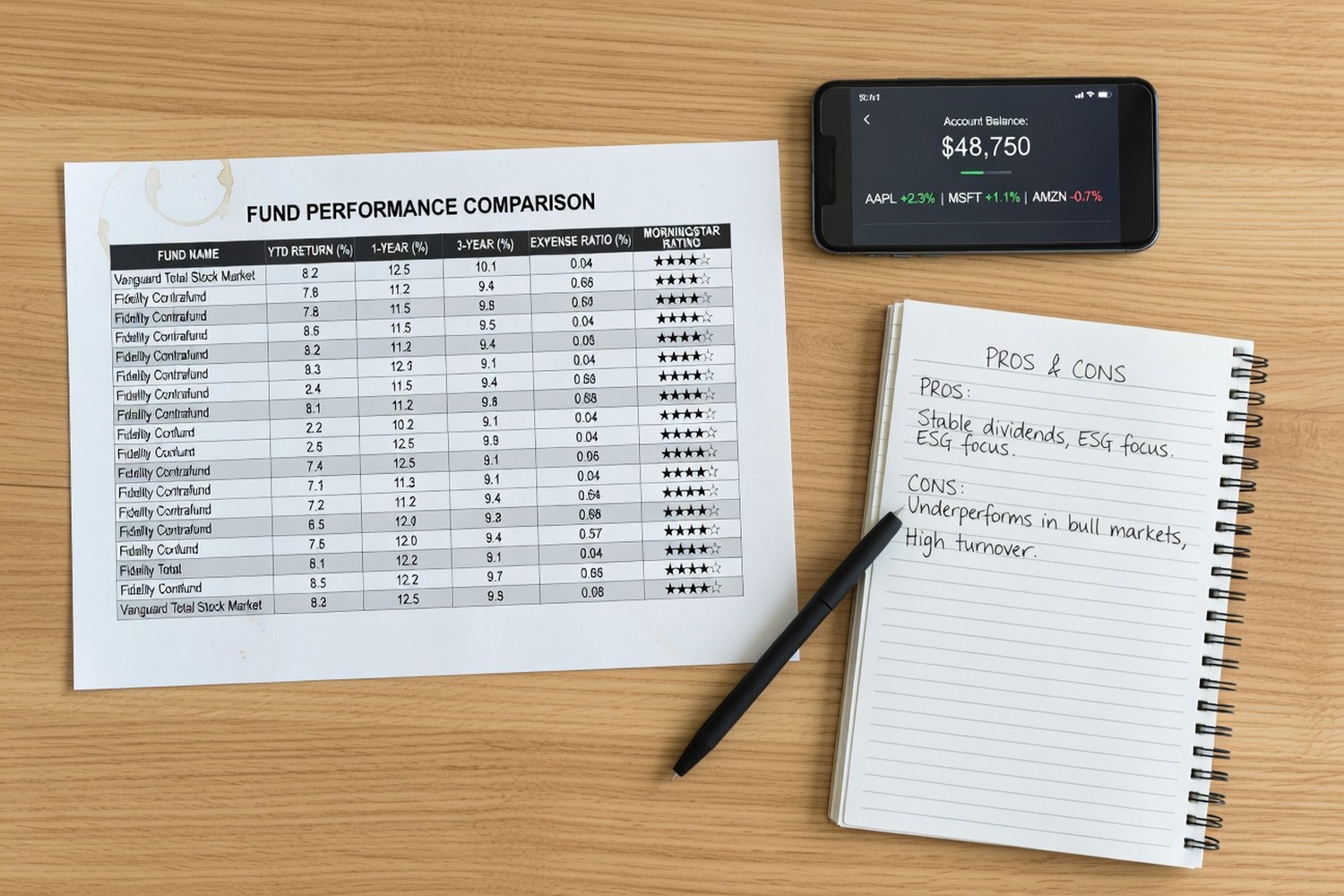
Head-to-head comparison of index mutual funds and ETFs on the features that actually affect investors.
Tax Efficiency: Where ETFs Win
This is the one area where ETFs have a genuine, structural advantage — but it only matters in taxable brokerage accounts. In retirement accounts (401(k), IRA, Roth IRA), there are no capital gains taxes regardless of which product you hold. So if all your investing happens in retirement accounts, skip this section entirely.
In a taxable account, here is what happens. Mutual funds occasionally distribute capital gains to all shareholders. If other investors sell their shares and the fund manager has to sell underlying stocks to raise cash, the fund realizes capital gains. Those gains get passed to you as a taxable distribution even if you did not sell anything. You owe taxes on gains you never chose to take. This is annoying and can create unexpected tax bills in December.
ETFs avoid this problem through a mechanism called “in-kind creation and redemption.” Without getting into the plumbing, the structure allows ETFs to shed appreciated stocks without triggering taxable events for existing shareholders. The result: ETFs almost never distribute capital gains. Vanguard’s ETFs have distributed zero capital gains for years. This structural advantage can save you 0.5-1% per year in tax drag in a taxable account — which is actually a bigger deal than the expense ratio difference.
Our 401k vs IRA comparison covers which accounts to prioritize. The short version for this discussion: max out tax-advantaged accounts first (where it does not matter which you choose), then use ETFs in your taxable brokerage account for the tax efficiency edge.
💡 Pro Tip
Vanguard has a unique patent (now expired) that lets their index mutual funds share the same tax efficiency as their ETFs. So VFIAX and VOO have identical tax efficiency. This is the one exception to the general ETF tax advantage rule.
Automated Investing: Where Mutual Funds Win
If your investing strategy is “put $500 into the market on the 1st of every month without thinking about it” — which is exactly what your strategy should be — mutual funds still have a slight practical edge at some brokerages.
With a mutual fund, you set up an automatic investment: “$500 on the 1st into FXAIX.” Done. It executes at that exact dollar amount every month. No fractions to think about, no market-hours requirement, no price fluctuation between when you place the order and when it fills. The money moves, the shares appear, and you go about your life.
ETF auto-investing has gotten much better. Fidelity, Schwab, and most major brokerages now offer recurring ETF purchases in dollar amounts with fractional shares. But the setup is sometimes buried in the interface, and some brokerages still do not support it at all. If your brokerage makes automatic ETF investing easy, there is no disadvantage. If it does not, the mutual fund version works perfectly.
The automation matters because consistency is everything. A plan that invests $500 every month for 30 years beats a plan that invests $600 in months you remember and $0 in months you forget. If the mutual fund version is easier for you to automate, use the mutual fund. The small tax efficiency advantage of the ETF is dwarfed by the cost of inconsistent contributions. Our automated savings guide covers tools that make consistent investing even easier.

Which One for Which Account?
Here is the simple decision framework I use with my clients. It takes thirty seconds.
401(k): You likely do not have a choice here. Your employer’s plan offers specific funds — usually mutual funds or target-date funds. Pick the lowest-cost index fund available. If there is an S&P 500 index fund or total market fund with an expense ratio under 0.10%, choose that. Our wealth building guide walks through how to evaluate your 401(k) options.
Roth IRA: Either works perfectly. I slightly prefer mutual funds here because the auto-invest is seamless and there are no tax implications regardless. But if you already own ETFs in your Roth, there is zero reason to switch.
Taxable brokerage account: ETFs win here because of the tax efficiency advantage described above. Use VOO (Vanguard S&P 500 ETF), SPLG (Schwab’s ultra-low-cost alternative), or VTI (Vanguard Total Market ETF) for broad US stock exposure.
HSA (Health Savings Account): Treat this like a Roth IRA — either works, pick whichever automates most easily. If your HSA provider offers investment options (many do), they likely offer a limited menu of mutual funds.
The Specific Funds Worth Buying
Rather than giving you a universe of options, here are the specific ticker symbols that cover 90% of what a beginning investor needs. Each pair tracks the same index — pick the mutual fund or ETF version based on the account type guidance above.
S&P 500 (large US companies): Mutual fund: FXAIX (Fidelity, 0.015%), VFIAX (Vanguard, 0.04%), SWPPX (Schwab, 0.02%). ETF: VOO (Vanguard, 0.03%), SPLG (Schwab, 0.02%), IVV (iShares, 0.03%). All of these track the same 500 companies and deliver nearly identical returns. Pick the one that matches your brokerage.
Total US Market (includes small and mid-cap): Mutual fund: FSKAX (Fidelity, 0.015%), VTSAX (Vanguard, 0.04%), SWTSX (Schwab, 0.03%). ETF: VTI (Vanguard, 0.03%), ITOT (iShares, 0.03%), SCHB (Schwab, 0.03%). The total market funds hold about 4,000 stocks instead of 500, giving you broader diversification. The performance difference versus the S&P 500 is historically tiny — roughly 0.1-0.2% per year — but some investors prefer the completeness.
International (non-US stocks): Mutual fund: FTIHX (Fidelity, 0.06%), VTIAX (Vanguard, 0.12%). ETF: VXUS (Vanguard, 0.08%), IXUS (iShares, 0.07%). Adding 20-30% international diversification to your portfolio is a common recommendation, though plenty of respected investors skip it entirely and stick with US-only. Our ESG investing guide covers values-based alternatives if you want your portfolio to reflect ethical priorities alongside financial ones.
💡 Pro Tip
Fidelity offers ZERO expense ratio index funds (FZROX for total market, FNILX for large cap). The catch: they are only available at Fidelity and cannot be transferred to another brokerage. If you plan to stay at Fidelity long-term, they are a genuinely free way to invest. If you might switch brokerages someday, stick with the standard funds.
Stop Comparing and Start Investing
I have watched people spend months researching the difference between index funds and ETFs. Months where their money sat in a savings account earning 4% instead of being invested in the market earning a historical average of 10%. The opportunity cost of that analysis paralysis dwarfs any difference between the two products.
Let me put it in dollar terms. If you have $10,000 ready to invest and you spend three months deciding between VOO and FXAIX, you miss roughly $250 in expected market returns (assuming historical averages). The total fee difference between those two products over an entire year on $10,000 is about $1.50. You spent three months and $250 to save $1.50. That math does not work.
Here is what I want you to do right now. If you have a brokerage account, log in. If you do not, open one at Fidelity, Schwab, or Vanguard — it takes fifteen minutes. Buy either the mutual fund or ETF version of an S&P 500 or total market index fund. Set up automatic monthly contributions. Close the browser. Come back in a year and be pleasantly surprised. Our complete investing guide has the full step-by-step if you need hand-holding through the process.
The difference between an index mutual fund and an ETF is a rounding error on the returns that matter. The difference between investing and not investing is the difference between financial security and financial regret. Choose either one. Choose both. Just choose today. If you are still carrying high-interest debt and wondering whether you should invest at all, our debt freedom guide covers how to balance debt payoff and investing simultaneously — spoiler: most people should do both at the same time, not one then the other.
References
- S&P Global. “SPIVA Scorecard: Active vs. Passive Fund Performance.” https://www.spglobal.com
- Securities and Exchange Commission. “Mutual Funds and ETFs: A Guide for Investors.” https://www.sec.gov
- Vanguard. “ETF vs. Mutual Fund: How to Decide.” https://www.vanguard.com
Keep Reading
If you found this guide helpful, check out these related articles: