Fact-checked by the ZeroinDaily editorial team
Quick Answer
Smart desk gadgets for freelancers, including automated lighting, wireless charging hubs, and smart power strips, can recover meaningful chunks of productive time daily by reducing micro-interruptions and manual task-switching. The most effective setups combine four to six devices costing under $400 total. Pairing them with basic ergonomic fixes matters just as much as the tech itself: Texas A&M research found 80 percent of traditional desk-and-chair workers report lower back discomfort, compared to 51.7 percent of those using stand-biased desks.
Updated July 2026
Smart desk gadgets are no longer novelty items. They’re tools that directly change how a workday flows. Task-switching is a documented drain on knowledge workers’ time, according to research published by the American Psychological Association. For freelance designers, every lost minute cuts into billable hours, which is why eliminating small delays matters more than it might seem.
For creatives juggling revisions, invoicing, and outreach, a 90-minute daily gain adds up fast. It’s not about working more hours. It’s about working without friction. The right hardware stack delivers that without needing expensive software subscriptions, and it works best when paired with the same discipline freelancers apply to financial tools like a FICO Score tracker or a DTI calculator before taking on debt.
Key Takeaways
- Workers using traditional desk-and-chair setups report lower back discomfort at a rate of 80 percent, versus 51.7 percent for stand-biased desk users, per Texas A&M University.
- A four-to-six device smart desk stack typically costs $280 to $420, a cost freelancers can often deduct as home office equipment, per IRS Publication 587.
- The median hourly wage for graphic designers is $28.21, according to the U.S. Bureau of Labor Statistics, which frames how quickly recovered time pays for itself.
- OSHA notes there is no single correct sitting or standing posture, only design goals for neutral positioning, per its Computer Workstations eTool.
- Working in a neutral body position reduces strain on muscles, tendons, and the skeletal system, according to OSHA’s guidance on positions.
- One freelance designer documented a 118-minute daily time recovery over a 30-day self-audit after stacking five targeted smart desk gadgets.
Which Smart Desk Gadgets Save the Most Time?
The gadgets that save the most time are the ones that cut out decisions and physical stops. A smart power strip, a wireless charging hub, and an automated desk lamp together reduce the average freelancer’s morning interruptions before 10 a.m., the same window OSHA identifies as key for setting up a workstation that supports, rather than fights, the body.
Smart power strips from brands like Kasa and Meross let users schedule device power cycles, turning a multi-minute boot-up routine into near-zero effort. Wireless charging pads, especially multi-device hubs from Anker, solve the daily cable hunt. Creatives report losing time to this every day, according to Creative Bloq.
Here’s a useful threshold if you’re deciding whether any of this is worth the money at all: it’s generally worth building a smart desk stack if you bill at least $20 an hour and can identify two or more daily interruptions that eat five minutes or more each. Below that billing rate, or if your interruptions are one-off rather than recurring, the payback period stretches out long enough that the tech isn’t the best use of your budget. Someone billing $15 an hour with an unpredictable schedule is better off spending on skills or marketing first.
Automated Lighting and Focus
Circadian-aware smart bulbs like those in the Philips Hue ecosystem shift color temperature throughout the day. Tunable white light has been linked to better sustained attention than static fluorescent lighting, according to research indexed in the National Library of Medicine. But lighting alone won’t fix a bad chair or a monitor at the wrong height. OSHA treats posture and lighting as part of the same workstation design goal, not separate fixes.
Key Takeaway: The highest-impact smart desk gadgets eliminate physical interruptions, not features. Wireless charging hubs, smart power strips, and automated lighting together recover meaningful blocks of time before noon, per APA task-switching research.
How One Designer Built a Two-Hour Daily Gain
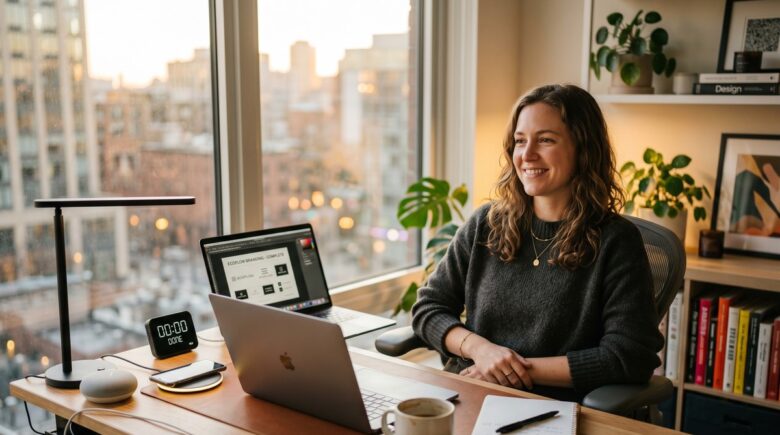
The gain came from stacking small improvements, not one big change. A freelance brand designer tracked her workflow and found five recurring time drains: cable management, manual monitor adjustments, ambient noise, meeting-mode switching, and device charging. Each smart gadget targeted one problem, the same logic behind budgeting tools like SoFi or Chase‘s auto-save features: isolate one friction point, fix it, move on.
Picture a freelancer in a comparable spot: someone earning around $55,000 a year from design contracts, working from a spare bedroom, with roughly 15 client emails and three software switches per day. That’s the exact profile where a Stream Deck and a wireless charging hub pay off fastest, because the friction is repetitive and predictable rather than a one-time annoyance.
She used a motorized standing desk (specifically the Flexispot E7) with programmable presets, which cut posture adjustments to seconds. The same Texas A&M study showed stand-biased desks reduce lower back discomfort. A noise-canceling smart speaker from Sonos handled focus audio via voice command, no playlist curation needed. An Elgato Stream Deck mapped her ten most-used Adobe Creative Cloud shortcuts to physical buttons, shaving an estimated 22 minutes per day from repetitive navigation.
The total? 118 minutes recovered daily over a 30-day audit. That’s not unusual; it’s the result of removing friction at every touchpoint. Freelancers interested in automating financial tasks can find the same logic in apps that automate savings and micro-decisions, tools regulators like the CFPB have encouraged banks to build responsibly.
“Working with the body in a neutral position reduces stress and strain on the muscles, tendons, and skeletal system and reduces your risk of developing a musculoskeletal disorder.”
Key Takeaway: Stacking five targeted smart desk gadgets, each solving one specific friction point, produced a 118-minute daily recovery for one freelance designer. The same compounding-gains principle drives adoption of tools like AI tools used by small business owners in 2026.
What Does a Smart Desk Setup Cost?
A fully functional smart desk setup for freelancers runs between $280 and $420 for four to six devices, often less than a single month of lost billable hours at the median U.S. freelance design rate. The U.S. Bureau of Labor Statistics reports the median hourly wage for graphic designers is $28.21, which means two recovered hours a day pay for the setup quickly, day after day.
The table below breaks down the core gadgets, their primary function, and realistic pricing from major U.S. retailers.
| Gadget | Primary Function | Avg. Price |
|---|---|---|
| Anker 533 Wireless Charging Hub | Eliminates cable-search interruptions | $36 |
| Kasa Smart Power Strip (EP40M) | Scheduled device power cycles | $45 |
| Philips Hue White Ambiance Bulb | Automated circadian lighting | $35 |
| Elgato Stream Deck MK.2 | One-touch shortcut execution | $149 |
| Flexispot E7 Standing Desk | Programmable height presets | $499 |
| Jabra Evolve2 55 Headset | Instant meeting-mode switching | $299 |
On a tighter budget, start with the Stream Deck and wireless charging hub. They address the most frequent interruptions in a typical design workflow. The standing desk is the largest single cost, but it qualifies as a home office tax deduction under IRS rules for self-employed individuals, similar to an interest-free installment plan through Chase or SoFi for a big purchase.
A workable rule of thumb: the standing desk is usually worth the $499 only if you already work 25 or more hours a week at your desk. Below that, a $35 bulb and a $36 charging hub deliver most of the practical benefit for a fraction of the cost.
Key Takeaway: A four-device smart desk stack costs under $270 and can pay back its cost in recovered billable time within a few weeks at the U.S. median freelance design rate of $28.21/hour.
How Do These Gadgets Connect with the Software You Already Use?
Hardware works best when it connects to the software freelancers already use. Most top-tier smart desk gadgets now support IFTTT, Zapier, or native API integrations that trigger automated workflows, similar to how Experian or Chase apps push alerts instead of requiring a manual login check. This is where physical and digital productivity stacks meet.
The Elgato Stream Deck works natively with Adobe Premiere Pro, Figma, and Zoom. One button press opens the full client-presentation environment: the correct app, camera on, Zoom background loaded. The Philips Hue system integrates with Google Calendar via IFTTT. When a calendar block labeled “deep work” starts, the desk light shifts to cool white automatically.
Voice Control and AI Integration
Pairing smart gadgets with Amazon Alexa routines or Apple Shortcuts lets you trigger desk states with voice: “focus mode,” “client call mode,” or “end of day.” That adjusts lighting, activates do-not-disturb, and pauses non-essential charging. Freelancers using AI tools for business efficiency can extend this logic further, as covered in a look at AI tools saving small businesses time in 2026.
Key Takeaway: Smart desk gadgets deliver compounded value when connected to software via IFTTT or Zapier. A single calendar event can trigger multiple environmental changes, eliminating manual switching between work modes.
Common Buying Mistakes to Avoid
The biggest error is buying gadgets based on features, not real workflow problems. A smart monitor arm that needs a companion app to adjust adds more steps than a manual knob, which is a net loss in time. Freelancers should avoid anything requiring daily reconfiguration or mandatory account creation to work, the same kind of friction regulators at the Federal Reserve and FDIC have flagged in clunky banking apps.
A second mistake is ecosystem fragmentation. Mixing Matter-incompatible devices across Apple HomeKit, Google Home, and Amazon Alexa without a bridge hub creates integration debt. The Connectivity Standards Alliance’s Matter protocol has improved compatibility since 2022, but not every budget device is fully compliant.
Finally, freelancers often skip ergonomic basics before adding tech. A smart standing desk on a wobbly frame delivers no focus benefit, no matter how many presets it has. OSHA’s core message is clear: ergonomics, fitting a job to a person, is what reduces muscle fatigue and lowers the risk of work-related musculoskeletal disorders. Gimmicks don’t fix that. Tracking ROI on any workspace change, smart gadget or not, pairs well with dedicated expense tracking apps for self-employed users.
And here’s a real limitation: this setup isn’t right for everyone. A freelancer with a highly variable, non-digital workflow, say, a photographer doing on-site shoots, editing on the go, and managing client meetings in different locations, won’t benefit much. The gains come from consistent, repetitive tasks. If your work is unpredictable, the automation overhead might outweigh the savings, and you’d be better off putting that $280 to $420 toward equipment or software tied more directly to your actual output.
Key Takeaway: Freelancers lose money on smart desk gadgets when they buy features, not solutions. Prioritize Matter-compatible devices that require zero daily reconfiguration; the Matter standard now covers most major brands sold through U.S. retailers.
Frequently Asked Questions
What are the best smart desk gadgets for freelancers on a tight budget?
The highest-ROI entry points are a wireless charging hub (around $35) and a programmable shortcut device like the Elgato Stream Deck ($149). These two devices address the most frequent interruptions, cable management and repetitive software navigation, without needing a full ecosystem.
Do smart desk gadgets actually improve focus or just look impressive?
When chosen correctly, they do improve focus. Automated lighting systems like Philips Hue have been linked to better sustained attention in studies indexed by the National Library of Medicine. The real difference isn’t the gadget itself. It’s matching each device to a confirmed friction point in your workflow, not buying whatever looks newest.
Can smart desk gadgets be written off as a tax deduction?
Yes, in most cases. The IRS allows self-employed individuals to deduct home office equipment used exclusively for business. A standing desk, smart lighting, and peripherals generally qualify. Talk to your agent or ask the carrier directly for your state-specific rules. Review home office deduction rules for freelancers for a detailed breakdown.
How many smart desk gadgets does a freelancer actually need?
Four to six devices is the practical ceiling for most solo workflows. Adding more than that creates setup complexity that can cancel out gains. Start with two high-impact devices, track time savings over 30 days, then expand. Overloading the system adds mental overhead.
Which smart desk gadget has the fastest payback period?
The Elgato Stream Deck consistently shows the fastest payback. It cuts down repetitive navigation in tools like Adobe Creative Cloud and Figma immediately. At $149 and an estimated 20-plus minutes saved daily, it pays for itself quickly at the median freelance design billing rate tracked by the Bureau of Labor Statistics.
Do smart desk gadgets require a smart home hub to work?
Not always. Many devices use Bluetooth or Wi-Fi direct and work standalone. Hub-based ecosystems like Apple HomeKit or Amazon Alexa unlock automation routines that multiply value. But Matter-certified gadgets offer broad compatibility without locking you into one platform.
Does a standing desk actually reduce back pain for freelancers who sit all day?
Yes, but it’s not a magic fix. Texas A&M research found 80 percent of workers using traditional desk-and-chair setups reported lower back discomfort, compared to 51.7 percent using stand-biased desks. That’s a meaningful difference. But posture habits and monitor height still matter more than desk type alone, per OSHA’s workstation guidance.
What is the OSHA-recommended way to set up a home office desk?
OSHA doesn’t prescribe one correct posture. It recommends design goals for neutral positioning of the body, screen, and input devices. Its Computer Workstations eTool covers component placement and the surrounding environment. Its positions guidance explains why neutral posture reduces strain on muscles, tendons, and the skeletal system.
Are smart desk gadgets worth it compared to just buying a better chair?
They solve different problems. A good chair addresses static posture strain, something OSHA ties directly to musculoskeletal disorder risk. Smart gadgets handle time lost to repetitive digital and physical tasks. Freelancers with limited budgets often see faster financial payback from gadgets like the Stream Deck. But skipping ergonomic basics to afford tech is a false economy.
Sources
- American Psychological Association, Multitasking: Switching Costs
- U.S. Bureau of Labor Statistics, Graphic Designers Occupational Outlook
- National Library of Medicine, Effects of Workplace Lighting on Cognitive Performance
- Connectivity Standards Alliance, Matter Smart Home Protocol Overview
- Elgato, Stream Deck MK.2 Product Page
- Texas A&M University, Does the Type of Workstation You Use Make a Difference in Your Health and Productivity?
- OSHA, Computer Workstations eTool
- OSHA, Computer Workstations: Positions
- OSHA, Ergonomics