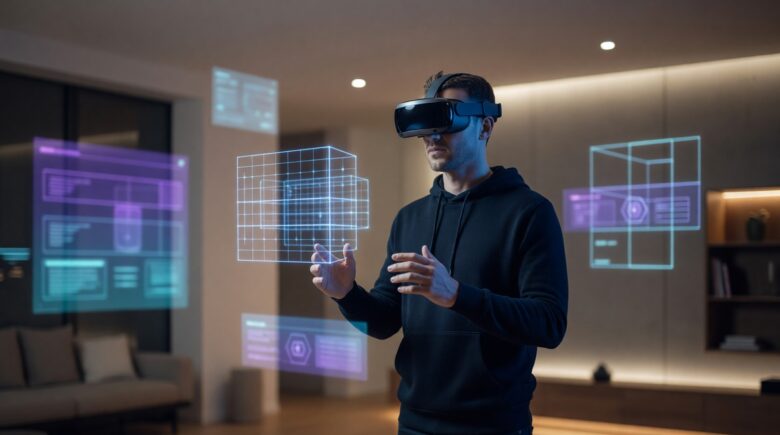
Fact-checked by the ZeroinDaily editorial team
Quick Answer
Spatial computing merges the physical and digital worlds through AR, VR, and AI-driven sensors, letting computers understand and respond to 3D space in real time., the global spatial computing market is valued at $110 billion and projected to reach $620 billion by 2032. It is already reshaping surgery, manufacturing, and enterprise training.
Spatial computing explained: it is the set of technologies that allow digital content to exist in, and interact with, physical space, not just on a flat screen. According to IDC’s 2024 Extended Reality Forecast, global spending on AR and VR surpassed $16 billion in 2023 and is accelerating faster than any prior computing cycle.
Apple’s Vision Pro launch, Meta’s Quest platform, and enterprise deployments by Microsoft HoloLens have moved spatial computing from research labs into operational workflows. For technology professionals, understanding it now is a competitive baseline, not an optional interest.
Key Takeaways
- The global spatial computing market was valued at $110 billion in 2024 and is projected to reach $620 billion by 2032, per Grand View Research.
- Boeing cut aircraft wiring assembly time by 25% using AR headsets that display routing instructions hands-free, per Boeing’s published AR implementation report.
- Walmart trained over 1 million employees using VR-based spatial simulations for customer service and emergency response scenarios.
- Venture capital investment in spatial computing startups exceeded $4.5 billion in 2023, according to PitchBook’s 2024 AR/VR Market Report.
- The Apple Vision Pro starts at $3,499, and current headset battery life averages just 2–3 hours, two hardware constraints that still limit mass enterprise deployment.
- The OpenXR standard from the Khronos Group is the industry’s primary attempt to bridge incompatible platforms from Apple, Meta, and Microsoft, though adoption remains incomplete.
What Exactly Is Spatial Computing?
Spatial computing is a computing paradigm in which machines perceive, process, and respond to three-dimensional physical environments rather than two-dimensional screen inputs. It combines augmented reality (AR), virtual reality (VR), mixed reality (MR), computer vision, depth sensing, and AI into a unified interaction model.
The term was coined by researcher Simon Greenwold in his 2003 MIT thesis, defining it as “human interaction with a machine in which the machine retains and manipulates referents to real objects and spaces.” Two decades later, the hardware finally matches that definition. Devices like the Apple Vision Pro, Microsoft HoloLens 2, and Meta Quest 3 use LiDAR sensors, eye-tracking cameras, and neural processing units to map and respond to physical space in real time.
Core Components of Spatial Computing
This is not a single product. It is a stack of technologies working together, with four key layers:
- Sensing: Depth cameras, LiDAR, and IMUs capture the physical world.
- Processing: On-device AI chips (e.g., Apple’s M2 and R1 chips) interpret sensor data at low latency.
- Display: Optical waveguides or OLED microdisplays overlay digital content on real or virtual scenes.
- Interaction: Hand tracking, eye tracking, voice, and haptics replace the mouse and keyboard.
This stack is what separates spatial computing from simple VR gaming. The interaction is ambient, context-aware, and anchored to real-world coordinates, a different relationship between humans and computers than anything a flat screen allows. For a broader look at how AI is being layered into these systems, see our overview of AI tools reshaping business workflows in 2026.
Key Takeaway: Spatial computing uses AR, VR, AI, and depth sensors to let computers perceive 3D space. First defined at MIT in 2003, the concept is now commercially viable with devices from Apple, Microsoft, and Meta, representing a market growing past $16 billion in annual hardware and software spend.
How Does Spatial Computing Differ from AR and VR?
Spatial computing is the umbrella. AR and VR are components within it, not synonyms for it. The distinction determines the use case, hardware requirement, and business model for any given deployment.
Augmented reality (AR) overlays digital content on the real world, think Google Glass or smartphone AR filters. Virtual reality (VR) replaces the physical environment entirely with a simulated one. Mixed reality (MR), as defined by Microsoft’s Mixed Reality documentation, anchors digital objects to real-world surfaces so they behave physically, a holographic engine part sitting on an actual workbench, for example.
What the spatial layer adds is intelligence. The system understands the geometry, context, and semantics of a space. It knows a surface is a table, not just a flat plane. It understands occlusion: a cup sitting on that table should block the digital object behind it. That environmental understanding is what moves the experience from “screen in front of your face” to genuine spatial interaction.
| Technology | Environment | World Awareness | Primary Use Cases |
|---|---|---|---|
| AR | Real world + digital overlay | Low (screen-based) | Navigation, retail, mobile apps |
| VR | Fully virtual | None (enclosed) | Gaming, simulation, training |
| MR | Real world + anchored digital | High (surface mapping) | Manufacturing, surgery, design |
| Spatial Computing | AR + VR + MR unified | Full (AI-driven spatial understanding) | Enterprise, healthcare, education, OS-level computing |
Key Takeaway: AR and VR are subsets of spatial computing. The defining difference is AI-driven environmental understanding, spatial systems know the context of space, not just its geometry. Microsoft defines mixed reality as the most mature commercial form, with HoloLens 2 already deployed in over 300 enterprise use cases globally.
Where Is Spatial Computing Already Being Used?
This is not a future concept. Spatial computing is an active operational tool in healthcare, manufacturing, defense, and education today. The gap between hype and deployment is closing faster than most analysts predicted three years ago.
In healthcare, surgeons at Johns Hopkins have used AR navigation systems to perform spinal surgeries with sub-millimeter precision, overlaying CT scan data directly onto the patient’s body during the procedure. In manufacturing, Boeing reduced aircraft wiring assembly time by 25% using AR headsets that display wire routing instructions hands-free, according to Boeing’s published AR implementation report.
Enterprise and Training Applications
The enterprise training market is among the fastest-growing segments. Walmart trained over 1 million employees using VR-based spatial simulations for customer service and emergency response scenarios. PTC’s Vuforia platform powers AR-guided maintenance for industrial equipment across oil, gas, and aerospace sectors.
Architecture and real estate are also changing. Firms like Gensler now walk clients through 1:1 scale building walkthroughs before a single foundation is poured. Catching design conflicts early saves an estimated $15,000 per error avoided in large commercial builds, per Autodesk’s BIM research. The same cross-sector pattern is visible in how digital banking trends are reshaping financial services, new interfaces change entire industries, not just individual workflows.
One honest caveat: most of these successes come from controlled enterprise environments with dedicated IT support, custom software integration, and trained operators. Replicating Boeing’s or Walmart’s results in a smaller organization without that infrastructure is harder than the headline numbers suggest. The ROI is real, but it does not arrive automatically.
Proven enterprise results: Boeing cut wiring assembly time by 25% with AR headsets, and Walmart trained over 1 million workers in VR simulations, evidence that enterprise ROI from spatial computing is measurable and repeatable today, though it requires meaningful implementation investment.
How Big Is the Spatial Computing Market?
The market is large, growing fast, and increasingly driven by enterprise rather than consumer demand. Current projections make it one of the highest-conviction technology investment theses of the decade.
According to Grand View Research’s 2024 Spatial Computing Market Report, the global market was valued at $110 billion in 2024 and is projected to grow at a compound annual growth rate (CAGR) of 20.5% through 2032, reaching approximately $620 billion. North America holds the largest current share, driven by enterprise adoption and a dense ecosystem of hardware and software developers.
Key players shaping this market include Apple (visionOS platform), Meta Platforms (Quest and Horizon Workrooms), Microsoft (HoloLens and Mesh), Google (ARCore, Project Starline), Qualcomm (Snapdragon XR chips), and NVIDIA (Omniverse simulation platform). The competitive dynamics resemble the early smartphone market, platform wars between closed ecosystems with OS-level lock-in implications. In that sense, the stakes are comparable to how blockchain technology is reshaping foundational financial infrastructure: a platform shift, not a feature update.
Investment and Venture Activity
Venture capital investment in spatial computing startups exceeded $4.5 billion in 2023, concentrated in enterprise AR, spatial AI, and haptics, according to PitchBook’s 2024 AR/VR Market Report. That figure excludes the multi-billion-dollar internal R&D budgets of Apple, Meta, and Google, which dwarf external funding by a factor of five or more.
Market scale: At $110 billion in 2024 and projected to hit $620 billion by 2032, growing at 20.5% annually, enterprise adoption is the primary engine, not consumer gaming, per Grand View Research.
What Are the Real Barriers to Spatial Computing Adoption?
Spatial computing faces genuine, unsolved challenges that the hype cycle consistently underweights. Acknowledging them is not pessimism, it is how you set a realistic adoption timeline.
Hardware remains the most visible barrier. The Apple Vision Pro launched at $3,499, a price point that restricts deployment to high-ROI enterprise use cases or early adopters. Battery life on current headsets averages 2–3 hours, which is inadequate for full-shift manufacturing or surgical use without tethering. Display resolution, while improving, still falls short of the human eye’s natural resolution at comfortable viewing distances.
There is also a comfort and compliance problem that does not get enough attention. Wearing a headset for four or more hours in a physical workspace causes fatigue for many users, and the ergonomic research on long-term headset use in industrial settings is still thin. Organizations that rush deployment without addressing that reality tend to see adoption rates drop sharply after the pilot phase.
Privacy and regulation represent a second wave of complexity. Spatial computing devices capture continuous video, depth maps, and biometric data, including eye movements, which can reveal health conditions and emotional states. The European Union’s AI Act and evolving interpretations of GDPR place real-time biometric surveillance in a restricted category. Enterprises deploying HoloLens or Vision Pro in the EU face compliance obligations that require legal and technical architecture work before launch. For professionals managing sensitive data across digital platforms, understanding these risks parallels learning how to protect yourself from identity theft in digital environments.
Interoperability and Developer Ecosystem
There is currently no universal spatial computing standard. Apple’s visionOS, Meta’s Horizon OS, and Microsoft’s Windows Mixed Reality are incompatible platforms. The OpenXR standard, maintained by the Khronos Group, aims to provide a cross-platform API layer, but adoption among major players remains incomplete as of mid-2025. For smaller development teams, that fragmentation means writing and maintaining separate codebases for each target platform, a real cost that inflates software budgets and slows deployment cycles.
The three primary barriers: hardware cost (Vision Pro starts at $3,499), battery life averaging under 3 hours, and regulatory complexity under GDPR and the EU AI Act. Add platform fragmentation across Apple, Meta, and Microsoft, and the OpenXR standard becomes the industry’s best current answer, though it is not yet a complete one.
Frequently Asked Questions
What is spatial computing in simple terms?
It is technology that lets computers understand and interact with the physical world in three dimensions, not just show content on a flat screen. Cameras, sensors, and AI map real spaces and place digital content inside them as if it were physically present.
Is spatial computing the same as the metaverse?
No. The metaverse is a concept, a persistent shared virtual world. Spatial computing is the underlying technology stack that could power one version of the metaverse, but it also has entirely separate enterprise and professional use cases that have nothing to do with virtual social spaces. Conflating the two is one of the most common category errors in tech media coverage.
What devices support spatial computing right now?
The leading commercial devices are the Apple Vision Pro, Meta Quest 3, and Microsoft HoloLens 2. Smartphone-based AR via ARKit (Apple) and ARCore (Google) makes basic spatial computing available on over 2 billion mobile devices globally. Enterprise-grade options also include Magic Leap 2 and RealWear Navigator for industrial use.
Will spatial computing replace smartphones?
Not imminently. It may replace the smartphone’s role as the primary computing interface within 10–15 years, Apple’s Tim Cook has publicly described spatial computing as “the successor to the phone.” Battery life, form factor, and social acceptability of wearing headsets in public remain unsolved before mainstream replacement is feasible.
How is AI connected to spatial computing?
AI is the enabling layer that makes spatial computing contextually aware. Computer vision models detect and classify real-world objects. Natural language processing allows voice control without a keyboard. On-device AI chips process sensor data fast enough to maintain low-latency overlays. Without AI, spatial computing is just a display. With it, the system understands and responds to its environment. This is closely related to how AI is transforming decision-making in adjacent industries like investment platforms.
What industries will be most disrupted by spatial computing?
Healthcare, manufacturing, construction, education, and defense have the clearest near-term ROI. Each involves complex physical tasks where overlaying precise digital information reduces error rates, training time, or physical risk. Retail and real estate are secondary waves, dependent on consumer headset adoption reaching meaningful scale, likely after 2027.
Who is spatial computing NOT a good fit for right now?
Small and mid-sized businesses without dedicated IT infrastructure, software development resources, or high-volume repetitive physical tasks should be cautious. The enterprise successes at Boeing and Walmart required custom software integration and sustained internal support. Off-the-shelf spatial computing solutions for general office work remain immature, and the cost-to-benefit ratio does not favor organizations that cannot dedicate a team to the implementation.
How does the EU AI Act affect spatial computing deployments?
The EU AI Act classifies real-time biometric surveillance as a restricted or prohibited use case depending on context. Because spatial computing headsets continuously capture eye-tracking data, depth maps, and video, deploying them in EU workplaces triggers compliance obligations under both the AI Act and GDPR. Organizations must conduct data protection impact assessments and, in some cases, obtain explicit worker consent before deployment. Legal review is not optional, it is a prerequisite.
What is OpenXR and why does it matter?
OpenXR is a cross-platform API standard maintained by the Khronos Group that allows developers to write spatial computing applications that run across multiple hardware platforms without full rewrites. It matters because Apple’s visionOS, Meta’s Horizon OS, and Microsoft’s Windows Mixed Reality are otherwise incompatible. OpenXR adoption is still incomplete among major vendors as of mid-2025, but it is the most credible path toward a less fragmented developer ecosystem.
How does spatial computing connect to broader digital transformation trends?
The pattern mirrors earlier platform shifts. Just as mobile computing changed how financial services, retail, and healthcare delivered products, not just how they displayed information, spatial computing is changing where and how work actually happens. The productivity gains compound when spatial interfaces replace paper-based or screen-based workflows in environments where workers’ hands need to stay free. That is why manufacturing and surgery show the earliest measurable ROI, while office-based knowledge work lags.