Fact-checked by the ZeroinDaily editorial team
Quick Answer
The best portable power banks for heavy phone users and travelers in July 2025 offer between 10,000mAh and 26,800mAh of capacity, with top-rated models supporting 65W USB-C PD fast charging. Leading picks include the Anker 737, Baseus Blade, and Mophie Powerstation. Capacity, watt output, airline carry-on compliance, and weight are the four factors that separate everyday options from travel-grade units.
Portable power banks are rechargeable battery packs that store electrical energy and deliver it to devices via USB-A, USB-C, or wireless charging ports. According to Grand View Research’s 2024 market report, the global portable power bank market was valued at $9.9 billion in 2023 and is projected to grow at a compound annual rate of 12.4% through 2030, driven largely by smartphone dependency and international travel recovery.
Modern smartphones consume more battery than ever — flagship models now carry screens above 6.5 inches, 5G radios, and always-on processors. This guide covers what capacity you actually need, which brands lead the market, how airline rules affect your choices, and exactly which units deliver the best value for heavy users and travelers in 2025.
Key Takeaways
- A 10,000mAh power bank typically provides 2–3 full charges for a standard smartphone with a 3,500mAh battery, making it the minimum recommended capacity for day-trip travel (per Qualcomm’s Quick Charge documentation).
- The FAA limits carry-on power banks to 100Wh (27,000mAh at 3.7V); units above 100Wh require airline approval and those above 160Wh are banned entirely, according to FAA dangerous goods regulations.
- The Anker 737 Power Bank delivers 140W bi-directional charging — enough to charge a MacBook and an iPhone simultaneously — making it a benchmark for high-output portable power banks (Anker product specifications).
- USB-C Power Delivery (PD 3.0) can charge a compatible smartphone to 50% in approximately 30 minutes, roughly 3x faster than standard 5W USB-A charging, according to USB Implementers Forum data.
- Wireless charging power banks lose approximately 30–40% efficiency compared to wired transfer, meaning a 10,000mAh wireless bank delivers the equivalent of roughly 6,000–7,000mAh usable charge (per Wireless Power Consortium Qi standards).
In This Guide
- How Much Capacity Do You Actually Need?
- What Are the Best Portable Power Banks Available Right Now?
- Does Fast Charging Really Make a Difference in a Power Bank?
- What Are the Airline Rules for Traveling With Power Banks?
- Wireless vs. Wired Power Banks: Which Is Better for Travelers?
- What Should You Look for When Buying a Portable Power Bank?
- Frequently Asked Questions
How Much Capacity Do You Actually Need?
The right capacity depends on your phone’s battery size, how many devices you carry, and how long you’ll be away from a wall outlet. A 10,000mAh bank covers most single-device users for a full day; travelers needing multi-device support should target 20,000mAh or higher.
Flagship smartphones like the Samsung Galaxy S24 Ultra carry a 5,000mAh battery, while Apple’s iPhone 15 Pro Max holds 4,422mAh. Accounting for the average 85–90% transfer efficiency of lithium-ion power banks, a 10,000mAh unit realistically delivers about 8,500mAh of usable energy — roughly 1.7 full iPhone 15 Pro Max charges.
Capacity Tiers at a Glance
Light users who commute and spend most time near outlets do fine with 5,000–10,000mAh. These units are slim, often fitting in a jacket pocket, and weigh under 200 grams. Heavy users — those gaming on mobile, using GPS navigation continuously, or working from a phone — should target 20,000mAh to ensure a full day without anxiety.
Multi-device travelers (phone, tablet, earbuds) should consider units in the 25,600–26,800mAh range, which approach the FAA limit but still qualify as carry-on items. If you’re planning extended international trips, our guide to slow travel and minimizing gear overhead covers how to balance power needs with carry weight.
The mAh rating on a power bank is measured at 3.7V (battery voltage), but USB output runs at 5V. This voltage conversion is why a 20,000mAh bank never delivers 20,000mAh to your device — effective output is closer to 13,000–15,000mAh after conversion losses.
What Are the Best Portable Power Banks Available Right Now?
The top portable power banks in 2025 are the Anker 737, Baseus Blade, Mophie Powerstation Pro, and Iniu BI-B60 — each excelling in specific use cases from maximum wattage to ultra-slim travel design.
The table below compares the leading models across the metrics that matter most: capacity, maximum wattage, weight, and price.
| Model | Capacity | Max Output | Weight | Approx. Price |
|---|---|---|---|---|
| Anker 737 | 24,000mAh | 140W | 680g | $110 |
| Baseus Blade | 20,000mAh | 100W | 445g | $80 |
| Mophie Powerstation Pro | 10,000mAh | 30W | 227g | $70 |
| Iniu BI-B60 | 25,000mAh | 65W | 490g | $55 |
| RavPower 20000 | 20,000mAh | 60W | 420g | $65 |
| Belkin BPB011 | 10,000mAh | 18W | 210g | $50 |
Best Overall: Anker 737
Anker is the dominant brand in the portable charging category, holding an estimated 30% share of Amazon’s power bank sales according to Statista’s consumer electronics data. The Anker 737 delivers 140W bi-directional output, meaning it can charge a laptop and a phone at the same time at full speed.
Its built-in digital display shows both battery percentage and real-time wattage draw — a feature rare below the $120 price point. The unit’s 24,000mAh capacity qualifies under FAA carry-on rules without requiring special airline approval.
Best for Slim Profiles: Baseus Blade
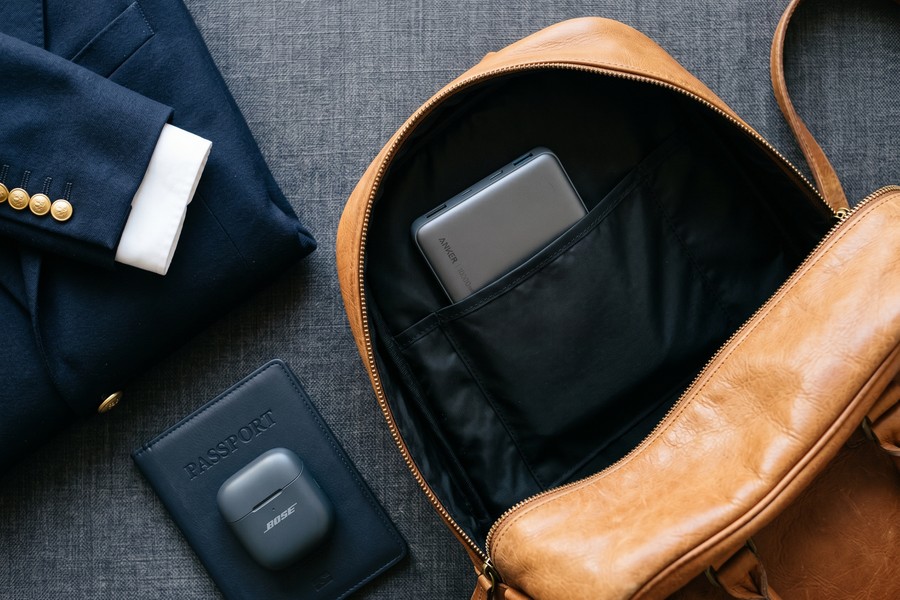
The Baseus Blade is a standout for travelers who prioritize packing efficiency. At just 14mm thick, it fits flat in a laptop sleeve or suit pocket. Despite its slim form, it outputs up to 100W over USB-C, sufficient to run a 13-inch laptop at full charge speed.
“For frequent travelers, the single most underrated feature in a portable charger is not capacity — it’s wattage output. A 65W or higher USB-C port means one cable charges your phone, laptop, and earbuds without juggling adapters.”
Does Fast Charging Really Make a Difference in a Power Bank?
Yes — fast charging from a power bank is meaningfully faster than standard charging, but only if both the power bank and the device support the same protocol. USB-C Power Delivery (PD) and Qualcomm Quick Charge 4.0 are the two dominant standards to look for in 2025.
According to Qualcomm’s Quick Charge benchmarks, a Quick Charge 4.0-compatible device can reach 50% battery in 15 minutes when paired with a compatible charger. Standard 5W charging achieves the same milestone in approximately 45–60 minutes.
Understanding Wattage in Portable Power Banks
Wattage (W) determines how quickly energy transfers to your device. A 5W output is basic and slow. 18W–30W is considered fast for smartphones. 45W–65W is needed for tablets and entry-level laptops. Above 100W handles most professional laptops at or near full charge speed.
Heavy phone users traveling internationally will benefit from pairing a high-wattage power bank with a quality travel adapter. If you’re optimizing your full travel tech stack, the hidden costs of travel including adapter and charging gear is worth reviewing before your next trip.
Power banks supporting USB-C PD at 65W or higher can fully recharge themselves from empty in under 2 hours when connected to a compatible wall adapter — compared to 6–10 hours for budget models using standard 5W input charging.
What Are the Airline Rules for Traveling With Power Banks?
The FAA requires all lithium battery power banks to be carried in carry-on baggage only — they are prohibited in checked luggage. Units up to 100Wh do not require airline approval; units between 100Wh and 160Wh require carrier authorization; units above 160Wh are banned on commercial flights.
The 100Wh threshold equals approximately 27,027mAh at 3.7V, which covers nearly every consumer power bank on the market. This calculation comes directly from the FAA’s dangerous goods passenger guidance page. Most product listings from Anker, Baseus, and Mophie now display the Wh rating alongside mAh for this reason.
International Airline Variations
While FAA rules govern U.S. carriers, the International Air Transport Association (IATA) sets the baseline for global flights. IATA’s rules mirror FAA limits, but individual airlines such as Singapore Airlines and Emirates apply additional restrictions during specific routes. Always verify with your carrier before travel.
Planning an overseas trip? Pairing the right portable power bank with good travel insurance protects your gear investment. Our explainer on what travel insurance covers and whether you need it outlines which policies include electronic gear protection.
To convert mAh to Wh — the unit airlines actually measure — multiply mAh by the battery voltage (3.7V) and divide by 1,000. A 26,800mAh bank equals approximately 99.16Wh, just under the FAA’s 100Wh no-approval threshold.
Wireless vs. Wired Power Banks: Which Is Better for Travelers?
Wired portable power banks are more efficient and better suited for most travelers. Wireless (Qi-based) charging adds convenience but reduces effective capacity delivery by 30–40%, which matters when every milliamp-hour counts on a long-haul flight or backcountry hike.
The Wireless Power Consortium sets the Qi charging standard used by Apple MagSafe, Samsung, and most Android flagships. Current consumer wireless power banks top out at 15W wireless output — well below the 65W–140W achievable via USB-C wired connections.
When Wireless Makes Sense
Wireless power banks are ideal when cable management is a priority — for example, when topping up a phone in a conference bag without fumbling for a USB-C cable. Brands like Mophie and Belkin specialize in MagSafe-compatible wireless banks optimized for iPhone users.
Travelers focused on maximizing miles and points sometimes use rewards cards that offer purchase protection on electronics. The best travel credit cards for frequent flyers often include device purchase protection that covers power banks bought abroad.
What Should You Look for When Buying a Portable Power Bank?
The five factors that define a quality portable power bank are: capacity (mAh), output wattage (W), number of ports, weight, and safety certification. Travelers should also confirm the unit’s Wh rating for airline compliance before purchasing.
Safety certification is frequently overlooked. Reputable units carry UL 2056 certification from Underwriters Laboratories, which tests for overcharge protection, short circuit protection, and thermal runaway resistance. Uncertified units — often sold cheaply on third-party marketplaces — pose real fire risks, especially at altitude inside an aircraft cabin.
Port Configuration Matters
For heavy users traveling with multiple devices, look for at least two USB-C ports and one USB-A port. This allows simultaneous charging of a laptop (USB-C high-watt), a phone (USB-C PD), and a legacy device like older earbuds or a camera (USB-A). The Anker 737, for example, includes two USB-C and one USB-A port with intelligent power distribution.
For travelers who manage tech costs as part of a broader budget, tools that help track spending on gear and subscriptions are worth bookmarking. The best expense tracking apps for 2026 can help you monitor recurring electronics and travel purchases in one place.
Always recharge your portable power bank within 3 months of storage, even if unused. Lithium-ion cells stored at low charge levels for extended periods experience permanent capacity loss — industry guidance from Battery University recommends storing at 40–60% charge for maximum long-term cell health.
“Consumers consistently underestimate the importance of input charging speed. A power bank that takes 10 hours to recharge itself is effectively useless for back-to-back travel days. Look for at least 45W input before assuming the unit is travel-ready.”
Related reading: Pro Tips for Using a Portable Phone Charger in Remote Work Zones.
Frequently Asked Questions
How many times can a power bank charge an iPhone 15?
A 10,000mAh power bank can charge an iPhone 15 (3,349mAh battery) approximately 2.5 times, accounting for an 85% transfer efficiency rate. A 20,000mAh unit would deliver roughly 5 full charges under the same conditions.
Can I take a 26,800mAh power bank on a plane?
Yes. A 26,800mAh power bank at 3.7V equals approximately 99.16Wh, which falls just under the FAA’s 100Wh carry-on threshold requiring no airline approval. It must be placed in your carry-on bag — not checked luggage — per FAA regulations.
What is the best portable power bank for international travel?
The Baseus Blade 20,000mAh and Anker 737 are consistently rated the best portable power banks for international travel in 2025. Both support 65W+ USB-C PD, comply with FAA carry-on limits, and offer multi-device output. The Baseus Blade wins on weight and portability; the Anker 737 wins on total wattage.
Is a higher mAh always better in a power bank?
Not always. Higher mAh means more charges but also more weight and longer self-recharge time. A 10,000mAh unit at 65W is often more practical for a business traveler than a 26,800mAh unit that outputs only 18W and takes 10+ hours to recharge itself.
Do power banks lose capacity over time?
Yes. Lithium-ion cells degrade with each charge cycle. Most quality power banks retain 80% of original capacity after 500 charge cycles, according to battery degradation standards referenced by the U.S. Department of Energy. After 500 cycles, capacity decline accelerates.
Can a power bank charge a laptop?
Yes, provided the power bank outputs at least 45W over USB-C PD. Most ultrabooks (Dell XPS 13, MacBook Air M3) charge at 30–61W. A 65W+ output bank like the Anker 737 or Baseus Blade will charge a laptop at full speed. Units below 30W will charge a laptop slowly or only maintain current charge without gaining capacity.
What certifications should I look for in a power bank?
UL 2056 from Underwriters Laboratories is the primary U.S. safety certification for portable power banks. CE marking indicates European conformity. Avoid units with no visible certification markings, particularly low-cost options from unknown brands on third-party platforms, as they carry documented fire risks.
Sources
- FAA — Dangerous Goods: Carry-On Battery and Power Bank Regulations
- Grand View Research — Portable Power Bank Market Size and Forecast 2024–2030
- Qualcomm — Quick Charge Technology Specifications and Benchmarks
- Wireless Power Consortium — How Qi Wireless Charging Works
- USB Implementers Forum — USB-C and Power Delivery Standards
- Statista — Consumer Electronics Market Data 2024
- U.S. Department of Energy — Device Energy Efficiency and Battery Standards
- IATA — Lithium Battery Regulations for Passengers and Crew
- Anker — 737 Power Bank Official Specifications
- Battery University — How to Store Lithium-Ion Batteries for Long-Term Health






