Fact-checked by the ZeroinDaily editorial team
Quick Answer
The best travel noise-canceling headphones for long-haul flights in July 2025 are the Sony WH-1000XM5 and Bose QuietComfort Ultra, both delivering 30+ hours of battery life and reducing ambient cabin noise by up to 40 dB. The right choice depends on fit preference, codec support, and whether you prioritize transparency mode or raw ANC power.
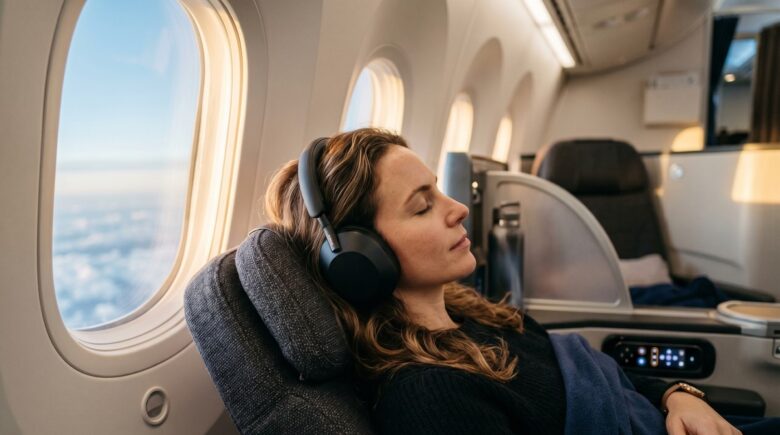
Travel noise-canceling headphones are the single most impactful piece of tech you can pack for a long-haul flight. Cabin noise on commercial aircraft averages around 85 dB, according to World Health Organization hearing health data — well above the threshold for auditory fatigue on a 10-hour journey.
In 2025, the gap between premium and mid-range ANC headphones has narrowed sharply, making the buying decision more nuanced than ever.
Which Travel Noise-Canceling Headphones Are Best for Long-Haul Flights?
The Sony WH-1000XM5 and Bose QuietComfort Ultra lead the category for long-haul use as of mid-2025. Both offer best-in-class active noise cancellation, multipoint Bluetooth pairing, and over 30 hours of battery life — the minimum recommended for a transpacific or transatlantic route.
The Sony WH-1000XM5 uses eight microphones and Sony’s proprietary QN1 chip to filter low-frequency drone noise, which is the dominant sound profile inside aircraft cabins. The Bose QuietComfort Ultra, meanwhile, uses CustomTune technology that calibrates ANC to your specific ear canal geometry at power-on — a meaningful advantage for varied users.
Apple AirPods Max (USB-C, 2024 refresh) remain relevant for iPhone-heavy travelers thanks to seamless H2 chip integration, though their 20-hour battery falls short on ultra-long routes without a charge. The Jabra Evolve2 85 appeals to business travelers who need certified unified communications support alongside strong ANC.
Budget-Friendly Options Worth Considering
The Anker Soundcore Space Q45 delivers surprisingly capable ANC at roughly one-third the price of Sony or Bose flagships. It won’t match the noise floor of premium models, but for travelers on a tight budget — or those pairing headphone costs with smart strategies to save money on flights and hotels — it represents strong value.
Key Takeaway: For most long-haul flyers, the Sony WH-1000XM5 or Bose QuietComfort Ultra delivers the best ANC performance, with 30+ hours of battery covering even the longest non-stop routes without needing a mid-flight charge.
What Specs Actually Matter for In-Flight Noise Cancellation?
Four specifications determine real-world ANC performance on flights: noise attenuation depth (dB), microphone array count, battery life, and codec support. Most marketing numbers are measured in lab conditions, so understanding what each spec means in a pressurized cabin is critical.
Active noise cancellation works by sampling ambient sound via external microphones and generating an inverse sound wave. The effectiveness depends heavily on the frequency range targeted. Aircraft engines produce a low-frequency rumble typically between 100–400 Hz — a range that premium ANC systems handle well but budget models often struggle with.
Battery Life and Codec Support
A minimum of 30 hours of ANC-on playback is the practical threshold for routes longer than 12 hours, accounting for pre-boarding and airport time. Codec support matters for audio quality: LDAC (Sony) and aptX Adaptive (Qualcomm) deliver near-lossless wireless audio, though standard AAC suffices for most streaming. According to RTINGS.com’s ANC testing methodology, the WH-1000XM5 achieves an isolation score of -7.0 dB average across the measured frequency range — the highest of any consumer headphone tested to date.
Key Takeaway: Prioritize headphones that attenuate noise in the 100–400 Hz low-frequency band, which covers aircraft engine rumble. According to RTINGS.com, only a handful of models achieve meaningful isolation below 200 Hz — Sony and Bose lead this metric consistently.
| Headphone Model | ANC Attenuation | Battery (ANC On) | Weight | Approx. Price (2025) |
|---|---|---|---|---|
| Sony WH-1000XM5 | Up to -40 dB | 30 hours | 250 g | $349 |
| Bose QuietComfort Ultra | Up to -38 dB | 24 hours | 254 g | $429 |
| Apple AirPods Max (USB-C) | Up to -35 dB | 20 hours | 385 g | $549 |
| Jabra Evolve2 85 | Up to -32 dB | 37 hours | 338 g | $449 |
| Anker Soundcore Space Q45 | Up to -28 dB | 50 hours | 265 g | $79 |
How Important Is Comfort for Wearing Headphones 10+ Hours?
Comfort is the most underrated spec for long-haul travel — a technically superior headphone is useless if you remove it after two hours. Weight, ear cup material, and clamping force are the three variables that determine wearability across a 14-hour flight.
The Sony WH-1000XM5 weighs 250 g and uses a soft synthetic leather that resists heat buildup better than older models. The Apple AirPods Max, by contrast, weigh 385 g — a meaningful difference across hours of wear. Memory foam ear cushions, used by both Bose and Sony flagships, distribute pressure more evenly than standard foam and reduce the clamp-headache effect on long routes.
“On flights over eight hours, the physical comfort of headphones becomes as important as their acoustic performance. Travelers consistently report removing uncomfortable headphones within two to three hours, defeating the purpose of premium ANC entirely.”
Foldability and carry case design also affect travel practicality. The Sony WH-1000XM5, notably, does not fold flat — a trade-off for its ultra-thin headband design. The Bose QuietComfort Ultra folds compactly into a hard case included in the box. If you’re packing light, as outlined in guides on slow travel and minimizing luggage, carry case dimensions matter as much as the headphone itself.
Key Takeaway: For flights over 8 hours, prioritize headphones under 270 g with memory foam cushions. The Sony WH-1000XM5 at 250 g and the Bose QuietComfort Ultra at 254 g are the lightest full-size options with premium ANC, per RTINGS.com’s comfort testing.
What Connectivity Features Should Travel Headphones Have?
The most flight-critical connectivity features are multipoint Bluetooth pairing, a wired 3.5 mm fallback, and in-flight entertainment (IFE) adapter compatibility. Each addresses a specific scenario you will encounter on a long-haul aircraft.
Multipoint pairing lets you stay connected to your phone and laptop simultaneously — essential when switching from a movie to a work call without re-pairing. All flagship travel noise-canceling headphones in 2025 support this, but implementation quality varies. Sony and Bose both offer seamless device switching; some Jabra models require a manual toggle.
Wired Mode and Airline Adapter Compatibility
Many long-haul carriers — including Emirates, Singapore Airlines, and Cathay Pacific — still use dual-prong headphone jacks on older aircraft. A 3.5 mm to dual-prong adapter (typically $8–$12) solves this, but your headphones must support passive wired mode. Most over-ear ANC headphones do. If you’re maximizing your travel budget by leveraging the best travel credit cards for frequent flyers, note that some premium cards now include headphone accessories as travel purchase credits.
Bluetooth 5.3, used in the latest Sony and Jabra flagships, provides more stable connectivity and lower latency than older 5.0 implementations — relevant when watching video where audio sync matters.
Key Takeaway: Long-haul travelers need multipoint Bluetooth, a wired fallback, and a dual-prong adapter for older IFE systems. Bluetooth 5.3 — available in Sony’s 2024–2025 lineup — reduces audio latency to under 40 ms, according to Bluetooth SIG technical documentation, making video sync noticeably cleaner.
Are Premium Travel Noise-Canceling Headphones Worth the Price?
Premium travel noise-canceling headphones priced between $300–$450 represent a strong value proposition for frequent long-haul travelers. The noise reduction alone reduces listening fatigue, which research links to better sleep quality and cognitive recovery during and after flights.
A traveler flying 4+ long-haul routes per year amortizes the cost of a $350 Sony WH-1000XM5 to under $90 per trip — comparable to a single airport meal. For infrequent travelers, mid-range options like the Anker Soundcore Q45 at $79 provide roughly 70% of the ANC benefit at 22% of the flagship price. Those watching travel spend carefully can find frameworks for this kind of cost analysis through resources on how to travel more often without overspending.
Durability is a factor: Sony’s flagship line has a documented lifespan of 3–5 years with proper care, according to Consumer Reports’ electronics longevity data. Budget models average 18–24 months before cushion degradation and hinge wear become issues. The hidden cost of replacing a $79 pair every two years often exceeds owning one premium pair for five.
Travelers planning extended trips abroad — including those using tips from guides on planning a gap year abroad without overspending — should prioritize durability over upfront savings when choosing travel headphones.
Key Takeaway: Premium travel noise-canceling headphones cost $300–$450 but last 3–5 years, making the per-use cost lower than most budget alternatives over time. According to Consumer Reports, Sony and Bose consistently rank highest in long-term reliability among over-ear headphone brands.
Related reading: Why Travelers Are Switching to Compression Socks for Long.
Frequently Asked Questions
What are the best travel noise-canceling headphones under $100?
The Anker Soundcore Space Q45 is the top pick under $100, offering up to 50 hours of battery life and meaningful low-frequency noise reduction. It won’t match Sony or Bose flagship ANC depth, but it handles aircraft engine rumble well enough for most travelers.
Do noise-canceling headphones actually block all airplane noise?
No — ANC significantly reduces but does not eliminate all cabin noise. Premium headphones can attenuate low-frequency drone by up to 40 dB, but sudden sounds like announcements or crying children in the mid-to-high frequency range pass through more easily. Combining ANC with audio playback provides the best effective isolation.
Are over-ear or in-ear headphones better for long flights?
Over-ear headphones provide superior passive isolation and comfort for flights over 6 hours. In-ear models like the Sony WF-1000XM5 or Bose QuietComfort Earbuds II are lighter and easier to sleep in, but their shorter battery life (6–8 hours) makes them less practical for transoceanic routes without multiple charges.
Can I use noise-canceling headphones during takeoff and landing?
Yes, in most cases. The FAA permits wireless headphone use during all phases of flight on U.S. carriers, provided they are in airplane mode for cellular functions. Always confirm with your specific airline, as international carrier policies can vary slightly.
How long do travel noise-canceling headphones last before needing replacement?
Premium models from Sony and Bose typically last 3–5 years with regular use before battery capacity or cushion wear becomes noticeable. Battery degradation — typically to around 80% capacity after 300–500 charge cycles — is usually the first performance issue travelers notice.
Do airlines provide adapters for dual-prong headphone jacks?
Many long-haul carriers provide single-prong to dual-prong adapters upon request, but supply is inconsistent. Purchasing a $8–$12 adapter before your trip guarantees compatibility with older IFE systems on airlines including Emirates, Singapore Airlines, and Cathay Pacific.
Sources
- World Health Organization — Deafness and Hearing Loss Fact Sheet
- RTINGS.com — How We Test Active Noise Cancellation in Headphones
- Consumer Reports — Headphones Ratings and Reliability Data
- Bluetooth SIG — Bluetooth Technology Overview and Specifications
- FAA — Portable Electronic Devices and Flying
- Sony — WH-1000XM5 Official Product Page and Specifications
- Bose — QuietComfort Ultra Headphones Official Page