Fact-checked by the ZeroinDaily editorial team
Your smartphone can process billions of calculations per second, yet your bank still takes three business days to clear a transfer. Your weather app refreshes in real time, yet climate models predicting hurricane paths remain dangerously imprecise. That frustrating gap — between what computing feels like it should do and what it actually does — is exactly what quantum computing explained in plain terms can help close.
According to IBM’s quantum research division, classical computers have followed Moore’s Law for decades, doubling transistor density roughly every two years. But that law is hitting a physical wall. Transistors are now so small they’re approaching the size of individual atoms, and quantum tunneling errors are making further miniaturization increasingly unreliable. Meanwhile, McKinsey estimates quantum computing could unlock $700 billion in economic value by 2035 across pharmaceuticals, finance, and logistics alone.
This guide cuts through the hype. You’ll get a rigorous, plain-English breakdown of how quantum computers actually work, how they differ from the machine under your desk, which industries will feel the change first, and — critically — what this means for your daily digital life in the next five to ten years. No physics degree required.
Key Takeaways
- Quantum computers use qubits that can exist in multiple states simultaneously, making them up to 158 million times faster than classical computers on specific tasks, according to Google’s 2019 benchmark.
- The global quantum computing market was valued at $1.3 billion in 2024 and is projected to reach $5.3 billion by 2029, growing at a CAGR of 32.7%.
- Current RSA-2048 encryption — protecting most banking and email — could theoretically be broken by a sufficiently powerful quantum computer within the next 10 to 15 years.
- IBM’s Osprey processor reached 433 qubits in 2022, and the company targets 100,000 error-corrected qubits by 2033 under its quantum roadmap.
- Drug discovery timelines could shrink from 12 years and $2.6 billion per drug to under 5 years with quantum-assisted molecular simulation.
- NIST finalized its first post-quantum cryptography standards in August 2024, giving businesses a concrete framework to begin transitioning their security infrastructure.
In This Guide
- Classical vs. Quantum: The Fundamental Difference
- How Qubits Actually Work
- Quantum Computing Explained: Speed and Limitations
- Which Industries Feel the Change First
- The Encryption and Security Threat
- What Actually Changes for Everyday Users
- Quantum Computing Explained: Realistic Timeline
- How to Prepare Before Quantum Goes Mainstream
- Quantum Computing vs. AI: How They Interact
Classical vs. Quantum: The Fundamental Difference
Every classical computer — from your phone to the world’s fastest supercomputer — processes information using bits. A bit is either a 0 or a 1. That binary system underpins everything from streaming video to online banking. It’s extraordinarily powerful, but it has one structural limitation: it can only evaluate one possibility at a time.
Quantum computers use qubits instead of bits. Thanks to a quantum property called superposition, a qubit can be 0, 1, or any combination of both simultaneously. This isn’t a metaphor — it’s a measurable physical state that allows quantum processors to explore many possible solutions in parallel.
Think of it this way. Finding the shortest route between 10 cities is manageable for a classical computer. But add 50 cities, and the number of possible routes exceeds the number of atoms in the observable universe. A classical machine works through combinations one by one. A quantum machine, in principle, evaluates vast numbers of them at once.
The Role of Entanglement
Beyond superposition, quantum computers exploit entanglement — a phenomenon where two qubits become linked so that the state of one instantly influences the other, regardless of distance. This allows quantum processors to coordinate information across qubits in ways that have no classical equivalent.
Entanglement is what makes quantum systems exponentially more powerful as you add qubits. Add one qubit and you don’t just double your computing power — you square it. A 300-qubit system, if error-free, could theoretically represent more states simultaneously than there are particles in the universe.
The Role of Interference
Quantum interference is the third pillar. Quantum algorithms are designed to amplify paths leading to correct answers and cancel out paths leading to wrong ones. It’s analogous to noise-canceling headphones — destructive interference eliminates the “wrong” calculations before you read the result.
Together, superposition, entanglement, and interference form the architecture that makes quantum computing categorically different from classical computing — not just faster, but fundamentally different in how problems are approached.
| Feature | Classical Computing | Quantum Computing |
|---|---|---|
| Basic Unit | Bit (0 or 1) | Qubit (0, 1, or both) |
| Processing Style | Sequential or parallel threads | Quantum parallelism via superposition |
| Scaling | Linear power gain per added bit | Exponential gain per added qubit |
| Operating Temperature | Room temperature | Near absolute zero (-273°C) |
| Error Rate | Extremely low | Currently high (quantum noise) |
| Best Use Case | General-purpose tasks | Optimization, simulation, cryptography |
How Qubits Actually Work
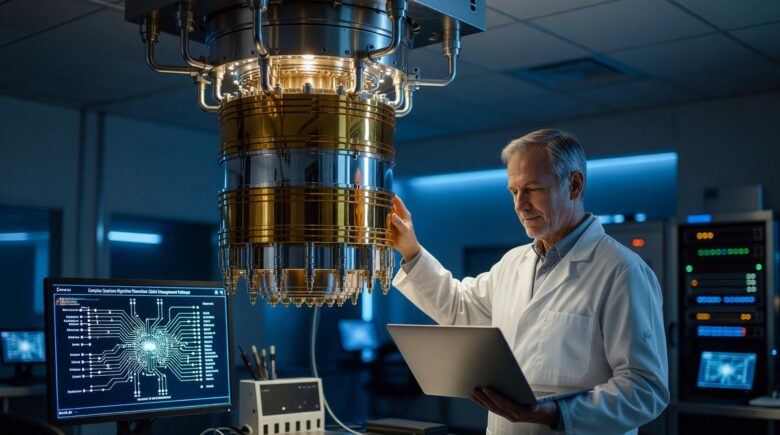
Qubits aren’t software constructs — they’re physical objects. Different companies build them using different materials. Superconducting qubits, used by IBM and Google, are tiny circuits cooled to 15 millikelvin — colder than outer space. Trapped-ion qubits, favored by IonQ and Honeywell, use individual charged atoms held in electromagnetic traps.
Each approach has tradeoffs. Superconducting qubits are fast but fragile. Trapped-ion qubits are more stable but slower to operate. Photonic qubits, used by companies like PsiQuantum, operate at room temperature but face different engineering hurdles around routing and detection.
IBM’s quantum computers operate at temperatures 250 times colder than deep space. The cryogenic cooling systems required cost upward of $500,000 per unit and consume enormous amounts of electricity.
The Decoherence Problem
The biggest challenge in building quantum computers is decoherence. Qubits are so sensitive to their environment that even a stray vibration, electromagnetic signal, or heat fluctuation can destroy the quantum state before a calculation completes. This is called “collapsing” the superposition.
Current quantum processors spend enormous resources on quantum error correction — using multiple physical qubits to encode a single “logical” qubit that’s stable enough to be useful. IBM estimates it currently takes 1,000 physical qubits to produce one reliable logical qubit, which is why the race to build larger qubit counts is so intense.
NISQ Era: Where We Are Now
Today’s quantum computers exist in what researchers call the NISQ era — Noisy Intermediate-Scale Quantum. These machines have 50 to 1,000+ qubits but are too error-prone for most real-world applications without extensive error mitigation strategies.
According to John Preskill’s foundational NISQ paper at Caltech, NISQ devices “will not be able to run the celebrated quantum algorithms of the 1990s without error correction.” This is the honest state of play: impressive, but not yet transformative for general use.

Quantum Computing Explained: Speed and Limitations
Speed comparisons between quantum and classical computers are frequently misrepresented. Quantum computers are not universally faster. They are dramatically faster for specific categories of problems — and slower or irrelevant for others. Getting this distinction right is essential for understanding real-world impact.
In 2019, Google claimed quantum supremacy when its 53-qubit Sycamore processor completed a specific sampling task in 200 seconds — a task it claimed would take the world’s fastest classical supercomputer 10,000 years. IBM contested this, arguing their Summit supercomputer could do it in 2.5 days with clever optimization. Even so, the gap was staggering.
Google’s Sycamore quantum processor completed a benchmark calculation 158 million times faster than the classical comparison. The calculation had no practical commercial application — but it proved quantum supremacy is physically achievable.
Problems Quantum Computers Excel At
Quantum advantage is clearest in three problem types: optimization problems (finding the best solution among millions of variables), simulation problems (modeling quantum-scale systems like molecules), and cryptography problems (factoring enormous prime numbers).
Grover’s algorithm gives quantum computers a quadratic speedup over classical machines for searching unsorted databases. Shor’s algorithm — the most consequential — factors large numbers exponentially faster than any known classical method. It’s why cryptography experts are worried.
What Quantum Computers Are Bad At
Quantum computers are not magic accelerators for everything. Streaming video, word processing, browsing the web, gaming, and most everyday computing tasks will see zero benefit from quantum hardware. Classical computers are highly optimized for these deterministic, sequential tasks.
Quantum systems are also expensive, fragile, and physically enormous. They require specialized environments, expert operators, and cloud infrastructure to access. For the foreseeable future, they will remain specialized tools — powerful for specific scientific and industrial problems, not replacements for your laptop.
| Task Type | Classical Computer | Quantum Computer | Winner |
|---|---|---|---|
| Factoring large primes | Exponentially slow | Polynomial time (Shor’s) | Quantum |
| Database search | Linear time | Quadratic speedup (Grover’s) | Quantum |
| Molecular simulation | Approximations only | Exact quantum modeling | Quantum |
| Video streaming | Excellent | No advantage | Classical |
| General AI training | Well-optimized | Unproven advantage | Classical (for now) |
| Financial optimization | Slow for large sets | Potential quadratic speedup | Quantum (future) |
Which Industries Feel the Change First
Not every industry will be disrupted simultaneously. Quantum computing will arrive in waves, with some sectors transformed within five years and others unchanged for a decade or more. The sequencing depends on which industries have the most to gain from solving optimization and simulation problems at scale.
Pharmaceuticals and Drug Discovery
Drug development is perhaps the most compelling near-term use case. Classical computers cannot accurately simulate molecules larger than caffeine at the quantum level. This forces pharmaceutical researchers to rely on approximations that miss critical molecular interactions. Quantum simulation can model these interactions exactly.
The numbers are stark. A single drug takes an average of 12 years and $2.6 billion to bring to market, according to the Tufts Center for the Study of Drug Development. Quantum-assisted molecular modeling could reduce initial screening timelines from years to weeks. Companies like Roche, Pfizer, and Biogen are already partnering with quantum hardware providers to explore this.
“The first killer app for quantum computing is almost certainly going to be chemistry and materials science. The ability to simulate molecular behavior at the quantum level will transform what’s possible in drug design within a decade.”
Finance and Portfolio Optimization
Financial institutions are investing heavily. JPMorgan Chase, Goldman Sachs, and HSBC all have active quantum research teams. The primary use case is portfolio optimization — finding the best allocation across thousands of assets under thousands of constraints simultaneously.
Current Monte Carlo simulations used for risk analysis can take hours on classical hardware. Quantum algorithms like Quantum Amplitude Estimation could reduce this to seconds, enabling real-time risk management at a scale impossible today. For context on how emerging technologies are already changing finance, our coverage of how blockchain technology is changing personal finance shows a parallel trajectory of disruption.
Logistics and Supply Chain
The traveling salesman problem — finding the optimal route through multiple stops — becomes exponentially harder with each added destination. FedEx, UPS, and DHL route millions of packages daily using classical optimization that leaves measurable inefficiency on the table. Volkswagen and Airbus have already run early quantum optimization experiments for fleet routing and aircraft design.
UPS saved $400 million per year and reduced fuel use by 10 million gallons annually using classical route optimization software called ORION. Quantum optimization could dwarf those savings — the company is watching quantum developments closely.
The Encryption and Security Threat
This is where everyday users need to pay attention now, not in ten years. The encryption protecting your email, bank account, and medical records is mathematically secure against classical computers. It is not mathematically secure against a sufficiently powerful quantum computer running Shor’s algorithm.
RSA-2048 — the encryption standard protecting most financial and government communications — relies on the fact that factoring a 2,048-bit number is computationally infeasible for classical machines. A quantum computer with roughly 4,000 error-corrected logical qubits could crack it. We don’t have that yet, but the timeline is shortening.
Nation-state adversaries are already harvesting encrypted data today in “store now, decrypt later” attacks. They collect encrypted communications now, planning to decrypt them once quantum capability matures. Sensitive data with a 10-15 year shelf life is already at risk.
Post-Quantum Cryptography: The Fix
The good news is that the cryptography community has been preparing. In August 2024, NIST released its first three finalized post-quantum cryptography standards — CRYSTALS-Kyber, CRYSTALS-Dilithium, and SPHINCS+. These algorithms are designed to resist both classical and quantum attacks.
The migration challenge is enormous. Updating global encryption infrastructure involves every browser, server, certificate authority, and application that transmits data. NIST estimates the transition could take 10 to 15 years to complete fully — which means organizations need to start now to avoid a dangerous window of vulnerability.
What Users Should Watch For
Browser security indicators, VPN providers, and password managers will begin advertising “post-quantum” security within the next two to three years. This isn’t marketing hype — it will be a meaningful distinction. If you store sensitive data in cloud services, you should be asking providers about their post-quantum migration timelines starting today.
For a deeper look at protecting yourself from emerging digital threats, the guide on how to protect yourself from financial scams and identity theft covers the defensive fundamentals that will remain relevant as quantum threats mature.
What Actually Changes for Everyday Users
Most quantum computing coverage focuses on technical benchmarks and enterprise applications. But the more important question for most readers is simple: what changes about my daily digital life? The honest answer involves both near-term invisible changes and longer-term visible ones.
Changes You Won’t See (But Will Benefit From)
The first wave of quantum impact will be invisible. Drug prices may stabilize or fall as development costs shrink. Weather forecasts will become more accurate, reducing disaster losses currently estimated at $300 billion annually in the United States alone. Financial products will carry less hidden risk because portfolio modeling will be more precise.
Supply chains will become more resilient. The COVID-era shortages of semiconductors, food products, and medical supplies were partly failures of optimization — systems couldn’t adapt fast enough to disruption. Quantum-optimized logistics will handle volatility more effectively, with downstream benefits for prices and availability.
Changes You Will See Directly
Within five to eight years, consumer-facing changes will become visible. Your bank will offer faster fraud detection — quantum machine learning algorithms can identify anomalous patterns across billions of transactions simultaneously. Security warnings on websites will increasingly mention post-quantum encryption as a feature.
AI assistants and search engines will become meaningfully more capable. Quantum-enhanced optimization can accelerate training and inference for large language models and recommendation systems. The AI tools you use daily — and the growing category of AI tools saving small businesses time — will operate on increasingly quantum-enhanced infrastructure behind the scenes.
A 2023 McKinsey report estimates that quantum computing could create $700 billion in value by 2035, with $80 billion flowing directly to consumers through better products, lower drug costs, and improved financial services.
Personal Finance and Banking
The most direct consumer impact will be in financial services. Credit scoring models will incorporate thousands of variables simultaneously, potentially making credit decisions both faster and more equitable. Mortgage pricing, insurance premiums, and investment recommendations will all become more precisely tailored.
For users already exploring AI-driven financial tools, understanding quantum’s role in finance is worth tracking alongside developments in AI-powered investment platforms and robo-advisors, which will be among the first consumer-facing services to integrate quantum-enhanced modeling.
Quantum Computing Explained: Realistic Timeline
One of the most frustrating aspects of quantum computing coverage is the abuse of timelines. “Quantum computing will change everything within five years” has been a running headline since 2015. A more honest, evidence-based timeline requires separating technical milestones from commercial deployments.
| Timeframe | Technical Milestone | Consumer Impact |
|---|---|---|
| 2024-2026 | 500-1,000 qubit NISQ devices | None directly; back-end research benefits |
| 2026-2028 | Early error-corrected logical qubits | Pharmaceutical breakthroughs begin |
| 2028-2032 | Fault-tolerant quantum systems | Financial services transformation begins |
| 2030-2035 | Quantum advantage at commercial scale | Post-quantum encryption mainstream |
| 2035+ | General-purpose quantum processors | Visible consumer product improvements |
IBM’s Quantum Roadmap
IBM has published the most detailed public quantum roadmap of any major vendor. Their 2022 milestone was the 433-qubit Osprey processor. The 2023 Condor processor hit 1,121 qubits. IBM’s stated goal is 100,000 error-corrected qubits by 2033 — a level most researchers believe would unlock fault-tolerant quantum advantage for real-world problems.
Google’s roadmap is less publicly detailed but targets a “useful” quantum computer — one that outperforms classical machines on real commercial tasks — by 2029. Microsoft is pursuing a fundamentally different approach using topological qubits, which it claims will be inherently more error-resistant, though the timeline for commercial deployment remains unclear.
“We are not yet at fault-tolerant quantum computing. The progress is real and the trajectory is positive, but anyone telling you quantum will replace classical computing within five years is either misinformed or selling something.”
The Cloud Access Factor
Importantly, everyday users and businesses won’t need to own quantum hardware. IBM, Google, Amazon (via AWS Braket), and Microsoft (via Azure Quantum) already offer cloud-based quantum access. As hardware matures, quantum computing services will be consumed the same way organizations use cloud storage today — on demand, pay per use.
For businesses evaluating infrastructure costs, this mirrors the evolution of cloud storage for small businesses — where ownership gave way to affordable subscription access, dramatically lowering the barrier to entry.
How to Prepare Before Quantum Goes Mainstream
The gap between “quantum computing is coming” and “I know what to do about it” is where most coverage fails its readers. There are concrete, practical steps that individuals and small business owners can take today — none of which require a physics background.
Auditing Your Digital Security
Start with your current encryption posture. Any data or communications that need to remain confidential for more than ten years — legal documents, medical records, trade secrets — should be evaluated for post-quantum encryption migration now. Not in 2030. Now. The NIST standards provide the framework.
For businesses using cloud services, ask your providers directly: “What is your post-quantum cryptography roadmap?” Major providers including Google Cloud, AWS, and Cloudflare have already begun integrating post-quantum protocols. Vendors without a public answer to this question are behind the curve.
Enable hybrid post-quantum encryption in Chrome or Firefox today. Both browsers have begun testing KYBER-based post-quantum key exchange in HTTPS connections. It adds negligible latency and begins hardening your connections against future quantum threats at no cost.
Building Quantum Literacy
You don’t need to understand quantum mechanics to make informed decisions about quantum’s business impact. IBM’s IBM Quantum Learning platform offers free courses from introductory to advanced levels. MIT OpenCourseWare and Coursera both offer quantum computing fundamentals accessible to anyone with a high school math background.
Organizations that develop internal quantum literacy now will be better positioned to identify opportunities and threats as the technology matures. Even a basic understanding of what quantum computers can and cannot do is a competitive advantage in strategic planning conversations.
Quantum Computing vs. AI: How They Interact
A common misconception frames quantum computing and artificial intelligence as competing technologies. They are not. They are increasingly complementary. Understanding their relationship is essential to understanding where both fields are heading.
Quantum Machine Learning
Quantum machine learning (QML) is an emerging field exploring whether quantum processors can accelerate the training and inference of AI models. Early research suggests quantum systems may offer exponential speedups for certain optimization problems central to neural network training — though rigorous, reproducible benchmarks remain limited.
The more near-term intersection is one-directional: classical AI is being used to improve quantum hardware. Machine learning models help calibrate qubits, identify decoherence patterns, and optimize error correction protocols. AI is actively making today’s quantum computers better.
Google DeepMind’s AlphaCode and similar AI systems are being applied to quantum circuit design — automating the discovery of quantum algorithms that might have taken human researchers years to develop manually.
The Combined Impact on Finance and Search
The largest consumer applications of AI — search engines, recommendation systems, financial modeling — will be among the first to benefit from quantum acceleration. When Google or Amazon integrates quantum optimization into their recommendation infrastructure, users will experience measurably better personalization without knowing why.
The digital banking sector is another convergence point. Banks using both AI and quantum-enhanced optimization will have capabilities in fraud detection and credit modeling that represent structural competitive advantages. For users tracking these trends, our analysis of digital banking trends changing how people manage money provides essential context for what’s already shifting under the surface.
| Dimension | Classical AI | Quantum-Enhanced AI |
|---|---|---|
| Training Speed | Hours to weeks on GPU clusters | Potentially minutes for specific architectures |
| Optimization | Gradient descent approximations | Exact quantum optimization possible |
| Data Requirements | Massive labeled datasets needed | May generalize better with less data |
| Current Status | Commercially deployed at scale | Experimental; 5-10 year horizon |
| Hardware Cost | $1M-$100M GPU cluster | $10M-$50M+ cryogenic system |

“Quantum computing and AI are not rivals. The most powerful systems of the next decade will be hybrid architectures — quantum processors handling the combinatorial heavy lifting, classical AI handling pattern recognition and inference. Together they will do things neither could do alone.”
Quantum computing hype has attracted significant investment fraud. Multiple “quantum computing startups” have raised millions of dollars with no functional hardware and no credible roadmap. Always verify claims against peer-reviewed research or independent benchmarks before making any investment decisions.
Follow the arXiv quantum physics preprint server at arxiv.org/list/quant-ph for real, unfiltered research. When a headline claims a quantum breakthrough, cross-checking against actual published papers takes five minutes and reveals whether the claim is substantiated.
Global investment in quantum technology startups reached $2.35 billion in 2023, according to McKinsey. The United States, China, and the European Union have collectively committed over $38 billion in government quantum research funding through national programs.
Real-World Example: How a Mid-Size Bank Saved $40 Million with Early Quantum Pilot
In 2022, a mid-size European bank with approximately $85 billion in assets under management partnered with IBM Quantum to pilot quantum-enhanced portfolio optimization. The bank’s classical risk models required overnight batch processing — each full portfolio rebalancing run took 14 hours using conventional hardware. During that window, market conditions could shift, rendering the output partially stale before traders could act on it.
The quantum pilot targeted a specific sub-problem: optimizing a 500-asset equity portfolio under 200 regulatory and risk constraints. Using a hybrid classical-quantum algorithm running on IBM’s 127-qubit Eagle processor, the bank completed equivalent optimization runs in under 90 minutes — a 93% reduction in processing time. More importantly, the quality of the optimization improved: back-testing showed the quantum-assisted allocations would have outperformed the classical approach by 1.3% annually over the previous three years.
On a $10 billion equity book, a 1.3% performance improvement represents approximately $130 million in annual returns. The bank’s quantum pilot cost $2 million over 18 months, including hardware access fees and technical staff time. Even at early-stage accuracy levels requiring significant human oversight, the risk-adjusted benefit was unambiguous. The bank has since expanded the pilot to fixed-income portfolios and hired three dedicated quantum algorithm specialists.
The bank’s Chief Technology Officer publicly noted that the transition was less about the quantum processor itself and more about rebuilding internal workflows to incorporate hybrid quantum-classical pipelines. Teams that had spent a decade optimizing classical code had to rethink their assumptions about what computation was feasible. That cultural shift, not the hardware, was identified as the longest lead time in the implementation.
Your Action Plan
-
Assess your current encryption exposure
Inventory the sensitive data your organization or personal accounts hold. Identify anything that must remain confidential for more than 10 years. Flag all systems currently using RSA or elliptic curve cryptography — these are the first to need post-quantum upgrades.
-
Ask your cloud and software vendors about post-quantum timelines
Email your cloud storage, email, banking, and SaaS providers. Ask: “What is your roadmap for implementing NIST post-quantum cryptography standards?” Vendors with serious security practices will have a concrete answer. Those without one are a risk to monitor.
-
Enable hybrid post-quantum protocols where available
Google Chrome and Mozilla Firefox already support experimental post-quantum key exchange. Cloudflare and major CDN providers offer quantum-resistant TLS configurations. Activating these adds no cost and begins hardening your connections today.
-
Build foundational quantum literacy
Spend four hours on IBM Quantum Learning’s free introductory course. You don’t need to become a programmer — you need to understand the vocabulary well enough to ask informed questions in boardrooms, vendor calls, and hiring conversations. This investment pays compounding returns.
-
Follow credible quantum research sources, not press releases
Bookmark Nature, arXiv’s quant-ph section, and IBM Research’s blog. Cross-reference any “quantum breakthrough” headline against actual published research before acting on it strategically or financially. The gap between headlines and reality in this field is routinely enormous.
-
Identify which of your core business problems are quantum-relevant
Review whether your business faces large-scale optimization, simulation, or pattern recognition challenges. Logistics routing, financial modeling, materials selection, and drug screening are high-probability quantum use cases. If your business operates in these domains, begin following vendor quantum pilots closely now.
-
Monitor NIST and government quantum security guidance
Subscribe to NIST’s cybersecurity updates at nist.gov. The U.S. National Security Agency has already mandated post-quantum cryptography migration timelines for national security systems. Commercial guidance will follow. Staying ahead of compliance requirements is cheaper than responding under deadline pressure.
-
Revisit your action plan annually
Quantum computing is advancing faster than most enterprise technology planning cycles. Set a calendar reminder to review your quantum security posture and opportunity assessment every 12 months. What is experimental today may be commercially deployable 18 months from now.
Frequently Asked Questions
Is quantum computing explained the same as quantum mechanics?
Quantum computing uses principles from quantum mechanics — superposition, entanglement, and interference — but they are distinct fields. Quantum mechanics is a branch of physics describing how subatomic particles behave. Quantum computing is an engineering discipline that harnesses those behaviors to build information-processing machines. You don’t need to understand quantum mechanics deeply to grasp quantum computing’s practical implications.
Will quantum computers replace classical computers?
No — not in any foreseeable timeframe, and likely not ever for most tasks. Quantum computers are specialized tools optimized for specific problem categories. Classical computers are highly efficient, cheap, and well-suited for the vast majority of computing tasks. The future is hybrid: quantum processors handling specialized workloads alongside classical infrastructure, not replacing it.
When will quantum computers be available to regular consumers?
Access to quantum computing is already available to anyone through IBM Quantum, Amazon Braket, and Google Quantum AI’s cloud platforms. However, consumer-facing applications built on quantum infrastructure are still 5 to 10 years away for most everyday use cases. The first consumer experiences will be invisible — faster AI, better fraud detection, cheaper drugs — not personal quantum devices.
Is my online banking safe from quantum threats right now?
Yes, today your banking encryption is computationally secure against current quantum hardware. The threat is a medium-term one — roughly 10 to 15 years — when fault-tolerant quantum computers capable of running Shor’s algorithm at scale may exist. The risk to be aware of now is “harvest now, decrypt later” attacks on data with a long sensitive life. Banks are already migrating, but users should watch for post-quantum encryption announcements from their providers over the next three to five years.
How many qubits does a quantum computer need to be useful?
This depends entirely on the application and error rate. For Shor’s algorithm to break RSA-2048 encryption, researchers estimate roughly 4,000 error-corrected logical qubits are needed — which may require millions of physical qubits under current error rates. For optimization problems in finance or logistics, useful quantum advantage may be achievable with hundreds of logical qubits. The qubit count alone is less important than qubit quality and error correction capability.
What is “quantum supremacy” and has it actually been achieved?
Quantum supremacy refers to a quantum computer completing a specific task faster than any classical computer could. Google claimed this milestone in 2019 with its Sycamore processor, completing a sampling calculation in 200 seconds that it estimated would take classical supercomputers 10,000 years. IBM disputed the exact numbers but not the fundamental achievement. The caveat is that the task demonstrated had no immediate commercial application — it was a benchmark, not a practical breakthrough.
Should small business owners care about quantum computing now?
Yes — specifically regarding security. If your business stores sensitive customer data, financial records, or proprietary information, you need to begin evaluating your encryption infrastructure against the post-quantum migration timeline. On the opportunity side, businesses in logistics, finance, pharmaceuticals, or materials science should be tracking quantum developments in their industry. For most other small businesses, practical impact is still five or more years away.
What is post-quantum cryptography and is it different from quantum cryptography?
These are two different things. Post-quantum cryptography refers to classical mathematical algorithms designed to resist attacks from quantum computers — the NIST standards released in 2024 are examples. These run on ordinary hardware. Quantum cryptography (specifically quantum key distribution) uses quantum physics itself to transmit encryption keys in a way that’s theoretically unbreakable. Both approaches address quantum security threats, but through completely different mechanisms. Post-quantum cryptography is further along in practical deployment.
How does quantum computing relate to blockchain and cryptocurrency?
Most blockchain systems, including Bitcoin and Ethereum, use elliptic curve cryptography for digital signatures — which is vulnerable to quantum attack via Shor’s algorithm. A sufficiently powerful quantum computer could theoretically forge blockchain signatures, compromising wallet security. The cryptocurrency community is actively researching quantum-resistant signature schemes. This is a real long-term threat, though not an immediate one. For more on how emerging technologies are intersecting with personal finance, our overview of crypto investing for beginners covers the current landscape.
What is the NISQ era and when does it end?
NISQ — Noisy Intermediate-Scale Quantum — describes today’s quantum computers: real, functional, but too error-prone for most commercial applications without extensive error mitigation. The NISQ era ends when fault-tolerant quantum computers with enough error-corrected logical qubits arrive. Most researchers estimate this transition begins between 2028 and 2033, with IBM’s 100,000-qubit target for 2033 representing one credible marker for the post-NISQ era.
Sources
- IBM Research — What Is Quantum Computing
- arXiv — John Preskill, Quantum Computing in the NISQ Era and Beyond
- NIST — First Three Finalized Post-Quantum Encryption Standards (2024)
- IBM Quantum Learning — Free Quantum Computing Courses
- McKinsey Digital — Quantum Technology: Record Investments and Progress
- Nature — Google AI: Quantum Supremacy Using a Programmable Superconducting Processor
- IBM Research — IBM Quantum Development Roadmap
- NIST — Post-Quantum Cryptography Standardization Project
- McKinsey — The Bio Revolution: Innovations Transforming Economies and Societies
- MarketsandMarkets — Quantum Computing Market Size and Forecast
- Tufts Center for the Study of Drug Development — Drug Development Cost Data
- Quantum Computing Report — Industry Analysis and Hardware Benchmarks
- Amazon Web Services — AWS Braket Quantum Computing Service
- Google Cloud — Quantum Computing Research and Services
- World Economic Forum — Quantum Computing: What Is It and How Will It Change the World