Updated August 2026
Fact-checked by the ZeroinDaily editorial team
You’ve heard the term quantum computing thrown around at tech conferences, in news headlines, and buried inside billion-dollar corporate press releases, and if you’re being honest, it’s never quite clicked. You’re not alone. The gap between “this will change everything” and any useful explanation is enormous, and most articles either drown you in physics jargon or stay so vague they tell you nothing. That’s exactly why a clear quantum computing explained breakdown matters more than ever right now.
Here’s the scope of what’s happening: governments and corporations have poured more than $35 billion into quantum technology since 2022, with the global quantum computing market projected to reach $450 billion by 2030, according to McKinsey. IBM, Google, and China’s government are in a full-scale race to achieve quantum supremacy at a commercial level. The U.S. National Security Agency has already warned that quantum computers could break today’s encryption standards within the next 10 to 15 years, putting every password, bank transaction, and medical record at risk.
In this guide, you’ll get a plain-English walkthrough of what quantum computing actually is, how it differs from classical computing, why major industries are scrambling to adopt it, and what it means for your digital life. No physics PhD required. By the end, you’ll understand the core concepts, recognize hype vs. reality, and know exactly what to watch for as this technology matures.
Key Takeaways
- The global quantum computing market is projected to hit $450 billion by 2030, up from roughly $1.3 billion in 2024, a 34,000% growth trajectory.
- Google’s quantum processor solved a problem in 200 seconds that would take the world’s fastest classical supercomputer approximately 10,000 years.
- The U.S. government allocated $800 million to quantum research in its 2024 federal budget, part of a $1.8 billion multi-year commitment under the National Quantum Initiative Act.
- Current RSA-2048 encryption, used by most banks and websites, could be broken by a sufficiently powerful quantum computer within 8 hours, according to 2022 research from the University of Sussex.
- IBM’s quantum roadmap targets 100,000 qubits by 2033, compared to its 1,121-qubit Condor processor unveiled in late 2023.
- Pharmaceutical companies estimate quantum simulations could reduce drug discovery timelines by 30–50%, potentially saving $26 billion per new drug development cycle.
In This Guide
- What Is Quantum Computing, Really?
- Classical vs. Quantum Computing: Key Differences
- How Qubits Work: Superposition, Entanglement, and Interference
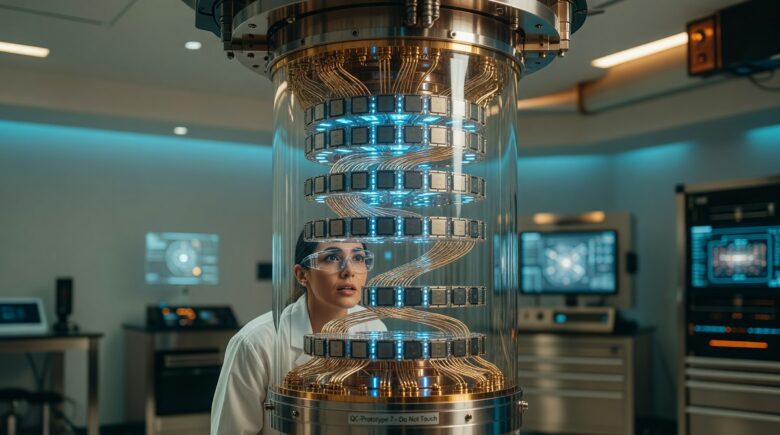
- Quantum Hardware: The Physical Machines Behind the Magic
- Real-World Applications Transforming Industries Now
- Quantum Threats to Cybersecurity and Encryption
- Who’s Winning the Quantum Race in 2025?
- Quantum Computing Explained: A Timeline to Commercial Reality
- Limitations and Challenges You Need to Understand
- What Quantum Computing Means for Everyday People
What Is Quantum Computing, Really?
At its core, quantum computing is a method of processing information that exploits the laws of quantum mechanics, the physics governing subatomic particles, to perform calculations in ways that are deeply different from traditional computers. Classical computers, from your laptop to the most powerful supercomputer on Earth, process information using bits. Each bit is either a 0 or a 1. That binary foundation has driven every computer ever built since the 1940s.
Quantum computers use qubits (quantum bits) instead. A qubit can exist as 0, 1, or both at the same time, a property called superposition. This isn’t science fiction; it’s observable physics, the same mechanics that govern how electrons behave inside atoms. That single difference unlocks computational power that scales exponentially rather than linearly.
Think of it this way: if classical computing is like flipping through a maze one path at a time, quantum computing explores all paths simultaneously. For certain types of problems, particularly those involving optimization, simulation, and pattern recognition, this makes quantum computers not just faster, but categorically different in capability.
The Origin of the Idea
The concept of quantum computing was first proposed by physicist Richard Feynman in 1982 and formalized by David Deutsch in 1985. Their central insight was that simulating nature at the quantum level requires a computer that itself operates quantum mechanically. For decades, it was pure theory. The first working qubit wasn’t demonstrated until 1998 at MIT and Los Alamos National Laboratory.
Progress was slow through the 2000s. But from 2016 onward, IBM, Google, and startups like IonQ and Rigetti began racing to build commercially accessible quantum hardware. IBM launched the first cloud-based quantum computer in 2016, allowing researchers worldwide to run experiments via the internet, a moment that shifted quantum from academic curiosity to engineering challenge.
Why “Quantum” Matters
Quantum mechanics describes how matter and energy behave at the smallest scales. These rules are strange, particles can be in multiple states at once, two particles can be “entangled” so that measuring one instantly affects the other, no matter the distance. These aren’t theoretical quirks; they’re experimentally verified phenomena that underpin lasers, MRI machines, and transistors. Quantum computing harnesses these same effects deliberately for computation.
Richard Feynman’s original 1982 paper argued that only a quantum computer could efficiently simulate quantum systems, a prediction that drug and materials companies are now racing to fulfill, with combined R&D investments exceeding $2 billion annually.
Classical vs. Quantum Computing: Key Differences
Understanding the difference between classical and quantum computing isn’t just academic, it determines which problems each type of machine can realistically solve. Classical computers are extraordinarily capable. They power everything from social media algorithms to airplane navigation systems. But they have hard limits when problem complexity scales exponentially.
A classic example: the traveling salesman problem. If a salesman needs to visit 10 cities, a classical computer can solve the optimal route quickly. At 30 cities, it requires more calculations than atoms in the observable universe. Quantum computers can approach such problems using quantum algorithms that drastically reduce the solution space.
| Feature | Classical Computing | Quantum Computing |
|---|---|---|
| Basic Unit | Bit (0 or 1) | Qubit (0, 1, or both) |
| Processing Style | Sequential / parallel | Quantum parallel (superposition) |
| Best For | Logic, data retrieval, streaming | Optimization, simulation, cryptography |
| Error Rate | Extremely low (<10^-15) | Currently 0.1–1% per operation |
| Operating Temp | Room temperature | Near absolute zero (-273°C) |
| Maturity | 70+ years, fully commercialized | ~30 years, early commercial phase |
When Classical Computers Win
Classical computers remain superior for most everyday tasks. Sending emails, browsing websites, editing videos, running databases, these are all tasks quantum computers would handle worse, not better. Quantum machines are not general-purpose replacements. They are specialized tools for specific high-complexity problem types.
The distinction matters because a lot of media hype implies quantum computers will simply replace laptops. They won’t, at least not in any near-term future. The realistic picture is a hybrid model: classical computers handling everyday tasks, quantum processors tackling specific bottlenecks in research, finance, logistics, and security.
When Quantum Computers Win
Quantum computers excel at problems with exponential complexity. Shor’s algorithm, developed in 1994 by mathematician Peter Shor, showed quantum computers could factor large numbers exponentially faster than classical machines, threatening the RSA encryption standard used by virtually every secure website. Grover’s algorithm can search unsorted databases quadratically faster. These aren’t marginal improvements; they represent fundamental leaps.
Google’s 53-qubit Sycamore processor completed a specific sampling task in 200 seconds in 2019. IBM’s best classical supercomputer at the time estimated it would take 10,000 years to perform the same calculation, a claim Google published in Nature.
How Qubits Work: Superposition, Entanglement, and Interference
Three quantum phenomena define how qubits deliver their power: superposition, entanglement, and interference. Understanding each one, at even a basic level, unlocks the rest of the quantum computing story. You don’t need the math; you need the concept.
Superposition: Being in Two States at Once
Superposition means a qubit can represent 0 and 1 simultaneously until it is measured. The moment you measure it, it “collapses” to either 0 or 1. Before measurement, it holds both possibilities in a probabilistic blend. Two qubits in superposition can represent four states at once (00, 01, 10, 11). Ten qubits represent 1,024 states simultaneously. Three hundred qubits represent more states than there are particles in the known universe.
This is not the same as a classical bit being “maybe 0 or maybe 1.” Superposition is a physical reality verified by decades of quantum experiments. It’s the reason quantum computers can explore massive solution spaces simultaneously rather than one option at a time.
Entanglement: Instant Correlation Across Distance
Quantum entanglement occurs when two qubits become linked so that the state of one instantly determines the state of the other, regardless of physical distance. Einstein famously called this “spooky action at a distance” and doubted its validity. He was wrong. Experiments by physicist John Bell in the 1960s and subsequent lab tests confirmed it unambiguously.
In quantum computing, entanglement allows qubits to coordinate their states without classical communication between them. This enables quantum algorithms to process correlated information in ways classical machines cannot replicate. Entanglement is what allows quantum computers to solve certain problems using exponentially fewer steps. As Andrew Wilson, a physicist at the National Institute of Standards and Technology (NIST), explains: “Entanglement means you’ve got at least two things that are always connected; they have no independent existence.”
Interference: Amplifying the Right Answers
Quantum interference is the mechanism by which quantum algorithms amplify correct answers and cancel out wrong ones. Quantum waves (probability amplitudes) can interfere constructively or destructively, similar to how sound waves can reinforce or cancel each other. Skilled quantum algorithm design uses interference to steer the computation toward correct solutions. This is what separates useful quantum algorithms from raw qubit power.
“It seems to me we’re just on the threshold of quantum systems doing genuinely new simulations that we can’t do classically.”

Quantum Hardware: The Physical Machines Behind the Magic
Building a quantum computer is one of the most technically demanding engineering challenges humanity has attempted. Qubits are extraordinarily fragile. Even the slightest vibration, electromagnetic interference, or temperature fluctuation causes decoherence, the collapse of quantum states before computation completes. This is why today’s quantum computers operate near absolute zero, colder than outer space.
There are currently several competing hardware approaches, each with different qubit types, error rates, and scalability profiles. No single approach has won yet, and billions of dollars are riding on each one.
| Qubit Type | Leading Company | Key Advantage | Key Limitation |
|---|---|---|---|
| Superconducting | IBM, Google | Fast gate speeds, scalable | Requires -273°C cooling |
| Trapped Ion | IonQ, Quantinuum | High fidelity, long coherence | Slower operations, hard to scale |
| Photonic | PsiQuantum, Xanadu | Room temperature, no decoherence | Difficult to implement 2-qubit gates |
| Topological | Microsoft | Inherently error-resistant | Not yet demonstrated at scale |
| Neutral Atom | Atom Computing, QuEra | Highly scalable, flexible connectivity | Slower than superconducting |
The Qubit Count Race
Raw qubit count is the most-cited metric in quantum computing, but it’s often misleading. A 1,000-qubit machine with high error rates may be less useful than a 100-qubit machine with near-perfect fidelity. The useful measure is quantum volume, a metric IBM developed that accounts for both qubit count and error correction capability.
IBM’s Condor processor reached 1,121 qubits in December 2023. Google’s roadmap targets a million-qubit system by the early 2030s. IonQ, using trapped ion technology, claims significantly higher fidelity per qubit despite lower counts. The winner of this race will likely be determined by who achieves fault-tolerant quantum computing first, a milestone where error correction makes computations reliably accurate.
Error Correction: The Central Unsolved Problem
Today’s quantum computers are classified as NISQ devices (Noisy Intermediate-Scale Quantum machines), a term coined by John Preskill in 2018. They have too many errors for most real-world applications. Error correction requires encoding one logical qubit across thousands of physical qubits to detect and fix mistakes mid-computation. IBM estimates fault-tolerant quantum computing will require machines with at least 100,000 physical qubits to perform reliably, a milestone they’re targeting for the early 2030s.
Many quantum computing announcements in the press confuse qubit count with actual capability. A 1,000-qubit machine with 1% error rates per operation can fail completely on circuits requiring more than 100 sequential steps. Always look for “quantum volume” or “circuit layer operations per second” metrics for a more honest picture.
Real-World Applications Transforming Industries Now
Despite being in an early, noisy phase, quantum computing is already delivering measurable impact in specific domains. The applications are not hypothetical future scenarios, companies are running quantum workloads on cloud platforms today, and some are already reporting results that classical computers couldn’t achieve in practical timeframes.
Drug Discovery and Life Sciences
Pharmaceutical companies are among the most aggressive quantum computing adopters. Modeling molecular interactions, the foundation of drug design, is a quantum mechanics problem. Classical computers approximate it, often inaccurately. Quantum computers simulate it directly. Biogen, Merck, and Roche have active partnerships with IBM and Google to explore quantum-assisted molecular simulation.
Pfizer has publicly stated that quantum simulations could cut the cost of drug development by a significant margin. Given that average drug development costs approximately $2.6 billion per approved drug according to a Tufts University study, even fractional savings represent hundreds of millions of dollars per molecule. This is why pharma is not waiting for perfect quantum hardware, they’re building the expertise now.
If you’re running drug discovery at a small biotech with a $5 million annual R&D budget and a 3-year timeline to get a candidate into preclinical trials, the math is worth paying attention to. A 30% reduction in the discovery phase, the kind of improvement quantum simulations are targeting, translates to roughly $1.5 million in savings and a full year of time. That’s the difference between a viable business plan and a missed window.
Financial Services and Portfolio Optimization
JPMorgan Chase, Goldman Sachs, and BBVA have all published research on quantum applications in finance. The use cases include portfolio optimization (selecting optimal investment combinations from thousands of assets), fraud detection, and risk modeling. JPMorgan’s quantum team demonstrated a 1,000x speed improvement in certain derivative pricing calculations using a hybrid quantum-classical approach in 2022.
For context on how emerging technologies are reshaping finance, our breakdown of how blockchain technology is changing personal finance covers a related wave of disruption hitting everyday banking. Quantum computing represents the next layer of that transformation, particularly in security and computational finance.
Logistics and Supply Chain
Volkswagen partnered with D-Wave Quantum to optimize traffic flow in Lisbon, reducing congestion by 17% in a 2019 pilot. DHL and Airbus have both run quantum optimization experiments for route planning and aircraft component scheduling. These are combinatorial optimization problems, exactly the category where quantum machines outperform classical ones as scale increases.
Amazon Web Services, Microsoft Azure, and IBM Cloud all offer quantum computing access as a paid service today. IBM’s Quantum Network includes over 400 member organizations, including Fortune 500 companies, universities, and national labs, running real quantum workloads right now.
Quantum Threats to Cybersecurity and Encryption
This is the section with the most immediate real-world stakes for every person reading this. The encryption protecting your bank account, medical records, and private messages relies on mathematical problems that are practically unsolvable by classical computers. Quantum computers threaten to make them trivially solvable.
RSA encryption, the bedrock of internet security, works because factoring a 2,048-bit number into its prime components would take a classical computer millions of years. Peter Shor’s algorithm, running on a sufficiently powerful quantum computer, reduces this to hours. A 2022 paper from the University of Sussex estimated that a quantum computer with 20 million qubits could break RSA-2048 in just 8 hours.
Harvest Now, Decrypt Later
The threat is not entirely in the future. Intelligence agencies and sophisticated adversaries are already conducting “harvest now, decrypt later” attacks, intercepting and storing encrypted data today, with the plan to decrypt it once quantum computers are powerful enough. Sensitive data with long-term value, including government secrets, medical records, and financial transactions, is particularly at risk.
The U.S. National Security Agency issued a 2022 directive urging critical infrastructure operators to begin transitioning to post-quantum cryptography (PQC) immediately. NIST finalized the first four post-quantum cryptographic standards in August 2024, a milestone that took eight years of global cryptographic research. NIST has finalized its principal set of encryption algorithms designed to withstand cyberattacks from a quantum computer, and organizations should now begin migrating their systems to quantum-resistant cryptography. For anyone concerned about how their financial data is protected, the intersection with protecting yourself from financial scams and identity theft is becoming increasingly relevant as quantum threats grow closer.
Post-Quantum Cryptography: The Defense
Post-quantum cryptography involves developing new encryption algorithms based on mathematical problems that quantum computers also struggle to solve, such as lattice-based cryptography. NIST’s 2024 standards, CRYSTALS-Kyber for key encapsulation and CRYSTALS-Dilithium for digital signatures, are already being integrated into browsers, VPNs, and government systems. The migration won’t happen overnight. Security experts estimate full industry adoption will take 10–15 years.
The global post-quantum cryptography market is projected to grow from $240 million in 2023 to $17.69 billion by 2030, according to Grand View Research, a compound annual growth rate of 37.8%, driven almost entirely by quantum computing risk.

Who’s Winning the Quantum Race in 2025?
The quantum computing race has geopolitical dimensions that extend well beyond corporate competition. National security, pharmaceutical leadership, financial dominance, and AI advancement all intersect with quantum capability. The players are no longer just tech companies, they include sovereign governments treating quantum supremacy as a strategic priority equivalent to nuclear capability in the 20th century.
| Country/Company | Investment (2020–2024) | Qubit Milestone | Key Advantage |
|---|---|---|---|
| United States | $3.7B (government) | 1,121 qubits (IBM, 2023) | Private sector depth, cloud access |
| China | $15B+ (government) | 176 qubits (USTC, 2023) | Largest state investment globally |
| European Union | $7.2B (Quantum Flagship) | Various national labs | Coordinated research, PASQAL |
| United Kingdom | $3B (National QC Strategy) | Quantinuum H2 (56 qubits) | Highest fidelity trapped ion |
| $1B+ (Alphabet) | 72 qubits (Bristlecone) | Quantum supremacy claims, AI integration |
IBM’s Roadmap Strategy
IBM has been the most transparent about its roadmap. The company publishes annual updates targeting specific qubit milestones and error correction breakthroughs. Its 2023 Condor processor (1,121 qubits) and Heron processor (133 qubits, significantly reduced error rates) represent a deliberate strategy: demonstrate scale with Condor, demonstrate quality with Heron. IBM’s stated goal is 100,000 physical qubits by 2033, with error-corrected logical qubits capable of solving commercially valuable problems.
IBM’s cloud-based Quantum Network gives it another structural advantage: 400+ member organizations are building quantum expertise on IBM hardware today. When fault-tolerant machines arrive, those organizations will already know how to use them.
Google’s Quantum AI Division
Google’s quantum work is closely integrated with its AI research division. The company’s 2019 quantum supremacy paper in Nature, claiming its Sycamore processor outperformed classical computers by a factor of 10,000 years vs. 200 seconds, was challenged but never definitively refuted. In 2023, Google published results showing its quantum processor could model certain quantum phenomena that no classical simulation could match at any practical scale. The intersection of quantum computing and AI is an area where Google has the deepest cross-disciplinary expertise.
China’s Patent Dominance
China’s quantum investment is not just about scientific prestige. It is about strategic capability in cryptography, materials science, and AI. By 2024, China held 60% of quantum patents globally, according to an MIT Sloan Initiative on the Digital Economy report. The country that achieves fault-tolerant quantum computing first gains a decade-long asymmetric advantage. Meanwhile, publicly announced venture capital investments in quantum computing firms reached $1.6 billion in 2024, signaling that private capital is now flowing alongside government funding at unprecedented scale.
Quantum Computing Explained: A Timeline to Commercial Reality
One of the most common frustrations in following quantum computing is timeline confusion. Every year, headlines announce breakthroughs. Every year, “commercial reality” seems to shift further out. This section lays out the realistic phases ahead.
| Phase | Timeframe | Capability | Commercial Impact |
|---|---|---|---|
| NISQ Era | Now – 2028 | Noisy, small qubit counts | Limited to research and narrow proofs of concept |
| Early Fault-Tolerant | 2028 – 2033 | 100s of logical qubits | Drug simulation, financial optimization, ML training |
| Full Fault-Tolerant | 2033+ | Millions of physical qubits | Cryptography, full molecular simulation, AGI support |
Quantum Advantage vs. Quantum Supremacy
Quantum supremacy (now often called “quantum advantage”) means a quantum computer solved a specific problem faster than any classical computer could. Google claimed this in 2019. But supremacy on a contrived benchmark is different from practical quantum advantage, solving a real-world problem better, cheaper, or faster than classical computing in a commercially relevant context.
Most experts agree the first undisputed practical quantum advantage for a commercially relevant problem will arrive between 2026 and 2028, likely in molecular simulation for drug discovery or materials science. Timeline predictions have consistently been optimistic, so building in a 2–3 year buffer is wise. Enterprise interest is already materializing: enterprise spending on quantum computing reached $550 million in 2025, according to Boston Consulting Group, a figure that signals early commercial adoption is underway even before fault-tolerant hardware arrives.
If you’re evaluating quantum computing investments or career opportunities, focus on the software and algorithm layer rather than hardware. The hardware race is capital-intensive and winner-take-few, but quantum software, error correction algorithms, and application development are open competitive fields with significantly lower barriers to entry.
Limitations and Challenges You Need to Understand
The quantum computing narrative in mainstream media often glosses over the profound engineering challenges that remain unsolved. Understanding these limitations is essential for separating legitimate breakthroughs from hype, and for making sensible decisions about when to pay attention vs. when to wait.
Decoherence and Noise
Decoherence is the fundamental enemy of quantum computing. It refers to quantum states degrading due to interaction with the environment, heat, vibration, electromagnetic fields, even cosmic rays. Current superconducting qubits maintain coherence for microseconds to milliseconds. Running useful algorithms often requires millions of operations. The math doesn’t yet work at room temperature or for long computations without aggressive error correction.
The cooling infrastructure alone represents a massive practical barrier. IBM’s quantum computers operate at 15 millikelvin, about 180 times colder than outer space. The dilution refrigerators required cost $500,000 to $1 million each and take days to cool down. Scaling to millions of qubits while maintaining these conditions is an unsolved engineering problem of enormous proportions.
The Talent Gap
Quantum computing requires expertise at the intersection of physics, computer science, mathematics, and engineering. The global supply of people with relevant doctoral-level training is measured in the thousands. A McKinsey analysis found a potential shortfall of 6,000–10,000 quantum-ready engineers by 2025 across the U.S., EU, and China combined. Universities are expanding programs aggressively, but training quantum engineers takes 6–10 years.
This talent dynamic creates opportunities. Companies like IBM, Google, and quantum software startups are actively recruiting people with strong mathematics and classical computing backgrounds and training them in quantum methods. The intersection of AI and quantum computing is particularly talent-hungry, an area where, just as AI tools are saving businesses time today, quantum-enhanced AI could transform enterprise computing in the next decade.
Software and Algorithm Immaturity
Even if perfect hardware existed tomorrow, the software ecosystem would not be ready to exploit it. Quantum algorithms that demonstrate clear advantage over classical alternatives are known for only a handful of problem types. Writing useful quantum software requires deep expertise. The tooling is primitive compared to classical software development, debugging a quantum program is fundamentally different from classical debugging, because measuring a quantum state destroys it.
Many companies claiming “quantum-powered” products today are using classical simulations of quantum processes, not actual quantum hardware. This is not necessarily fraudulent, but it means results do not scale to the levels real quantum hardware would eventually achieve. Always ask whether a product runs on actual quantum hardware or a classical quantum simulator.
What Quantum Computing Means for Everyday People
You may not be a physicist, cryptographer, or pharmaceutical researcher. So what does quantum computing actually mean for your daily life? The honest answer is: not much in the next two years, quite a lot by the mid-2030s. The changes will be mostly invisible, embedded in the systems you already use, rather than a new device you buy.
Your Data Security Will Change
The most immediate impact on everyday people is the migration to post-quantum cryptography. Your bank, email provider, and healthcare portal will need to update their encryption over the next 5–10 years. For most users, this will be invisible, like when websites migrated from HTTP to HTTPS. But if these migrations are delayed or poorly executed, the window of vulnerability created by quantum computing could expose financial and medical data to retrospective decryption.
The connection to personal financial security is direct. Digital banking trends are already transforming how money is managed, and as explored in our coverage of digital banking trends that are changing how people manage money, the security infrastructure underlying these systems will need quantum-resistant upgrades within the decade. NIST has published detailed guidance on transitioning from quantum-vulnerable cryptographic algorithms to post-quantum digital signature algorithms and key-establishment schemes, a process that every financial institution will need to follow.
Medicines and Materials of the Future
The drugs you take in 2035 may have been discovered with quantum computing assistance. Quantum simulation of protein folding and molecular bonding will enable researchers to design more effective drugs with fewer side effects, and to test them computationally before expensive clinical trials. Materials science will similarly benefit, new battery chemistries, more efficient solar cells, and lighter-weight alloys could all emerge from quantum-simulated materials discovery.
AI Will Accelerate Faster
Quantum computing and artificial intelligence are not competing technologies, they are deeply complementary. Quantum algorithms can accelerate certain machine learning tasks, particularly optimization of neural network architectures and training data sampling. As AI systems grow in complexity, classical computing bottlenecks in training will become acute. Quantum-accelerated AI training is one of the most commercially compelling long-term use cases. For those tracking AI’s current momentum, the growth of AI-powered investment platforms gives a preview of how quantum-enhanced AI could reshape financial decision-making within a decade.
“Quantum computers work by harnessing quantum physics… and have the potential to rapidly crunch through certain problems that would take current computers years.”
IBM has a free online learning platform called IBM Quantum Learning that teaches quantum computing concepts from scratch, with interactive circuit builders and real access to quantum hardware. Over 500,000 people have completed modules on the platform, no physics degree required.

Real-World Example: How a Pharmaceutical Company Cut Drug Discovery Time by 40%
In 2022, Boehringer Ingelheim, one of the world’s largest privately held pharmaceutical companies, with $24 billion in annual revenue, signed a three-year quantum computing partnership with Google’s Quantum AI division. Their target: simulating the molecular behavior of cytochrome P450 enzymes, a family of proteins central to drug metabolism and notoriously difficult to model classically. Prior classical simulations of these enzymes required weeks of supercomputer time and still produced approximations with known accuracy gaps.
Using Google’s quantum processors via cloud access, Boehringer’s research team ran hybrid quantum-classical simulations that captured electron correlation effects classical methods routinely missed. The first 18 months of the partnership produced molecular models with 15–20% greater accuracy than the best prior classical results. More importantly, the team identified three previously overlooked binding configurations in a target molecule, configurations that would have required 18–24 additional months to discover through classical trial-and-error screening.
The business impact was direct: one of those binding configurations became the basis for an optimized drug candidate that entered preclinical trials in Q3 2023, an estimated 14 months ahead of the schedule that classical methods would have produced. Boehringer publicly stated that the quantum-assisted phase of the project cost approximately $4.2 million in cloud computing and personnel, compared to an estimated $18–22 million the equivalent classical compute time and extended timeline would have required.
The case illustrates quantum computing’s current reality precisely: not a wholesale replacement of classical research, but a targeted accelerator at specific computational bottlenecks where the return on investment is already measurable in the tens of millions of dollars per project. As hardware improves, Boehringer has committed to expanding the program to cover 12 additional molecular targets by 2026, a signal that the ROI case has crossed the threshold from theoretical to proven.
Your Action Plan
-
Build Your Foundational Understanding First
Before engaging with any quantum computing product, investment, or career decision, invest 5–10 hours in foundational education. IBM Quantum Learning (free), MIT OpenCourseWare’s quantum computation course (free), and Michael Nielsen and Isaac Chuang’s textbook “Quantum Computation and Quantum Information” are the three best starting points, in ascending order of depth. You do not need to understand the full mathematics to grasp the strategic implications.
-
Audit Your Personal Data Security Posture
Check whether your most sensitive service providers, bank, email, health portal, have published timelines for post-quantum cryptography migration. Most major banks and Google have already begun. If your financial institution has no published plan, that’s a meaningful risk signal worth factoring into your decisions. Use NIST’s post-quantum cryptography resource page as your reference standard.
-
Separate Quantum Hype from Quantum Reality
When you see a quantum computing headline, ask three questions: Was this tested on real quantum hardware or a classical simulator? Does the performance claim come from a peer-reviewed publication or a press release? Does the claimed advantage apply to a commercially relevant problem or a contrived benchmark? Most breathless quantum headlines fail at least one of these tests. The IBM Quantum blog and Nature journal are the most reliable non-hype sources.
-
If You Work in Finance or Tech, Start Learning Quantum Algorithms
Quantum advantage will arrive first in finance, pharmaceuticals, and logistics optimization. If you work in any of these fields, understanding the basics of Shor’s algorithm, Grover’s algorithm, and the Variational Quantum Eigensolver (VQE) will position you ahead of 95% of your colleagues. Qiskit (IBM’s open-source quantum programming framework) is free, well-documented, and runs on a laptop via simulation.
-
Track the Right Milestones, Not the Wrong Ones
Stop tracking raw qubit counts as the key metric. Start tracking: logical qubit demonstrations (not physical), fault-tolerant circuit depth achievements, and peer-reviewed practical advantage claims in real applications. IBM’s annual quantum roadmap updates and Google’s Nature publications are the two most reliable progress indicators. Set a calendar reminder to review these once per year.
-
Evaluate Career and Investment Angles Carefully
If you’re considering quantum computing as a career pivot or investment theme, focus on the software and application layer rather than hardware. Hardware competition is brutal, capital-intensive, and likely to produce one or two dominant players. Quantum software, error correction R&D, quantum networking, and application development for specific industries (pharma, finance) represent less capital-intensive but highly talent-dependent opportunities with strong growth trajectories through the 2030s.
-
Watch China and the Geopolitical Dimension
China’s $15+ billion quantum investment is not primarily about scientific research, it’s about strategic capability in cryptography and surveillance. Monitor U.S. export controls on quantum hardware and software (which began in 2023), EU quantum sovereignty initiatives, and NIST’s post-quantum cryptography standard adoption timelines. The geopolitical trajectory of quantum computing will shape which companies, universities, and nations lead, and who gets access to what.
-
Revisit This Topic Every 12 Months
Quantum computing is advancing rapidly enough that an understanding formed today will be partially outdated in 18 months. Set an annual review of your quantum knowledge base. The milestones to watch in the next 12 months include IBM’s next processor release, any new peer-reviewed practical advantage claims, NIST’s post-quantum cryptography adoption metrics, and Google’s next Quantum AI publication. This topic rewards sustained attention more than any single deep dive.
Frequently Asked Questions
Will quantum computers make my laptop or smartphone obsolete?
No, not in any realistic timeframe. Quantum computers are specialized tools for specific problem types, not general-purpose replacements for classical machines. Your laptop handles email, video, web browsing, and most software tasks far more efficiently than any quantum computer. The realistic future is a hybrid model where classical computers handle everyday computing and quantum processors tackle narrow but high-value scientific and optimization problems via cloud services.
When will quantum computers be available to the general public?
Cloud-based quantum computing is already available to the public today. IBM Quantum Network offers free access to real quantum processors via the web. Amazon Braket, Google Quantum AI, and Microsoft Azure Quantum all offer pay-per-use quantum computing. What isn’t available, and won’t be for at least a decade, is a fault-tolerant quantum computer capable of solving commercially transformative problems reliably. General public impact will come indirectly through products built on quantum-enhanced research, not through direct personal use of quantum devices.
Is quantum computing related to quantum physics?
Yes, directly. Quantum computing applies the principles of quantum mechanics, specifically superposition, entanglement, and interference, to information processing. You don’t need to understand quantum physics deeply to use quantum computing tools, just as you don’t need to understand semiconductor physics to use a smartphone. But the underlying physical laws are why quantum computers behave so differently from classical machines.
How is quantum computing different from AI?
These are distinct but increasingly complementary technologies. Artificial intelligence is a software approach to pattern recognition and decision-making, typically running on classical computer hardware. Quantum computing is a hardware and algorithmic paradigm that processes information using quantum mechanics. Quantum computing can potentially accelerate certain AI tasks, particularly optimization and certain machine learning operations, but they are not the same thing, and most current AI applications do not require quantum computing.
Can quantum computers hack into any system right now?
No. Current quantum computers are too small and error-prone to run the complex quantum algorithms needed to break modern encryption. Shor’s algorithm, the algorithm that would threaten RSA encryption, requires a fault-tolerant machine with millions of high-quality qubits. Today’s best machines have thousands of noisy physical qubits. The threat is real and urgent for long-lived sensitive data, but it is not an immediate operational risk for most systems today. Preparation for the quantum threat should begin now, but panic is not warranted.
What is quantum supremacy and has it been achieved?
Quantum supremacy (now often called quantum advantage) means a quantum computer performed a specific task faster than any classical computer could in a practical timeframe. Google claimed this milestone in October 2019, when its Sycamore processor completed a sampling task in 200 seconds that Google estimated would take 10,000 years on classical hardware. The claim was disputed by IBM, which argued improved classical algorithms could do the task in 2.5 days. The scientific consensus is that Google achieved a meaningful milestone, but the specific task was not commercially useful, making it more a proof of concept than a practical breakthrough.
How does quantum computing relate to blockchain or cryptocurrency?
Quantum computing poses a long-term threat to the cryptographic foundations of most current blockchains. Bitcoin and Ethereum rely on elliptic curve cryptography, which a sufficiently powerful quantum computer running Shor’s algorithm could break. Current quantum hardware is nowhere near capable of this attack, but blockchain developers are actively researching quantum-resistant cryptographic upgrades. If you’re interested in how emerging technologies intersect with cryptocurrency, our guide to crypto investing for beginners provides relevant context on how Bitcoin and Ethereum currently operate.
What industries will be affected first by quantum computing?
Pharmaceutical and materials science research will likely see the first commercially proven quantum advantage, expected between 2026 and 2029. Financial services, specifically portfolio optimization and derivatives pricing, are a close second. Cybersecurity and cryptography will be transformed by quantum threats and post-quantum defenses over the same period. Logistics, energy, and artificial intelligence training are medium-term (2028–2033) beneficiaries. Consumer applications are 10+ years away from meaningful quantum impact.
How much money is actually being spent on quantum computing right now?
Enterprise spending on quantum computing reached $550 million in 2025, according to Boston Consulting Group. Venture capital investments in quantum firms hit $1.6 billion in 2024, per the MIT Sloan Initiative on the Digital Economy. Government spending is even larger: China has committed more than $15 billion, the U.S. $3.7 billion, and the EU $7.2 billion through its Quantum Flagship program. These figures confirm that quantum computing has moved from lab experiment to a fully funded industrial race.
Is there a simple way to think about what a qubit does that a bit can’t?
The most accurate simple analogy: a classical bit is like a coin lying flat, it’s either heads (1) or tails (0). A qubit is like a coin spinning in the air, it’s in a superposition of heads and tails simultaneously until it lands (is measured). With 300 spinning coins, you can explore all 2^300 possible outcomes at once. With 300 classical bits, you check one combination at a time. That’s the core computational difference, and it’s why certain problems that are intractable for classical computers become feasible for quantum ones.
Sources
- McKinsey & Company, Quantum Technology Sees Record Investments, Progress on Talent Gap
- IBM Research, IBM Quantum Development Roadmap
- Nature, Quantum Supremacy Using a Programmable Superconducting Processor (Google Sycamore)
- NIST, First Three Finalized Post-Quantum Encryption Standards Released
- Quantum Computing Report, Qubit Count Progress Tracker
- IBM Quantum Blog, Latest Research and Hardware Updates
- arXiv / University of Sussex, Quantum Computing Hardware Required to Break RSA-2048 Encryption
- U.S. Department of Defense, DoD Releases Quantum Information Science Strategy
- Grand View Research, Post-Quantum Cryptography Market Size and Forecast Report
- Boston Consulting Group (BCG), CEOs Need to Shape Where Quantum Creates Value (2026)
- NIST, Quantum Computing Explained
- NIST, Post-Quantum Cryptography Project
- NIST, Transitioning to Post-Quantum Cryptography Standards (IR 8547)