Fact-checked by the ZeroinDaily editorial team
Quick Answer
To decide between TSA PreCheck vs Global Entry, match your travel patterns to the fees: Global Entry costs $120 for five years and includes TSA PreCheck, so it’s the better value if you take even one international trip a year. PreCheck alone starts at $77.95 and suits domestic-only flyers who want fast security without the customs benefit.
You’ve just booked a March getaway to London. The flight’s sorted, the hotel’s pinned, and then the boarding pass arrives without the little “TSA Pre✔” stamp. Now you’re standing in the security queue, fumbling with your belt while the family lane zips by. That moment, when you realize you could have been through in under five minutes, is the moment the “TSA PreCheck vs Global Entry” question stops being theoretical.
The numbers make the stakes concrete., 20 million travelers held an active TSA PreCheck membership, and Global Entry enrollment has swelled in parallel as international travel volumes rebounded beyond 2019 levels. The hassle you skip isn’t trivial: TSA data shows PreCheck lanes kept wait times under 10 minutes for the majority of passengers, a stark contrast to standard lanes that routinely stretch past 30 minutes at peak hours.
This guide unpacks both programs down to the wires, the kiosks, and the credit card credits. By the end, you’ll know exactly which one fits your travel style, what the 2025 policy changes mean for your benefits, and how to avoid the application delays that trap first-timers. No generic comparison, just a step-by-step path to the right fast track.
Key Takeaways
- Global Entry includes full TSA PreCheck benefits for five years, so the total cost difference against PreCheck alone is just $42.05 (or less if you catch a provider discount), a gap that disappears with a single international trip. (CBP Global Entry)
- TSA PreCheck enrollment can be completed at over 1,000 locations nationwide, and the lowest five-year fee dropped to $77.95 through Telos, making the domestic-only choice cheaper and more accessible than ever. (TSA press release, Aug 8 2024)
- Global Entry application processing can now exceed 90 days according to DHS, so applying close to an international trip is risky, many travelers start months in advance or stick with PreCheck and the free Mobile Passport Control app. (CBP How to Apply)
- DHS ended the mandatory shoes-off rule for all travelers in 2025, diminishing one of PreCheck’s most-advertised perks; the real edge now lies in the dedicated lanes and the customs fast-track Global Entry provides. (USA Today, March 2025)
- Kids 12 and under ride free with a parent’s PreCheck, but every child, even an infant, needs their own (now fee-free) Global Entry membership and interview, a detail that reshapes the math for families. (CBP Global Entry)
- Over 80% of Global Entry applications are approved within two weeks once the interview step is reached, but the bottleneck is landing that interview, many applicants schedule months out or use appointment scanners to grab earlier slots. (CBP How to Apply)
In This Guide
- Step 1: What’s the Real Difference Between TSA PreCheck and Global Entry?
- Step 2: How Much Does TSA PreCheck Cost vs Global Entry in 2025?
- Step 3: How Long Does Global Entry Approval Really Take?
- Step 4: Which One Fits Your Travel Style? A 3-Profile Breakdown
- Step 5: How the 2025 Shoes-Off Rule Change Affects Your Decision
- Step 6: Free and Low-Cost Alternatives: Mobile Passport, Airline Digital ID, CLEAR
- Step 7: Applying and Renewing Without the Surprises
Step 1: What’s the Real Difference Between TSA PreCheck and Global Entry?
The single biggest point of confusion in the TSA PreCheck vs Global Entry debate is that Global Entry isn’t a competitor to PreCheck, it’s PreCheck plus a customs fast-track. Membership in Global Entry automatically includes full TSA PreCheck benefits for domestic airport security, a nesting relationship the Transportation Security Administration makes explicit: “Global Entry provides expedited U.S. customs screening for international air travelers when entering the United States,” and because all Global Entry members are assigned a Known Traveler Number, they also get PreCheck’s dedicated security lanes.
Here’s the practical translation. With TSA PreCheck alone, you breeze through airport security on domestic departures: leave your shoes on, keep your laptop and 3-1-1 liquids in your bag, and skip the full-body scanner in many cases. But when you return from London or Cancún, you’re in the same customs line as every other passenger. Global Entry layers on top a separate, dedicated lane at U.S. customs where you walk up to a kiosk (or use a mobile app), scan your face, answer a few declaration questions, and hand the printed receipt to the officer, all while the main queue snakes through switchbacks.
The eligibility pool creates another split most comparisons gloss over. TSA PreCheck is open to U.S. citizens, nationals, and lawful permanent residents only. Global Entry, by contrast, invites citizens of select partner countries, the United Kingdom, Germany, India, and others, to apply, making it the only way for many frequent international visitors to get expedited entry.
If you take fewer international flights, consider enrolling in TSA PreCheck and using the Mobile Passport Control app instead of Global Entry.
How the Screening Tech Differs Under the Hood
While both programs lean on biometrics, the hardware and experience diverge. TSA PreCheck uses Credential Authentication Technology (CAT-2) units at many airports, which match your live photo to your ID photo in seconds, no boarding-pass scan required. Still, your identity is being verified against a document, not against a government database of vetted travelers in real time. Global Entry uses dedicated facial-recognition kiosks and, in select airports, touchless portals that capture your face upon arrival and compare it to the photo on file from your enrollment. Department of Homeland Security testing found its facial capture and matching technology performed at over 99% accuracy overall, though internal reviews noted a lower 98% success rate for Black travelers, a nuance that matters if you’re weighing privacy and accuracy trade-offs.
The bottom line: TSA PreCheck speeds security; Global Entry speeds both security and customs. Which one you need comes down to how often you’ll see a blue customs booth.

Step 2: How Much Does TSA PreCheck Cost vs Global Entry in 2025?
Global Entry’s fee is a flat $120 for five years, non-refundable, payable to the Department of Homeland Security. TSA PreCheck’s pricing, however, is more fragmented, and that’s the first thing you need to know before you swipe your credit card. The base cost through the official TSA enrollment provider Idemia is $85, but competing enrollment vendors like Telos have pushed the price down to $77.95, and you can occasionally find even lower promotional rates through membership organizations.
| Program | Five-Year Fee | What’s Included |
|---|---|---|
| TSA PreCheck (Telos) | $77.95 | Expedited security only |
| TSA PreCheck (Idemia) | $85 | Expedited security only |
| Global Entry (CBP) | $120 | Expedited customs + full TSA PreCheck benefits |
Do the Real Math with Your Own Travel Schedule
If you take one international trip a year, the difference boils down to small change when you calculate it per month. At the higher PreCheck rate of $85 for five years, you’re paying $1.42 per month. Global Entry stretches to $2.00 per month, a 58-cent monthly premium that buys you the ability to skip the hour-long customs line every time you land. Over five years, that’s a total of $35 more for Global Entry than the most expensive PreCheck path, or $42.05 more compared to Telos’s cheapest PreCheck. For many travelers, a single stress-free re-entry after a long-haul flight justifies that difference.
Many premium travel credit cards offer a $120 statement credit every four to five years for Global Entry or TSA PreCheck, essentially making either program free. Cards like the Chase Sapphire Reserve and Capital One Venture X carry this perk, as do several airline co-branded cards. If your card is among the best travel credit cards for frequent flyers, check your benefits before paying out of pocket.
Step 3: How Long Does Global Entry Approval Really Take?
The “two weeks” figure you’ll see in older guides is largely a ghost., DHS warns that new Global Entry applications can exceed 90 days from submission to conditional approval, with some stretching to four months. That timeline disrupts anyone applying a month before a trip. TSA PreCheck, by contrast, typically processes applications in 3 to 5 days after the 10-minute in-person fingerprint visit, with the Known Traveler Number available almost immediately once approved.
The bottleneck is the interview. Even after receiving conditional approval (which means your background check passed), you must schedule an in-person interview at a Global Entry Enrollment Center. In major cities, slots can be booked solid for weeks. A workaround many travelers use is “Enrollment on Arrival,” a CBP program that lets conditionally approved applicants complete the interview without an appointment when returning from an international trip, just walk to the CBP office in the arrivals hall. That tactic converts the delay into a souvenir you pick up on the way home.
What Slows a Global Entry Application Down
A handful of factors lengthen the wait. Name mismatches between your passport and application trigger manual review. Recent international travel to high-risk countries, even for tourism, can extend the vetting process. Minor criminal records, including long-expunged offenses, may require additional paperwork. None of these are automatic denials, but each can add weeks. If you have a clean record and a straightforward travel history, the odds are still strong that you’ll land in the over 80% of applicants approved within two weeks of completing the interview, according to CBP data.
Don’t let your Global Entry membership lapse before renewing. You can apply for renewal up to six months before expiration, and if you miss that window and the membership expires, you must submit a fresh application and go through the full vetting and interview process again, not just pay a fee.
Step 4: Which One Fits Your Travel Style? A 3-Profile Breakdown
DHS’s own guidance gives the clearest decision rule: TSA recommends PreCheck for travelers flying three or more times a year, and CBP recommends Global Entry specifically for those taking four or more international trips annually. But those are thresholds, not rigid mandates. Translating them into real traveler profiles exposes the right answer for most people.
Profile 1: The Domestic-Only Flyer
You fly out of Atlanta, Denver, or Seattle a few times a year, but never cross an ocean. TSA PreCheck wins outright. The Telos enrollment path keeps your cost at $77.95, your approval comes in under a week, and you never need to schedule a formal interview. You’ll keep your shoes on (though that’s no longer a PreCheck-exclusive perk, more on that in Step 5), your laptop in your bag, and you’ll typically clear security in under 10 minutes. Meanwhile, every dollar spent on Global Entry’s customs benefit sits unused.
Profile 2: The Occasional International Traveler (1–2 Trips a Year)
This is where most people get stuck. You visit family in Mexico once a year or take a European vacation every other summer. At $120 for five years, Global Entry essentially buys you PreCheck plus a customs lane you’ll use twice a year, for a premium of about $7 per re-entry over the standard PreCheck fee. Even if you go international just once annually, the time saved on customs, often 30 to 60 minutes per arrival, makes the math look good. If your home airport supports Enrollment on Arrival, you can skip the appointment stress and effectively get Global Entry after your first international trip of the five-year term. This profile leans Global Entry unless you have a pressing need for immediate PreCheck benefits and can’t wait for Global Entry’s approval timeline.
Profile 3: The Frequent International Flyer (4+ Trips a Year)
Get Global Entry. No debate. The bundled customs and security benefits pay for the $120 fee before your second trip. Pair it with a premium credit card that reimburses the application fee, and you’re out $0. If you also want to guarantee the absolute fastest security lane regardless of the general PreCheck line, layer CLEAR on top (a private membership that confirms identity with your eyes or fingers and bumps you to the front of the PreCheck queue). The best travel credit cards for frequent flyers often cover CLEAR’s annual fee, too, creating a zero-cost speed stack.
Step 5: How the 2025 Shoes-Off Rule Change Affects Your Decision
For years, the most visceral reason to get TSA PreCheck was simple: you kept your shoes on while everyone else shuffled through in socks. In early 2025, DHS ended the mandatory shoe-removal policy for all travelers at domestic checkpoints, erasing that single-bullet advantage. The change means the general security lane no longer forces every passenger to untie laces, which siphons off some of PreCheck’s most marketable convenience.
However, PreCheck still holds onto every other major perk: your laptop and 3-1-1 bag stay inside your carry-on, you don’t remove belts or light jackets, and you funnel through a dedicated lane where wait times are consistently under 10 minutes. The real re-framing: the shoe rule change shifts the TSA PreCheck vs Global Entry calculus toward Global Entry’s customs-side value, because that benefit remains untouched by checkpoint policy shifts. If you were leaning Global Entry but procrastinating because PreCheck felt “good enough,” the shoes decision removes a reason to stall, the real time-saver is now on the arrivals end.
Even without shoes-off drama, PreCheck lanes still move faster because TSA staffs them with fewer secondary screening procedures, fewer random bag checks, no full-body scanner requirements for most adults, and a smaller pool of experienced travelers who know the drill.
Step 6: Free and Low-Cost Alternatives: Mobile Passport, Airline Digital ID, CLEAR
You don’t have to pay government fees at all. The Mobile Passport Control (MPC) app, run by CBP, is a free download that lets U.S. citizens and Canadian visitors submit their passport info and customs declaration from their phone upon landing, then use a dedicated “Mobile Passport” lane at many airports. It doesn’t require an interview, application, or fee, and at some airports, the MPC line is nearly as fast as Global Entry. The tradeoff: MPC is being phased out at a few ports (Dulles was an early cut) while expanding at others, so it’s not universally available. For travelers who take fewer international flights, CBP literally recommends pairing TSA PreCheck with Mobile Passport Control as a low-cost alternative to Global Entry.
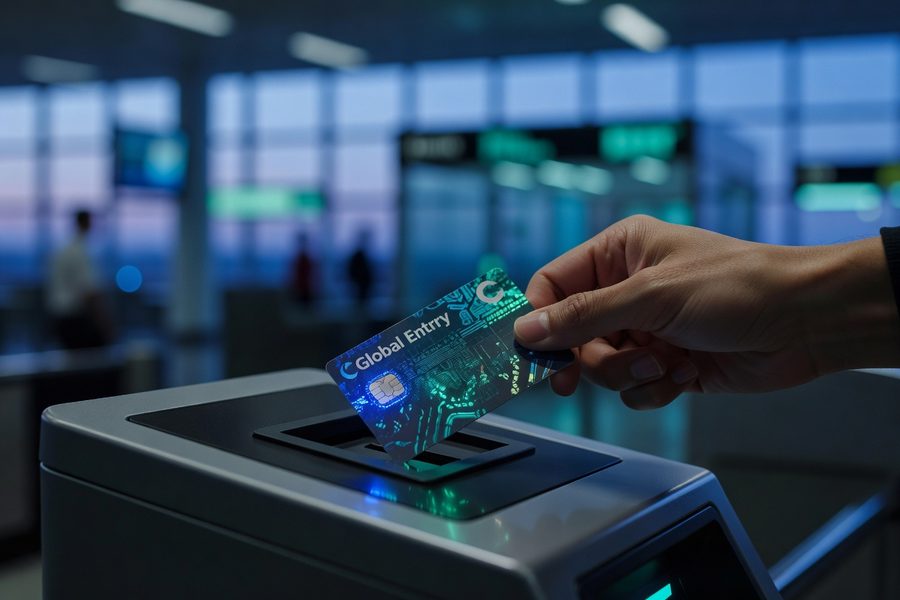
The main difference between Global Entry, TSA PreCheck, and other Trusted Traveler Programs is the type of expedited screening they provide.
Airline Digital ID and Biometric Programs
A parallel ecosystem is emerging from the private sector. Delta’s Digital ID and United’s biometric verification allow travelers to pass through security using facial recognition linked to their frequent flyer profile and passport, no physical ID or boarding pass needed, in participating airports. These programs don’t replace government trust status, but they can shorten the identity check at the TSA travel document checker, effectively mimicking the speed of PreCheck for that step. Combined with a budget travel strategy that maximizes every perk, these airline-run options fill gaps for domestic travelers who aren’t ready to pay $85 yet still want a streamlined experience.
CLEAR vs. the Federal Programs
CLEAR is a different beast entirely: a private company that uses your eyes or fingerprints to confirm your identity, then escorts you to the front of the PreCheck line (or standard lane, if you don’t hold PreCheck). Membership costs $199 per year, with family discounts available. It doesn’t confer PreCheck benefits, it only verifies your identity faster. If you hold both CLEAR and TSA PreCheck, you effectively get a VIP lane where you skip the ID check entirely and still keep your laptop in the bag. But CLEAR is only valuable if you fly out of airports where it operates and if the time saved at the identity check is worth the steep annual fee. For most travelers, the money is better spent on Global Entry or simply saved via the fee-free Mobile Passport app.
Step 7: Applying and Renewing Without the Surprises
The application flow for both programs is a three-act play: online form, payment, in-person step, but the in-person chapter is where they diverge sharply. For TSA PreCheck, you fill out the online application in 15 minutes, pay your fee, and then visit one of over 1,000 enrollment centers for a 10-minute fingerprinting appointment. Approval lands in 3–5 days. For Global Entry, the online application is longer (detailed travel history back five years), the conditional approval wait can stretch months, and the in-person interview, either at an enrollment center or via Enrollment on Arrival, is a formal conversation with a CBP officer. The points-maximizing traveler can offset any fee with the right card, but the time investment is the real currency.
Renewal Shortcuts That Save Headaches
Both programs allow online renewal up to six months before expiration. For Global Entry, many renewal applicants receive approval with no interview required, a “renewal without interview” decision that bypasses the entire center-scheduling ordeal. Just submit the renewal, pay the fee, and wait. TSA PreCheck renewal is even simpler: complete the online form, pay the reduced renewal fee (currently $58.75 to $70, depending on provider), and your KTN stays active without a new in-person visit. If you let either membership lapse, you’re back to square one with a full new application, so set a calendar reminder for month five before expiration.
Over 80% of Global Entry renewal applications are approved without an interview, according to CBP data, dramatically lowering the renewal friction compared to first-time enrollment.

Frequently Asked Questions
Does Global Entry include TSA PreCheck?
Yes. Every Global Entry member automatically receives full TSA PreCheck benefits for domestic flights, because Global Entry provides a Known Traveler Number that works for both programs. You don’t need to apply separately or pay anything extra, just enter your KTN in your airline reservation.
Can I use Global Entry for domestic flights?
Global Entry itself works only at customs when re-entering the U.S., but because it includes TSA PreCheck, you can use the PreCheck benefit for domestic departures. At the airport, you’ll look for the “TSA Pre✔” lane, not a “Global Entry” lane.
Is Global Entry worth it for one international trip a year?
Usually yes. The incremental cost over TSA PreCheck is about $35–$42 for five years, and saving 30–60 minutes at customs each time you return home makes that a strong value. If your home airport supports the free Enrollment on Arrival interview, the entire process becomes even easier.
How do I add my KTN to my airline ticket?
Add your nine-digit Known Traveler Number to each airline profile under “Secure Flight Passenger Data.” If you book through a third-party site, check that the airline ticket still shows your KTN. Missing this step is the main reason even active members don’t see the PreCheck indicator on their boarding pass.
Do kids need their own Global Entry?
Yes, every child regardless of age must have their own Global Entry membership and complete their own interview. The good news: as of a recent policy change, kids under 18 are processed for free, eliminating the per-child fee that used to make family enrollment costly. TSA PreCheck, by contrast, allows children 12 and under to accompany a parent through the PreCheck lane without their own membership.
Is Mobile Passport Control as good as Global Entry?
Not quite, but it’s close at many airports. Mobile Passport Control is a free app-based fast lane at customs that skips the kiosk and uses a dedicated line; it’s ideal for occasional international travelers who don’t want to pay a fee. However, Global Entry members bypass both the kiosk and the longer MPC queue, and Global Entry is more consistently available across airports.
TSA PreCheck vs Global Entry vs CLEAR: which is best?
For most travelers, Global Entry delivers the best value because it bundles security and customs for $120 over five years. CLEAR is a separate biometric ID-verification layer that can speed up the identity step at security, but it costs $199 yearly and works best when stacked with TSA PreCheck, not as a replacement.
What if my Global Entry application is stuck for months?
Conditional approval delays beyond 90 days are increasingly common. Check your online Trusted Traveler Programs dashboard for any requests for additional information. If nothing is flagged, you can email the CBP Trusted Traveler Programs Ombudsman for a manual review, though responses are not guaranteed to be quick. In the meantime, pairing PreCheck with Mobile Passport Control is the practical fallback.
How do I renew Global Entry online?
Log into your Trusted Traveler Programs account and submit the renewal application up to six months before expiration. Pay the $120 fee again, and you’ll likely be approved without a new interview. The online system lets you update your passport and address, and you can upload a new photo if needed, though many renewals use the existing biometric photo on file.
Does TSA PreCheck work for international flights?
TSA PreCheck works only for departure security within the U.S., it does not speed up customs or immigration at your destination. So yes, you can use the PreCheck lane when leaving the U.S. on an international flight, but you’ll need Global Entry (or a similar program) to expedite your return.
Sources
- Transportation Security Administration, What is the difference between Global Entry, TSA PreCheck, and other Trusted Traveler Programs?
- U.S. Customs and Border Protection, Global Entry
- Department of Homeland Security, Trusted Traveler Programs
- Transportation Security Administration, TSA PreCheck
- U.S. Customs and Border Protection, What is the difference between Global Entry and TSA PreCheck?
- TSA Press Release, TSA PreCheck Reaches Milestone of 20 Million Members
- CBP, Global Entry: How to Apply
- USA Today, TSA Ends Mandatory Shoe Removal for All Passengers in 2025