Fact-checked by the ZeroinDaily editorial team
Quick Answer
Digital twins in manufacturing are real-time virtual replicas of physical assets, processes, or systems that enable predictive maintenance, process optimization, and remote monitoring. The global digital twin market is projected to grow significantly, with manufacturers reporting up to 25% reductions in unplanned downtime after deployment. According to the National Institute of Standards and Technology (NIST), full adoption across the U.S. manufacturing industry could have an annual potential impact of $37.9 billion.
Updated August 2026
Digital twins manufacturing is no longer a frontier concept, it is operational infrastructure. A digital twin mirrors a physical asset in real time using sensor data, IoT feeds, and simulation models, allowing engineers to test changes, predict failures, and optimize output without touching the factory floor. The National Institute of Standards and Technology (NIST) highlights that full adoption of digital twins across U.S. manufacturing could generate an annual economic impact of $37.9 billion, underscoring their transformative potential. NIST is developing technical guidance and reference architectures to support trustworthy implementation.
That growth rate reflects urgency, not hype. Supply chain disruptions, skilled labor shortages, and rising energy costs are forcing manufacturers to extract more intelligence from existing assets, and digital twins are the fastest path there. Real-world deployments are already delivering measurable gains in reliability, efficiency, and cost control.
Key Takeaways
- The full adoption of digital twins across the U.S. manufacturing industry could deliver an annual economic impact of $37.9 billion, according to the National Institute of Standards and Technology (NIST). NIST (2024)
- Predictive maintenance via digital twins can reduce unplanned downtime by up to 25%, with one GE Aviation customer reporting a 20% improvement in time on wing due to enhanced operational reliability. NIST (2024)
- Factories using digital twins have achieved up to a 30% reduction in operation and maintenance costs, as demonstrated in a cement plant in China. NIST (2024)
- 65% of manufacturers with revenues above $500 million had deployed at least one digital twin by 2024, with automotive OEMs approaching 80% adoption, according to a 2024 IDC survey.
- Aerospace manufacturers report up to 30% maintenance cost reductions, while automotive manufacturers have cut product development cycles by roughly 20%.
- Deploying a digital twin across a mid-size facility typically requires an investment in infrastructure and integration, with payback periods averaging 18 to 36 months, driven by downtime reduction and quality improvements.
- Platforms including Siemens Xcelerator, Microsoft Azure Digital Twins, AWS IoT TwinMaker, and NVIDIA Omniverse now power full-factory simulation and autonomous monitoring at scale.
What Is a Digital Twin in Manufacturing?
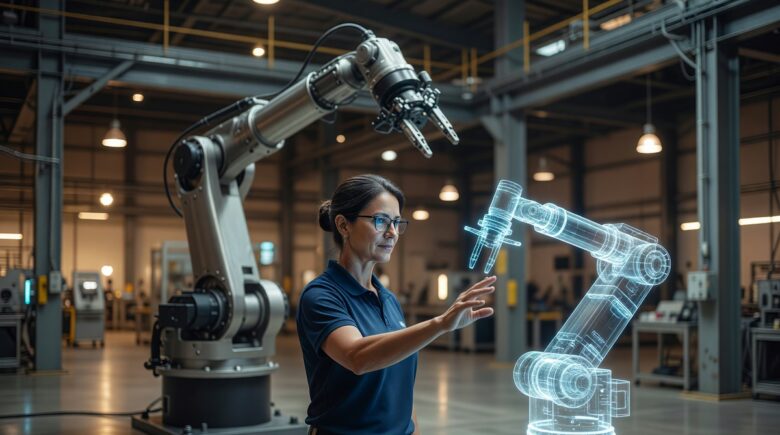
A digital twin in manufacturing is a dynamic, data-synchronized virtual model of a physical machine, production line, or entire facility. Unlike a static CAD drawing or a one-time simulation, a digital twin updates continuously as conditions change on the shop floor.
Three types of digital twins are most common in industrial settings. Component twins model individual parts such as motors or bearings. Asset twins represent whole machines. System twins replicate entire production lines, enabling end-to-end process visibility. Companies like Siemens, GE Digital, and PTC have built dedicated platforms, including Siemens’ Xcelerator and PTC’s ThingWorx, specifically to deploy and manage these three tiers at scale.
How Data Flows Into a Digital Twin
Sensors embedded in physical equipment transmit temperature, vibration, pressure, and throughput data via Industrial IoT (IIoT) networks. That data feeds into a physics-based or machine-learning model hosted in the cloud or on-premise. The model then generates real-time status dashboards, predictive alerts, and what-if scenario outputs that engineers can act on immediately.
Platforms such as ANSYS Twin Builder and Dassault Systèmes’ 3DEXPERIENCE add simulation layers on top of live data, allowing teams to stress-test designs or process changes virtually before committing resources in the real world.
Not every facility is ready for this. Plants running older programmable logic controllers without modern sensor arrays face significant retrofitting costs before any twin can be meaningfully synchronized. For manufacturers with aging equipment fleets, the infrastructure gap is the real barrier, not the software.
Key Takeaway: Digital twins in manufacturing operate across three tiers, component, asset, and system, continuously synced with live sensor data. Platforms from Siemens and PTC enable real-time simulation, giving engineers a 360-degree operational view without physical intervention.
How Do Digital Twins Improve Predictive Maintenance?
The most immediate ROI from digital twin deployment comes in predictive maintenance. By modeling how a machine degrades over time, a digital twin can flag an impending bearing failure days before it causes a line stoppage, eliminating the guesswork of calendar-based maintenance schedules.
Financial stakes are high. Unplanned downtime costs industrial manufacturers an estimated $50 billion per year globally, per Deloitte. However, a real-world case from GE Aviation shows that predictive maintenance enabled by digital twins can improve time on wing by 20%, directly enhancing reliability and reducing maintenance delays. NIST (2024)
Real-World Performance Gains
Rolls-Royce uses digital twins of its aircraft engines to monitor thousands of sensors per flight, predicting component wear and scheduling maintenance before failures occur. Renault has deployed factory-level digital twins across multiple European plants to reduce assembly line stoppages. These are not pilot programs, they are core operational systems generating measurable cost savings at scale.
Predictive models are only as accurate as the data feeding them. When sensor calibration drifts or IIoT network coverage is inconsistent, the twin’s predictions degrade. A false-negative maintenance alert, when a failure is missed, can be more costly than no alert at all, because it creates misplaced confidence. Data quality governance is not optional; it is the foundation the entire approach rests on.
Key Takeaway: Predictive maintenance via digital twins can reduce unplanned downtime by up to 25%, addressing a problem that costs manufacturers an estimated $50 billion annually. The shift from reactive to predictive repair is the single fastest path to measurable ROI from twin deployment.
How Widely Are Digital Twins Used Across Manufacturing Sectors?
Adoption is accelerating across aerospace, automotive, electronics, and heavy industry. Cloud-native platforms have lowered the entry cost significantly, bringing mid-market manufacturers into the ecosystem alongside Fortune 500 players.
According to a 2024 IDC survey, 65% of manufacturers with revenues above $500 million had deployed at least one form of digital twin technology. Among automotive OEMs specifically, adoption approaches 80%, driven by the complexity of electric vehicle battery systems that demand continuous monitoring and simulation.
| Industry Sector | Primary Use Case | Reported Efficiency Gain |
|---|---|---|
| Aerospace | Engine health monitoring | Up to 30% maintenance cost reduction |
| Automotive | EV battery simulation | 20% faster product development cycles |
| Electronics | PCB yield optimization | 15% improvement in first-pass yield |
| Heavy Industry | Equipment uptime management | 25% reduction in unplanned downtime |
| Energy | Turbine and grid simulation | 18% reduction in energy consumption |
The broader technology ecosystem is also maturing. AI-driven analytics tools, many highlighted in our overview of AI tools transforming business operations in 2026, are now being integrated directly into digital twin platforms, allowing automated anomaly detection without human review of every data stream.
Key Takeaway: 65% of large manufacturers had deployed digital twin technology by 2024, with automotive leading at roughly 80% adoption. Aerospace and heavy industry report efficiency gains of up to 30% on maintenance costs, validating the cross-sector business case.
What Infrastructure Is Needed to Run a Digital Twin?
Deploying digital twins in manufacturing requires two converging infrastructure layers working in tight coordination: edge computing for low-latency data capture, and cloud platforms for simulation and storage. IIoT connectivity bridges them. Without reliable connectivity, real-time synchronization breaks down entirely.
Edge computing nodes, often ruggedized servers placed on or near factory equipment, process high-frequency sensor data locally before sending filtered, structured feeds to cloud platforms. This reduces bandwidth costs and ensures that time-critical alerts (such as a temperature spike in a furnace) are generated in milliseconds, not seconds. Microsoft Azure Digital Twins, AWS IoT TwinMaker, and IBM Maximo are the three dominant cloud platforms providing the back-end simulation and data orchestration layer.
Connectivity and Security Considerations
Connectivity standards matter enormously. OPC-UA (Open Platform Communications Unified Architecture) has emerged as the preferred protocol for industrial data exchange because it is vendor-agnostic and supports encrypted transmission. Security is a parallel concern, a digital twin connected to live production equipment is a potential attack surface, and manufacturers must apply zero-trust network architectures to protect operational technology systems.
The infrastructure investment is substantial but trackable. A mid-size facility deploying asset-level twins typically invests in hardware, software, and integration services. Based on real-world case studies, such as a cement factory in China that achieved a 30% reduction in operation and maintenance costs, the return on investment is demonstrable. NIST (2024) The broader shift mirrors trends in how digital infrastructure is reshaping entire industries beyond manufacturing.
Key Takeaway: Digital twin deployment typically requires an investment of $500,000 to $2 million for a single mid-size facility, covering edge hardware, cloud licensing, and IIoT integration. Payback periods average 18 to 36 months, driven primarily by downtime reduction and quality improvement savings.
What’s Next for Digital Twins in Manufacturing?
The next evolution is the autonomous digital twin, a model that not only monitors and predicts but also executes corrective actions without human approval. AI inference engines embedded in the twin will close the loop between detection and response, adjusting machine parameters, rerouting production flows, or triggering supply orders automatically.
NVIDIA’s Omniverse platform is already enabling photorealistic, physics-accurate factory simulations that manufacturers use to design entire facilities before breaking ground. This “factory of the future” approach compresses facility design cycles from months to weeks. Bosch and BMW have publicly demonstrated Omniverse-based factory planning, establishing a benchmark other manufacturers are now racing to match.
Interoperability will be the defining challenge of the next five years. As manufacturers deploy twins from multiple vendors across complex supply chains, the lack of standardized data formats creates integration friction. Industry bodies including the Industrial Internet Consortium (IIC) and the Digital Twin Consortium are developing open standards to address this, progress that mirrors similar standardization efforts covered in our analysis of open data standards reshaping financial services.
Generative AI is also entering the picture. Large language models trained on equipment manuals, failure histories, and sensor logs can now answer engineer queries in plain language, turning the digital twin from a dashboard into a conversational operations intelligence system. For businesses tracking the broader AI landscape, our roundup of AI-powered platforms redefining decision-making in 2026 shows how this pattern is repeating across sectors.
Key Takeaway: Autonomous digital twins, capable of self-correcting without human input, represent the next frontier, with platforms like NVIDIA Omniverse already enabling full-factory simulation. The Digital Twin Consortium is working to resolve interoperability gaps that currently slow cross-vendor, cross-supply-chain deployment.
Frequently Asked Questions
What is a digital twin in manufacturing, in simple terms?
A digital twin in manufacturing is a live virtual replica of a physical machine, process, or facility that updates in real time using sensor data. It allows engineers to monitor performance, simulate changes, and predict failures without interrupting actual production. Think of it as a continuously updated virtual clone of your factory floor.
How much does it cost to implement a digital twin in a factory?
Costs vary based on scope: a single-asset twin can cost as little as $50,000, while a full plant-level system typically ranges from $500,000 to $2 million in hardware, software, and integration. Real-world implementations, such as a cement plant in China, have demonstrated 30% reductions in operation and maintenance costs, proving strong ROI potential. NIST (2024)
Which industries benefit most from digital twins manufacturing technology?
Aerospace, automotive, electronics, and heavy industry see the highest measurable ROI. Aerospace reports up to 30% maintenance cost reductions, while automotive manufacturers use twins to accelerate EV battery development and cut product cycles by roughly 20%. Energy and pharmaceutical sectors are also rapidly scaling adoption. A cement factory in China achieved 30% lower maintenance costs with digital twin use. NIST (2024)
How do digital twins differ from traditional simulation software?
Traditional simulation runs a one-time model based on static inputs. A digital twin is a persistent, continuously updated model fed by live operational data from IoT sensors. The key difference is real-time synchronization, the twin reflects what the physical asset is doing right now, not what it did when the model was built.
What platforms do manufacturers use to build digital twins?
The leading platforms include Siemens Xcelerator, PTC ThingWorx, Microsoft Azure Digital Twins, AWS IoT TwinMaker, NVIDIA Omniverse, and Dassault Systèmes 3DEXPERIENCE. Platform choice typically depends on existing ERP and PLM infrastructure, with Siemens and PTC dominating discrete manufacturing and GE Digital leading in energy and heavy industry.
Are digital twins only viable for large enterprises?
No. Cloud-native platforms have significantly lowered the entry cost, making component-level or single-asset twins accessible to mid-market manufacturers. Software-as-a-service pricing models from vendors like PTC and Microsoft allow smaller facilities to start with a focused deployment, one machine or one line, and scale incrementally without upfront capital expenditure exceeding $100,000.
What are the biggest risks or failure modes when deploying a digital twin?
Data quality is the most common failure point. A twin fed by poorly calibrated sensors or incomplete IIoT coverage will generate inaccurate predictions. Acting on a false-negative alert, missing a real failure, can be more disruptive than having no alert at all. Integration complexity is the second major risk: connecting a twin to legacy manufacturing execution systems (MES) or older ERP platforms from vendors like SAP often requires custom middleware that adds cost and timeline. Manufacturers that underestimate integration work routinely see projects run 30% to 50% over initial budget.
How does OPC-UA relate to digital twin connectivity?
OPC-UA (Open Platform Communications Unified Architecture) is the dominant industrial protocol for transmitting sensor and machine data securely between equipment and software platforms. It is vendor-agnostic and supports encrypted data transfer, which makes it the standard foundation for IIoT networks feeding digital twins. Without a reliable OPC-UA implementation, data latency and security gaps can undermine the real-time synchronization the entire model depends on.
Can digital twins help with supply chain visibility, not just factory operations?
Yes, increasingly. System-level twins that model entire production lines can be extended to include supplier lead times, logistics data, and inventory buffers, giving operations teams a single view of end-to-end throughput. Several large automotive OEMs have connected factory twins to supplier portals, enabling faster responses to component shortages. This is an emerging application area, more mature in automotive and electronics than in other sectors.
How does cybersecurity apply to digital twin deployments?
A digital twin connected to live production equipment creates a direct software pathway to physical machinery, which makes it a meaningful cybersecurity target. Manufacturers are expected to apply zero-trust network architectures to separate operational technology (OT) systems from enterprise IT networks. The Industrial Internet Consortium (IIC) publishes security frameworks specifically for IIoT environments, and compliance with those guidelines is increasingly a requirement in aerospace and defense supply chains.
What is the real-world impact of digital twins on manufacturing performance?
Real-world deployments show measurable results. In one case, a cement factory in China achieved a 30% reduction in operation and maintenance costs using a digital twin. A GE Aviation customer reported a 20% improvement in time on wing due to predictive maintenance enabled by digital twins. Full adoption across U.S. manufacturing could deliver an annual economic impact of $37.9 billion. NIST (2024)
How does NIST support digital twin implementation in manufacturing?
The National Institute of Standards and Technology (NIST) develops technical guidance, measurement science, reference architectures, and standards, including contributions to ISO 23247, to help manufacturers implement, validate, and ensure the trustworthiness and interoperability of digital twins in advanced manufacturing. NIST
Sources
- MarketsandMarkets, Digital Twin Market Size, Share and Global Forecast to 2027
- NVIDIA Omniverse, Industrial Digital Twins Platform Overview
- Digital Twin Consortium, Open Standards and Industry Framework
- National Institute of Standards and Technology (NIST), Digital Twins for Advanced Manufacturing Program