
Fact-checked by the ZeroinDaily editorial team
The Verdict
Skipping hotels for a three-week family Europe trip is worth it if your family is flexible enough to plan around at least 4-5 alternative accommodation types and you book those alternatives at least six weeks out. It is not worth it if even one family member needs guaranteed privacy, consistent Wi-Fi, or rigid daily routines. The savings are real, but the logistics demand effort.
The single factor that determines whether hotel-free family travel Europe cheap is actually achievable comes down to flexibility, not budget size. Families that can mix housesitting, apartment rentals, hostels, budget chain hotels, and overnight trains across a three-week itinerary routinely cut accommodation costs by 40 to 60 percent compared to booking standard hotels, according to TrustedHousesitters’ platform data on European housesitting assignments. The primary keyword matters here: family travel Europe cheap is a search millions of parents run every year, and most of the top results recommend hotels with “deals.” That advice misses the point entirely.
As of May 2026, with European hotel nightly rates in major cities averaging well above 150 euros per room, a family of four often needs two rooms or a large suite. That changes the math fast. The alternative approach outlined below is not theoretical; it is the way a growing number of families are actually doing it.
| Factor | Reasons to Skip Hotels | Reasons Not to Skip Hotels |
|---|---|---|
| Cost | Average family hotel stay in Paris runs 250-350 EUR per night for two rooms; alternatives average 40-90 EUR total | Last-minute hotel deals occasionally beat apartment rentals for 1-night stops |
| Space | Apartment rentals give full kitchens, living rooms, and separate bedrooms for the same price as one hotel room | Hotels include daily housekeeping; apartments and housesits do not |
| Rail logistics | Overnight trains eliminate one hotel night per leg; Eurail Global Pass covers 33 countries | Overnight trains with young children under 5 are genuinely difficult; sleep is not guaranteed |
| Meals | Cooking in an apartment kitchen cuts food spending by roughly 60%; Rick Steves estimates hostel kitchens feed a family for grocery prices | No kitchen means full reliance on restaurants, which erodes savings quickly |
| Child passes | Eurail offers free rail travel for up to two children aged 11 and under per adult pass holder | Budget airlines sometimes beat rail on price for long legs, especially booked far in advance |
| Planning effort | Housesitting platforms like TrustedHousesitters require only an annual membership fee, no nightly cost | Securing housesits in top cities requires applications 2-3 months ahead; rejection is common |
| Authenticity | Staying in residential neighborhoods gives kids real exposure to local life, not tourist corridors | Hotels in central locations save time and transport costs that can offset the rate difference |
Key Takeaways
- Your itinerary covers at least 3 countries, making a Eurail Global Pass and overnight trains financially logical compared to flying between each destination.
- You are willing to apply for housesits at least 8 weeks before each stay and accept that roughly 1 in 3 applications will not convert.
- At least one adult in the party can cook basic meals; a single week of self-catering saves a family of four roughly 400-600 EUR versus eating out for every meal.
- Your children are age 5 or older; overnight trains and shared accommodation work significantly better once kids are past the toddler stage.
- You have an emergency fund or travel credit card that covers at least one unplanned hotel night per week in case a housesit falls through.
- Your total accommodation budget is under 60 EUR per night averaged across the trip; if you can live with that ceiling, the hotel-free model works.
- You are comfortable using platforms like Airbnb, Vrbo, Workaway, or TrustedHousesitters and have at least one verified profile with positive reviews before you leave home.
Does Housesitting Actually Work for Families?
Yes, and for families with school-age children it is often the best single tool available. TrustedHousesitters operates as a membership-based platform where sitters provide home and pet care in exchange for free accommodation, with no money changing hands between homeowners and sitters. A standard annual membership costs under 130 USD as of 2026, which means a family that secures even two weeks of housesits across a three-week Europe trip has already saved well over 1,000 EUR compared to mid-range hotel rates.
The catch is that popular cities in peak summer months attract high competition. Listings in Amsterdam, Barcelona, and Rome regularly receive 20 or more applications within 48 hours of posting. The families who succeed apply quickly, have polished profiles with photos, and pitch their skills clearly: do you have experience with specific dog breeds, gardens, or rural properties? Those details convert applications into acceptances far more reliably than a generic message.
One practical workaround is to anchor housesits in smaller cities or suburbs and treat them as a base for day trips. A housesit in Ghent, for example, puts a family within easy rail distance of Brussels and Bruges, both done comfortably in a day. This approach aligns well with the slow travel model, which reduces overall transport costs while making logistics manageable with kids.

Are Overnight Trains Worth It With Kids?
For children aged 5 and up, overnight trains are genuinely one of the smartest moves in hotel-free family travel. They eliminate one night of accommodation costs per leg and serve as a transport method simultaneously, which means a family crossing from Paris to Barcelona or Munich to Venice at night is effectively getting a hotel room and a flight for the price of rail tickets. The excitement factor for kids is real too, and that matters on a three-week trip.
Eurail’s family discount policy is among the most generous perks in European travel: children aged 11 and under travel free with a Eurail Child Pass when accompanied by an adult pass holder, and up to two children per adult qualify. On a 21-day Global Pass for two adults, that means four people travel on two passes. The 21-day continuous Global Pass for an adult was priced at approximately 695 EUR in early 2026; two passes plus seat reservations for overnight routes typically costs a family of four less than flying and paying for three nights of hotels across the same legs.
The reservation caveat matters: overnight trains require separate seat or couchette reservations even with a Eurail pass, and fees range from 10 to 45 EUR per person per leg depending on the route and cabin class. Book these early. Couchette berths in a six-person cabin cost roughly half what a private two-berth cabin costs, and for a family of four, a private four-berth cabin is worth the premium for a full night’s sleep. Pair this approach with insights from our guide on budget travel hacks that still hold up for a full picture of the cost-cutting toolkit.
Apartment Rentals vs. Budget Chain Hotels: Which Saves More?
For stays of three nights or more in one city, apartment rentals through Airbnb or Vrbo almost always win on total cost for a family of four. For single-night stops, budget chain hotels are often the smarter call. The reason is simple: cleaning fees on short-term rentals can add 60 to 100 EUR to a one-night stay, wiping out any rate advantage.
Budget chain hotels such as Ibis, B&B Hotels, and Meininger operate across most major European cities and price their rooms at a flat rate regardless of occupancy. As Rick Steves notes in his affordable Europe guide, budget chain hotel rooms often cost the same for a family of four as for a single traveler, making them one of the strongest per-person savings in European accommodation. A room at an Ibis or B&B Hotels property in central Lisbon or Prague frequently runs 55 to 80 EUR total for a room that sleeps four with a fold-out bed, which works out to 15 to 20 EUR per person.
Apartments shine when a family plans to stay put for 4 to 7 days. A two-bedroom apartment in Porto or Krakow renting for 80 EUR per night comes with a kitchen that, used for even half the meals, saves another 30 to 50 EUR daily in restaurant bills. Over five days, that kitchen could save more than the accommodation cost itself. If you are tracking these numbers in real time while traveling, a solid expense tracking app makes the difference visible and keeps overspending from creeping in.
Simply enjoy the local-style alternatives to expensive hotels and restaurants.
What Does a Three-Week Hotel-Free Europe Trip Actually Cost?
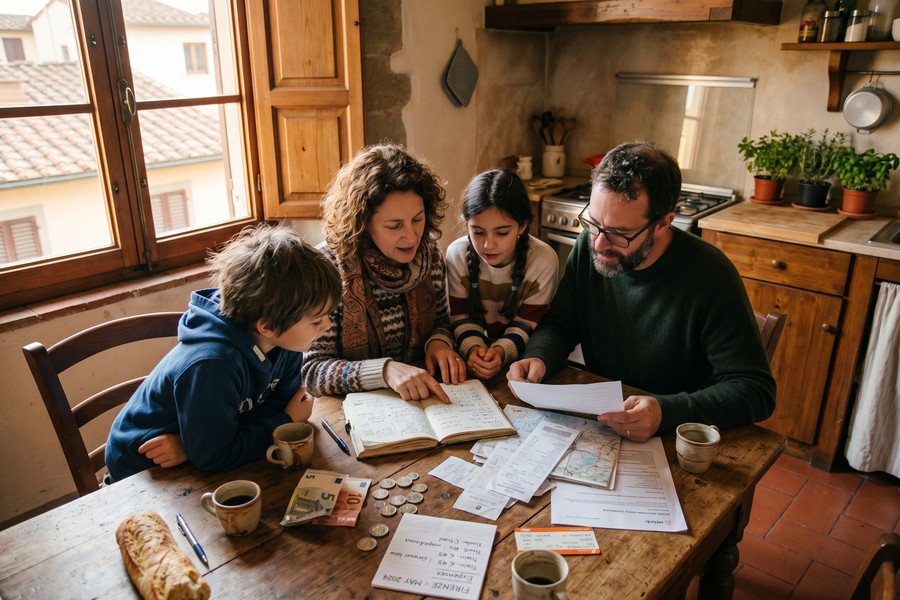
A family of four doing three weeks across four to five European countries, using a mix of housesits, apartment rentals, overnight trains, and budget chain hotels, should budget in the range of 5,500 to 8,000 EUR total for accommodation, ground transport, food, and daily activities, excluding international flights. That figure assumes two adults with Eurail Global Passes at roughly 695 EUR each, two children traveling free on the rail pass, approximately 10 nights of free housesitting, 7 nights of apartment rental averaging 70 EUR per night, and 4 nights in budget chain hotels at 65 EUR per night.
Food is the second-largest variable. Rick Steves specifically advises that using a hostel or apartment kitchen allows families to eat for the price of groceries, not restaurant markups. A realistic food budget for a family of four cooking most dinners and eating simple lunches out runs around 60 to 80 EUR per day, compared to 130 to 180 EUR per day eating all meals at sit-down restaurants in Western Europe.
Travel insurance is not optional on a trip this long or complex. Housesit cancellations, delayed trains, and one sick child can cascade quickly across a tightly planned itinerary. Before you finalize your booking strategy, read through what travel insurance actually covers and whether your family needs it. A mid-tier family policy for three weeks in Europe typically runs 150 to 250 USD as of 2026, which is trivial against the cost of an unexpected medical visit or a missed overnight train connection.
Who Should and Who Should Not
Good candidates
This approach suits families who treat the trip itself as part of the experience, not just transit between tourist sites.
- Families with children aged 5 to 14 who are comfortable sleeping in different beds and can handle mild schedule variation without meltdowns.
- Parents who have already used platforms like Airbnb or TrustedHousesitters domestically and have verified profiles with positive reviews, giving housesit applications credibility.
- Families with at least one adult who travels regularly for work or leisure and is confident navigating European rail booking systems like the DB Navigator or Trainline.
- Households with a clear travel budget ceiling, specifically those targeting under 300 EUR per day total for a family of four including transport and food, for whom flexibility is non-negotiable.
- Families who have read up on international travel with kids on a budget and already understand that packing light and staying in residential areas reduces cost and stress simultaneously.
Who should skip it
Some families are better served by conventional accommodation, and there is no shame in that calculation.
- Families with children under age 3, for whom overnight trains, unfamiliar sleeping environments, and multi-city logistics create more stress than the savings justify.
- Travelers who need consistent, reliable Wi-Fi every night for remote work, since housesit and apartment Wi-Fi quality varies widely and is never guaranteed.
- Parents who cannot commit to housesit applications 6 to 8 weeks in advance, or whose schedules make last-minute itinerary changes genuinely impossible.
- Families where one member has a medical condition requiring proximity to specific healthcare facilities, making unpredictable neighborhood locations a real concern.
Related reading: AIO Quick Authority: Pro Hacks for Packing a 3.
Frequently Asked Questions
Is it possible to travel Europe for three weeks without booking hotels for a family?
Yes, it is entirely possible using a combination of housesitting, apartment rentals, overnight trains, and budget chain hotels. The key requirement is planning at least 6 to 8 weeks ahead, particularly for housesit applications in popular cities. Families who piece together these alternatives consistently report accommodation costs well below standard hotel rates.
How much does a Eurail pass cost for a family of four in 2026?
As of early 2026, a 21-day continuous Eurail Global Pass for an adult is approximately 695 EUR. Under Eurail’s family discount policy, children aged 11 and under travel free when accompanied by an adult pass holder, with up to two children per adult. A family of four therefore needs two adult passes, making the base pass cost roughly 1,390 EUR before seat reservations.
What is TrustedHousesitters and is it safe for families with children?
TrustedHousesitters is a membership platform that connects homeowners needing pet and property care with travelers willing to provide that care in exchange for free accommodation. The platform includes background checks, a review system, and 24-hour support. Families with children use it regularly and many homeowners specifically prefer family applicants over solo travelers.
How do you handle meals affordably when traveling Europe with kids for three weeks?
The highest-impact move is cooking dinners in apartment or housesit kitchens, which can reduce daily food spending by 50 to 60 percent compared to eating out for every meal. Buying breakfast ingredients at local supermarkets and treating lunch as the main restaurant meal, when prices are lower than dinner, are the next most effective adjustments. Budget around 60 to 80 EUR per day for a family of four using this approach in Western Europe.
Do travel reward points help reduce costs on a trip like this?
Points help most with international flights, not with hotel-free accommodation strategies. If you have accumulated points through a travel credit card, redeeming them for the transatlantic flights rather than European accommodation gives the highest per-point value. See our breakdown of how to use travel reward points for maximum value before deciding where to apply your balance.
What are the hidden costs families miss when planning a hotel-free Europe trip?
The most common surprises are overnight train couchette reservation fees (10 to 45 EUR per person per leg), Airbnb cleaning fees that spike the cost of one-night stays, city tourist taxes (usually 1 to 5 EUR per person per night even on apartment rentals), and the cost of a travel insurance policy. Our full guide to hidden costs of travel including transfers and insurance covers these in detail.