Fact-checked by the ZeroinDaily editorial team
Quick Answer
Solid-state batteries replace the flammable liquid electrolyte in lithium-ion cells with a solid material, ceramic, glass, or polymer, enabling higher energy density (400–500 Wh/kg vs. 250–300 Wh/kg today), faster charging, and dramatically reduced fire risk. Mass-market wearables arrive first (2026–2027), smartphones follow (2027–2029), and EVs come last (2028–2032) as manufacturing costs fall from roughly $800–$1,200/kWh today toward $100–$150/kWh by 2030.
Lithium-ion batteries power nearly every device in your home, and they all share the same quiet problem: lose up to 20% of their total capacity within just 500 charge cycles. The phone you bought two years ago is already degraded, and your laptop, EV, and wearables are following the same curve. The global lithium-ion battery market was valued at over $60 billion in 2022 according to the U.S. Department of Energy, yet the technology still carries fundamental flaws: thermal runaway risks, limited energy density ceilings, and electrolytes that are inherently flammable. Between 2021 and 2023, over 200 e-bike battery fires were reported in New York City alone. Recalls from Samsung, Sony, and major EV manufacturers have cost the industry billions.
Solid-state batteries are the proposed fix, and the transition is already underway, unevenly and slowly, in ways that matter for decisions you’ll make about devices in the next two to five years.
This guide breaks down exactly what solid-state batteries are, how they compare to lithium-ion on every metric that matters, which devices will change first, what the timeline realistically looks like, and what you should actually do with that information today.
Key Takeaways
- Solid-state batteries can deliver energy densities of 400-500 Wh/kg, roughly 2-3x the best lithium-ion cells available today (which cap around 250-300 Wh/kg).
- The global solid-state battery market is projected to reach $8.4 billion by 2031, growing at a CAGR of 36.3% from 2022, according to Allied Market Research.
- Toyota has invested over $13.6 billion in battery R&D through 2030, targeting solid-state EV batteries with a 745-mile range in a single charge.
- Current solid-state battery manufacturing costs run approximately $800-$1,200 per kWh, compared to $139 per kWh for lithium-ion in 2023, but costs are projected to drop 60-70% by 2030.
- Samsung SDI has demonstrated a solid-state battery cell retaining over 90% capacity after 1,000 cycles, compared to lithium-ion’s typical 80% retention at 500 cycles.
- The first mass-market consumer solid-state battery devices, likely wearables and hearing aids, are expected commercially by 2026-2027, with EVs following by 2028-2030.
In This Guide
- What Is a Solid-State Battery, Exactly?
- The Chemistry Behind the Claims
- Head-to-Head: Performance Metrics That Actually Matter
- Safety First: Why the Solid Electrolyte Changes Everything
- Which Devices Will Change First, and When?
- The Manufacturing Challenge No One Talks About
- Who’s Winning the Solid-State Race?
- The Cost Curve: When Will This Actually Be Affordable?
- Environmental Impact: Is Solid-State Actually Greener?
- What This Means for You as a Consumer
What Is a Solid-State Battery, Exactly?
A solid-state battery replaces the liquid or gel electrolyte found in conventional lithium-ion cells with a solid material, typically ceramic, glass, or a solid polymer. This single substitution cascades into dozens of downstream improvements in safety, energy density, charge speed, and longevity.
The electrolyte in a battery is the medium through which lithium ions travel between the anode and cathode during charging and discharging. In lithium-ion batteries, this medium is a flammable liquid solution. In solid-state designs, that liquid is gone, replaced by a material that is both ionically conductive and physically stable.
The Three Types of Solid Electrolytes
Not all solid-state batteries are built the same way. Researchers and manufacturers are pursuing three main electrolyte categories, each with different trade-offs.
| Electrolyte Type | Key Advantage | Key Limitation | Maturity Level |
|---|---|---|---|
| Oxide (Ceramic) | Excellent thermal stability | Brittle, hard to manufacture thin | Early commercial |
| Sulfide | High ionic conductivity, flexible | Toxic H2S gas risk during manufacture | Advanced R&D |
| Polymer | Flexible, easier manufacturing | Lower conductivity at room temperature | Commercially available (niche) |
Sulfide electrolytes are currently the frontrunner for high-performance applications. Toyota, Samsung, and QuantumScape are all pursuing sulfide-based designs. Polymer electrolytes, used by Bolloré in Europe, have already powered EV bus fleets, but at lower energy densities than what the next generation promises.
How It Differs From What’s in Your Devices Today
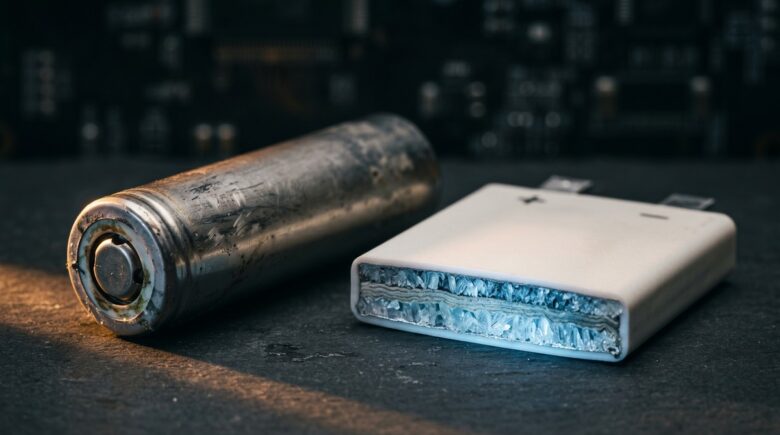
Your smartphone right now contains a lithium-ion pouch or cylindrical cell with a separator soaked in liquid electrolyte. That liquid can leak, can combust if punctured, and slowly degrades with each charge cycle. The solid-state architecture eliminates the separator and the flammable liquid entirely.
This structural difference isn’t cosmetic. It enables a thinner battery profile, higher stacking of electrode layers, and compatibility with lithium metal anodes, which hold nearly 10 times more energy per gram than the graphite anodes used in current lithium-ion cells.
The concept of solid-state batteries dates back to the 1830s, when Michael Faraday discovered that silver sulfide becomes ionically conductive at high temperatures. Modern solid-state research accelerated dramatically after 2010, driven by EV industry funding.
The Chemistry Behind the Claims
Understanding why solid-state batteries perform differently requires a brief look at what actually limits lithium-ion cells today. The answer comes down to three chemistry problems: dendrite growth, electrode degradation, and electrolyte decomposition.
Dendrites are microscopic lithium metal filaments that grow through a liquid electrolyte over repeated charge cycles. When they bridge the anode and cathode, the result is an internal short circuit, and potentially a fire. This is why lithium-ion batteries use graphite anodes instead of pure lithium metal, sacrificing significant energy density for safety.
Why Lithium Metal Anodes Matter So Much
Solid electrolytes are physically rigid enough to suppress dendrite growth, at least in theory. This opens the door to lithium metal anodes, which have a theoretical specific capacity of 3,860 mAh/g versus graphite’s 372 mAh/g. That’s a tenfold energy density advantage at the anode alone.
The practical gains are more modest due to other system constraints, but researchers have demonstrated cells with energy densities of 400-500 Wh/kg in lab settings. Current best-in-class lithium-ion cells max out around 250-300 Wh/kg. The gap is real and significant.
The Cathode Advantage
Solid-state designs also enable higher-voltage cathode materials, such as lithium-nickel-manganese-cobalt oxide (NMC) with higher nickel content, which deliver more energy per cycle. The solid electrolyte’s electrochemical stability window is wider, meaning it doesn’t break down under the higher voltages that would destroy a liquid electrolyte.
This chemistry combination, lithium metal anode plus high-voltage cathode plus solid electrolyte, is what makes the energy density projections so compelling. Three improvements stack simultaneously, not one.
Lithium metal anodes have a theoretical energy capacity of 3,860 mAh/g, over 10x the 372 mAh/g capacity of the graphite anodes used in today’s lithium-ion batteries.
Head-to-Head: Performance Metrics That Actually Matter
Marketing claims about solid-state batteries are everywhere. Here’s what the actual data says on the metrics that determine whether a battery technology is useful in real devices, not just a lab.
Energy Density and Range
Energy density is the headline metric, and solid-state wins clearly. The more nuanced comparison is at the system level, accounting for the weight of packaging, cooling systems, and battery management electronics. Even at system level, solid-state designs show a 30-40% improvement in energy density over current lithium-ion packs.
| Metric | Lithium-Ion (Current) | Solid-State (Projected 2027-2030) |
|---|---|---|
| Gravimetric Energy Density | 250-300 Wh/kg | 400-500 Wh/kg |
| Volumetric Energy Density | 600-700 Wh/L | 1,000-1,200 Wh/L |
| Cycle Life (80% capacity) | 500-800 cycles | 1,000-2,000+ cycles |
| Charge Rate (to 80%) | 30-60 minutes | 10-15 minutes (projected) |
| Operating Temperature Range | -20°C to 60°C | -30°C to 100°C+ |
| Flammability Risk | High (liquid electrolyte) | Very Low (solid electrolyte) |
Charging Speed Reality Check
The promise of 10-minute charging to 80% is real in laboratory conditions. In actual solid-state battery devices, the challenge is managing interface resistance between the solid electrolyte and electrodes at fast-charge rates. QuantumScape has demonstrated 15-minute charges to 80% in pouch cells, but thermal management at the pack level remains an engineering challenge.
For context, even a 20-minute charge to 80% would be transformative for EV adoption. The average American spends about 8 minutes at a gas station. Closing that gap to under 15 minutes changes the consumer calculus entirely.
“Solid-state batteries represent a step-change in what’s possible with electrochemical energy storage. The combination of higher energy density, faster charging, and improved safety isn’t incremental — it’s a platform shift.”
Longevity: The Hidden Advantage
Battery longevity is underrated as a consumer benefit. A device that retains 90% of its battery capacity after 1,000 cycles versus 80% after 500 cycles sounds like a small improvement. Over a 5-year device lifespan, though, it means the difference between replacing a battery pack once versus never, and in EVs, the difference between a $15,000 battery replacement and a pack that outlasts the vehicle.
Samsung SDI’s published test data shows their solid-state prototype retaining over 90% capacity at 1,000 cycles. Current lithium-ion cells in consumer devices typically hit the 80% threshold at 300-500 cycles under real-world charging patterns, which is why two-year-old smartphones feel sluggish.
Safety First: Why the Solid Electrolyte Changes Everything
Battery safety failures are not rare events. Between 2016 and 2023, the U.S. Consumer Product Safety Commission (CPSC) documented thousands of battery-related incidents involving personal electronics, e-bikes, and power tools. The Samsung Galaxy Note 7 recall alone cost the company an estimated $5.3 billion. These failures share a common root: thermal runaway in liquid electrolyte cells.
Thermal runaway occurs when a cell’s internal temperature rises faster than it can dissipate heat, triggering a chain reaction of exothermic chemical processes. The liquid electrolyte fuels this reaction. Remove the liquid, and you remove the fuel.
Thermal Runaway Resistance
Solid electrolytes are non-flammable. Independent testing by organizations including the National Renewable Energy Laboratory (NREL) has confirmed that solid-state cells subjected to nail penetration, crush, and overcharge tests show dramatically reduced thermal response compared to lithium-ion equivalents. No fire, no venting of toxic gases.
This safety profile changes what’s possible in product design. Thinner batteries closer to the device’s surface, reduced need for bulky thermal management systems, and new form factors previously too dangerous to attempt with liquid electrolytes all become viable.
Not all solid-state designs are equally safe. Sulfide-based electrolytes can release toxic hydrogen sulfide (H2S) gas if exposed to moisture during manufacturing. Consumer-grade solid-state products will need rigorous quality control standards before safety claims can be taken at face value.
Interface Stability: The Long-Term Safety Challenge
The one safety concern unique to solid-state batteries is interface degradation over time. As the solid electrolyte and electrode materials expand and contract during cycling, micro-cracks can form at the interface, increasing resistance and potentially causing localized heating. Researchers at Stanford and MIT are actively addressing this through interface engineering and buffer layers, but it remains an unsolved challenge in long-cycle solid-state battery devices.
Which Devices Will Change First, and When?
The transition to solid-state won’t happen uniformly across all device categories. Battery size, cost sensitivity, performance requirements, and safety regulations will determine the order of adoption. Here’s what the realistic timeline looks like by device type.
Wearables and Hearing Aids: The First Wave (2025-2027)
Small-format solid-state batteries, specifically thin-film oxide designs, are already commercially available in medical devices and select wearables. Companies like Cymbet and Solid Power have supplied thin-film cells to hearing aid manufacturers. These devices need very small batteries, meaning the cost premium of solid-state is manageable on a per-unit basis.
Apple has filed multiple patents related to solid-state battery integration in the Apple Watch. Samsung’s Galaxy Ring, launched in 2024, may represent a transitional step toward solid-state wearable designs. The wearable category is the proving ground for manufacturing processes that will later scale to smartphones.
| Device Category | Expected Transition Year | Key Driver | Cost Impact |
|---|---|---|---|
| Hearing Aids / Medical | 2025-2026 (already partial) | Safety regulations | +$50-$200/device |
| Smartwatches | 2026-2028 | Battery life demand | +$30-$100/device |
| Smartphones | 2027-2029 | Consumer demand, Apple/Samsung R&D | +$50-$150/device |
| Laptops | 2028-2030 | Energy density for thinner designs | +$100-$300/device |
| Electric Vehicles | 2028-2032 | Range and safety requirements | +$2,000-$5,000 initially |
| Grid Storage | 2030-2035 | Cycle life and safety at scale | High, slow adoption |
Smartphones: The Catalyst Moment
The smartphone market is where solid-state battery devices will hit mainstream consciousness. Samsung Electronics announced in 2023 that it was targeting a solid-state smartphone battery by 2027. Apple is reportedly working on a hybrid semi-solid design as a transitional product.
When flagship smartphones adopt solid-state batteries, the volume effect will drive manufacturing costs down rapidly, exactly as happened with lithium-ion batteries when the iPhone drove volume-based cost reductions from over $1,000/kWh in 2010 to under $140/kWh today.
The lithium-ion battery cost dropped 97% between 1991 and 2023, from approximately $7,500/kWh to $139/kWh. Analysts at BloombergNEF project a similar curve for solid-state, reaching $60-$80/kWh by 2035 if manufacturing scales as expected.
Electric Vehicles: The Biggest Prize
EVs represent the largest potential market for solid-state batteries. A solid-state EV battery pack with 400 Wh/kg energy density would allow a 75 kWh pack to weigh roughly 40% less than today’s equivalent, enabling longer range, lighter vehicles, or smaller packs at the same range. Toyota’s commitment of $13.6 billion through 2030 is the clearest signal that the automotive industry views solid-state as inevitable. Nissan has separately committed $17.6 billion to EV development through 2030, with solid-state batteries central to that strategy as well.
The Manufacturing Challenge No One Talks About
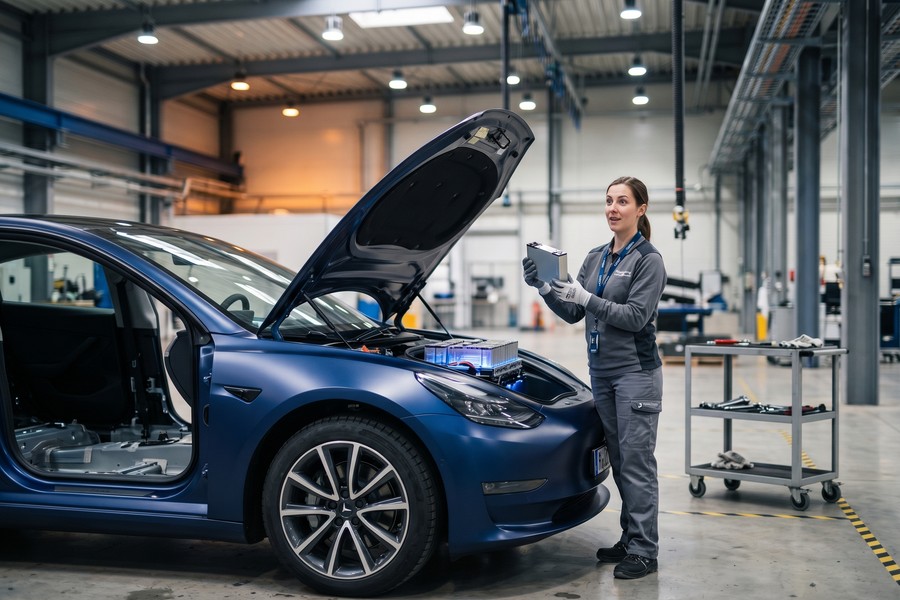
The chemistry of solid-state batteries works in a lab. Manufacturing them at gigawatt-hour scale is a different problem entirely, and it’s the primary reason the transition is taking years rather than months. Solid-state battery manufacturing requires solving problems that simply don’t exist in lithium-ion production.
The most fundamental challenge is achieving intimate contact between the solid electrolyte and electrode materials. In lithium-ion cells, the liquid electrolyte flows into every crack and crevice, ensuring complete ionic contact. Solid-to-solid interfaces are inherently less forgiving. Microscopic gaps mean dead zones in the battery.
Pressure, Thickness, and Yield
Sulfide-based solid-state cells typically require uniaxial pressure of 1-10 MPa to maintain adequate solid-solid contact during cycling. Designing battery packs that can apply and maintain this pressure consistently across thousands of cells, at automotive scale, is a significant engineering challenge. It adds weight, complexity, and cost to the pack design.
Electrolyte layer thickness is another bottleneck. The solid electrolyte layer must be thin enough (ideally under 50 micrometers) to allow fast ion transport, but thick enough to prevent dendrite penetration. Achieving consistent sub-50-micron layers across large surface areas with production yields above 95% is a manufacturing precision requirement that the industry is still working toward.
Dry Room Requirements
Many solid electrolyte materials, especially sulfides, are highly moisture-sensitive. Manufacturing must occur in extremely dry environments, called dry rooms, with dew points below -40°C. Building and operating dry room manufacturing facilities at gigawatt-hour scale costs hundreds of millions of dollars more than conventional lithium-ion gigafactories. This infrastructure gap is a significant barrier to rapid scale-up.
If you’re evaluating investments in battery technology companies, look for those that have announced partnerships with established semiconductor or display manufacturers. The precision thin-film deposition and dry room expertise needed for solid-state manufacturing exists in those industries, not in traditional battery factories.
Who’s Winning the Solid-State Race?
The solid-state battery race involves established automotive giants, pure-play startups, and consumer electronics companies investing across multiple fronts simultaneously. The field is competitive, well-funded, and moving faster than most analysts predicted five years ago.
The Automotive Leaders
Toyota holds the largest solid-state battery patent portfolio of any single company, over 1,000 patents. Their BiPolar+ solid-state battery, targeting a 745-mile range and 10-minute charge to 80%, is slated for production vehicles by 2027-2028. Nissan has committed $17.6 billion to EV development through 2030, with solid-state batteries central to their strategy.
Volkswagen-backed QuantumScape has arguably the most scrutinized solid-state technology in the industry. Their lithium-metal anode, ceramic electrolyte pouch cell has demonstrated 15-minute charges and 1,000+ cycle retention in independent testing, though scaling from single-layer to multi-layer cells for automotive application remains their primary challenge.
“We believe solid-state batteries are not a question of if, but when — and our data suggests we’re closer to ‘when’ than most people in the industry are willing to admit publicly.”
Consumer Electronics Players
Samsung SDI has invested heavily in solid-state R&D, targeting small-format batteries for wearables by 2025-2026 and smartphone batteries by 2027. Their published roadmap projects solid-state cells reaching $100/kWh by 2030 at volume. Apple’s secretive battery research division, Project Polaris, according to industry insiders, has filed over 50 solid-state battery patents since 2019.
Solid Power, a Colorado-based startup, has supply agreements with both BMW and Ford. Their sulfide-based cells entered engineering validation testing in 2023. Factorial Energy has partnerships with Stellantis and Mercedes-Benz. The strategic positioning of these startups, locked into long-term agreements with major OEMs before production, mirrors the early lithium-ion supply chain dynamics.
Toyota holds over 1,000 solid-state battery patents, more than any other single company. The automotive sector accounts for approximately 72% of total solid-state battery R&D investment globally.
Government and Institutional Backing
The U.S. Department of Energy’s Battery500 Consortium, a collaboration between national labs and universities, has invested over $130 million since 2016 to advance solid-state battery technology. The EU’s European Battery Alliance has earmarked €3.5 billion for next-generation battery research including solid-state. South Korea and Japan have both established national solid-state battery development programs with state funding. This isn’t purely private-sector speculation, governments are treating this as critical infrastructure.

The Cost Curve: When Will This Actually Be Affordable?
The single biggest factor determining when solid-state battery devices reach your hands is cost. Right now, the numbers are prohibitive for mass-market consumer electronics. The trajectory is clear, though, and the parallels to lithium-ion’s own cost curve are instructive.
Current Cost Reality
Thin-film solid-state batteries used in medical devices currently cost between $800 and $1,200 per kWh to produce, compared to $139 per kWh for lithium-ion in 2023 according to BloombergNEF. For a smartphone battery (roughly 0.015 kWh), that translates to an incremental material cost of $10-$15 per device at scale, manageable for a $999 flagship phone. For an EV battery (75-100 kWh), the premium would add $50,000+ at current costs. That’s why EVs come last.
The Cost Reduction Roadmap
Industry analysts project solid-state manufacturing costs following a steep learning curve as production scales. The key inflection points are: first automotive-scale factory coming online (2026-2027), smartphone adoption driving consumer electronics volume (2027-2029), and mature multi-gigawatt-hour production (2030+).
| Year | Projected Cost ($/kWh) | Key Milestone |
|---|---|---|
| 2024 (Current) | $800-$1,200 | Small-format medical/wearable only |
| 2026 | $400-$600 | First automotive validation cells |
| 2028 | $200-$300 | Smartphone flagship adoption |
| 2030 | $100-$150 | Mid-range consumer devices |
| 2035 | $60-$80 | Mass-market EV viability |
For context on how dramatically costs can fall: lithium-ion battery pack costs dropped from $1,100/kWh in 2010 to $139/kWh in 2023, an 87% reduction over 13 years, driven primarily by manufacturing scale and process improvements. Solid-state’s starting point is higher, but semiconductor-style thin-film deposition processes can achieve faster learning rates once production ramps.
The technology transition is also relevant in other fast-moving sectors. Just as AI tools have driven rapid cost reductions across enterprise software, manufacturing AI and robotics are being deployed in battery gigafactories to accelerate the solid-state learning curve.
Environmental Impact: Is Solid-State Actually Greener?
The environmental narrative around solid-state batteries is more nuanced than the headlines suggest. Yes, solid-state batteries last longer and eliminate some toxic liquid electrolyte chemistry. The manufacturing process, though, introduces its own environmental considerations.
Lifecycle Advantages
Extended cycle life is the most significant environmental benefit. A solid-state battery that lasts 1,500 cycles versus a lithium-ion battery at 500 cycles means one battery replacing three over the same time period. That’s a 67% reduction in battery manufacturing emissions per unit of energy delivered over a device’s life, a substantial gain when applied across billions of consumer devices.
Solid-state designs also eliminate the need for liquid electrolyte, which includes lithium hexafluorophosphate (LiPF6), a compound that reacts violently with water and releases toxic HF gas. Removing this compound from the supply chain and waste stream is a genuine environmental improvement. The evolution of battery technology connects to broader changes in how digital infrastructure is managed, similar to how digital banking trends are reducing physical infrastructure footprint in financial services.
Manufacturing Footprint Concerns
The dry room requirements for sulfide electrolyte manufacturing consume enormous amounts of energy to maintain sub-dew-point conditions. Early lifecycle analyses suggest that solid-state manufacturing could carry a 20-30% higher carbon footprint per cell than lithium-ion, before accounting for operational longevity gains. Over a full product lifecycle, solid-state still comes out ahead, but the manufacturing phase emissions are higher, not lower.
Cobalt content is another variable. Some solid-state cathode designs allow higher-nickel, lower-cobalt formulations, potentially reducing dependence on cobalt from the Democratic Republic of Congo, where mining practices remain a significant ethical concern. Not all solid-state designs achieve this, however.
The lithium used in solid-state electrolytes does not necessarily require lithium mining at higher rates. Many solid-state designs use thinner lithium layers at higher efficiency, potentially reducing total lithium content per kWh of storage compared to lithium-ion.
What This Means for You as a Consumer
The transition to solid-state battery devices won’t announce itself with a dramatic product launch event. It will happen incrementally, first in devices you might not notice (hearing aids, medical implants, specialty wearables), then in flagship products where the premium is justified, then in mainstream consumer electronics as costs normalize.
What to Expect From Your Next Devices
Anyone buying a smartphone or laptop in 2024-2025 is still buying lithium-ion. Plan accordingly: battery degradation will continue to be a real factor. Calibrating your expectations and understanding your device’s battery health tools matters now. Many consumers don’t realize that their phone’s “80% battery health” setting is designed to slow degradation, it’s worth enabling on any iOS or recent Android device.
By 2027-2028, flagship smartphone buyers will likely encounter their first solid-state or semi-solid hybrid batteries. These devices will advertise longer cycle life and potentially faster charging, but the energy density gains in a phone format may be modest initially, used primarily to enable thinner designs rather than dramatically larger capacity.
The EV Buyer’s Dilemma
Waiting for solid-state EV batteries means waiting potentially 4-8 years. Current lithium-ion EVs are already highly capable, and charging infrastructure is improving rapidly. The disruption happening across financial technology offers a useful parallel: waiting for the “perfect” technology often means missing years of practical benefit from what’s available today.
The calculus changes for buyers who expect to keep an EV for 10 or more years. In that scenario, the superior cycle life of solid-state batteries becomes directly relevant to total cost of ownership. A lithium-ion EV battery replacement can cost $10,000-$20,000. A solid-state battery that retains 90% capacity at 1,500 cycles potentially avoids that cost entirely.
“Consumers shouldn’t wait for solid-state. But they should understand that the devices they buy today are the last generation that will accept this level of battery compromise as normal.”
Be skeptical of consumer electronics marketing that uses “solid-state battery” loosely. Some products use semi-solid or hybrid designs that offer only marginal improvements over conventional lithium-ion. Ask specifically for cycle life data, energy density figures, and independent test results before paying a solid-state premium.

The average American replaces their smartphone every 2.7 years, often citing battery life as a primary reason. If solid-state batteries extend usable device life to 5+ years at full performance, the consumer device replacement market could contract by 30-40%, representing a fundamental shift in the consumer electronics economy.
Real-World Example: From Battery Anxiety to Two-Week Charge Cycles
Consider David, a 34-year-old field engineer based in Phoenix, Arizona. In 2023, David was on his third iPhone in four years, each replacement driven primarily by battery degradation. His iPhone 13 Pro, purchased new for $1,099 in late 2021, showed 79% battery health by early 2023. By that point, it was struggling to last past 3 PM on a typical workday that involved heavy GPS usage, site photography, and constant email. David’s solution: carry a 10,000 mAh power bank everywhere. Total investment in phone plus accessories plus a mid-cycle battery replacement service ($89 at an Apple Store): approximately $1,350 over 18 months.
Compare that scenario to the performance profile of the Samsung SDI solid-state prototype: 90%+ capacity retention at 1,000 cycles, with a projected cycle life of 1,500+ cycles before reaching the 80% threshold. For David’s charging pattern, approximately one full cycle per day, 1,500 cycles represents over four years of use before meaningful degradation. That same $1,099 phone, in theory, remains at full performance through 2028. No mid-cycle battery replacement. No power bank. No replacement phone at year two.
The economic math is clear. If David’s next device, anticipated as an iPhone 17 or 18 Pro, possibly featuring a semi-solid transitional battery, demonstrates even 70% of the cycle life improvement projected for solid-state, his total device cost per year drops from roughly $750/year to under $300/year. That’s a $450 annual saving for a single user, multiplied across the 1.4 billion smartphones sold globally each year.
David’s story isn’t unusual, it’s the default experience for power users. The reason solid-state battery devices matter isn’t abstract chemistry. It’s the elimination of the low-grade daily frustration that has become so normalized most users don’t even identify it as a solvable problem. They should.
Your Action Plan
-
Audit Your Current Battery Health Right Now
On iPhone, go to Settings → Battery → Battery Health and Charging. On Android, use AccuBattery or check Settings → Battery → Battery Usage. If your primary device is below 85% health, factor in a replacement timeline. Knowing your current baseline helps you evaluate future solid-state claims with real context.
-
Enable Battery Optimization Settings on All Devices
iOS’s Optimized Battery Charging and Android’s Adaptive Charging features use machine learning to limit charge to 80% overnight, reducing degradation by up to 30% over 18 months. Enable these settings today. This won’t fix a degraded battery, but it dramatically extends the life of a new or healthy one.
-
Research the Battery Specs Before Your Next Device Purchase
Starting in 2025, ask specifically about battery cycle life ratings and whether the device uses any solid-state or semi-solid components. Manufacturers like Samsung and Apple are beginning to disclose more cycle life data under pressure from EU battery regulation (the EU Battery Regulation 2023/1542 requires cycle life disclosure for EVs and industrial batteries, with consumer electronics provisions coming by 2027).
-
Watch the Wearables Market as Your Leading Indicator
The wearable category will see solid-state adoption 1-2 years before smartphones. For anyone in the market for a smartwatch or fitness tracker in 2025-2026, actively research whether solid-state battery options exist. Paying a modest premium, under $100, for a device with 1,500-cycle battery life versus 400-cycle is excellent long-term value. Tracking this kind of tech-driven financial decision is much easier with tools like modern budgeting apps that can categorize your device spending over time.
-
Track Key Industry Milestones to Time Your EV Decision
Set calendar reminders for Q1 2026 (Toyota solid-state production announcement) and Q4 2026 (QuantumScape first commercial cell validation). These dates are when the market will have clearer visibility on solid-state EV timelines. Making a major purchase based on clearer data is always better than speculating two years in advance. The same data-informed approach applies to major financial decisions, as explored in AI-powered investment analysis tools that help you model total cost of ownership scenarios.
-
Don’t Pay a “Solid-State Premium” for Unverified Claims
Until a product has published independent cycle life data, not just manufacturer marketing claims, treat “solid-state” labeling in consumer electronics with healthy skepticism. Ask the retailer for the specific electrolyte type, cycle life rating, and whether the cell is fully solid-state or a hybrid design. The first wave of products may use “solid-state” loosely to capture a premium price.
-
Monitor Battery Regulation Developments in Your Region
The EU Battery Regulation passed in 2023 mandates minimum battery performance standards, repairability requirements, and recycled content rules. The U.S. is developing parallel frameworks. These regulations will accelerate solid-state adoption by setting cycle life minimums that lithium-ion designs increasingly struggle to meet. Staying informed means you’ll understand why device manufacturers make changes, and anticipate them rather than react.
-
Consider the Total Cost of Ownership, Not Just Sticker Price
When solid-state devices do arrive at retail, the sticker price premium will be real, $50-$300 more depending on device category. Run the full math: a smartphone lasting 5 years at full performance versus 2.5 years with a mid-cycle battery replacement. The total cost of ownership often favors the solid-state option even at a significant upfront premium. Calculating this kind of long-run cost is exactly the scenario where online money management tools prove their value.
Frequently Asked Questions
Are solid-state batteries available to buy right now in consumer products?
Yes, but in a very limited way. Thin-film solid-state batteries are commercially available in select hearing aids, medical devices, and a small number of specialty wearables. These are small-format cells that benefit from solid-state’s safety and longevity advantages. Mass-market consumer electronics, smartphones, laptops, and EVs, are still using lithium-ion, with solid-state transitions expected between 2026 and 2030 depending on device category.
Will solid-state batteries make my phone last longer on a single charge?
Potentially yes, but the initial improvement may be used differently than you expect. Higher energy density could mean either more battery capacity in the same physical space, or a thinner device with the same capacity. Early flagship solid-state smartphones will likely prioritize thinner form factors over dramatically larger battery sizes, a design trade-off that manufacturers have historically made. Longer single-charge life may come in the second generation of solid-state smartphones, once form factor novelty is established.
Is it true solid-state batteries can charge in 10 minutes?
In controlled laboratory conditions, yes. QuantumScape has demonstrated charging a single-layer solid-state cell to 80% in under 15 minutes. The challenge is replicating this in a full multi-layer battery pack with thermal management at consumer device scale. Realistic consumer charging speeds for first-generation solid-state smartphones may be 20-30 minutes to 80%, still a significant improvement over today’s 30-60 minutes, but not quite the 10-minute headline figure.
Are solid-state batteries safer than lithium-ion?
Yes, significantly. The elimination of flammable liquid electrolyte removes the primary fuel source for thermal runaway events. Independent testing by NREL and other research institutions has demonstrated that solid-state cells subjected to nail penetration and crush tests show dramatically reduced thermal response compared to lithium-ion equivalents. The main caveat is that sulfide-based electrolytes require careful moisture management during manufacturing, but this is a factory challenge, not a consumer safety concern.
Why is the solid-state battery transition taking so long?
The chemistry works. The manufacturing challenge is what’s slowing things down. Achieving consistent thin electrolyte layers, maintaining intimate solid-solid interface contact across millions of cells, building dry room manufacturing at scale, and meeting automotive-grade quality requirements are all genuinely difficult engineering problems. The industry has been solving them steadily since 2016, but battery manufacturing is capital-intensive and quality standards are extremely high, especially for EVs where a battery failure at 70 mph has severe consequences.
How much more will solid-state devices cost?
The premium will vary by device category and timing. First-generation solid-state smartphones (2027-2028) may carry a $50-$150 premium over equivalent lithium-ion models. This will narrow over 2-3 product generations as manufacturing scales. For EVs, the initial premium may be $3,000-$5,000 on vehicle price, narrowing to cost parity with lithium-ion EVs by the mid-2030s. At that point, solid-state EVs will likely become the default option given their superior total cost of ownership.
Will I be able to replace a solid-state battery myself?
This depends heavily on device design decisions by manufacturers, not on the technology itself. The EU’s Right to Repair legislation and the EU Battery Regulation both push toward user-replaceable batteries by 2027 for consumer electronics. Whether manufacturers comply or find design workarounds remains to be seen. Technically, solid-state batteries are no harder to replace than lithium-ion; the question is whether they’ll be packaged in user-replaceable form.
How do solid-state batteries perform in cold weather?
Cold performance has historically been a weakness of solid-state designs, particularly polymer electrolytes, which show reduced ionic conductivity at low temperatures. Sulfide and oxide electrolytes perform better in cold, but still show some degradation below -10°C. The operating temperature range of solid-state batteries is projected to extend to -30°C, better than lithium-ion’s practical lower limit of around -20°C. Cold weather performance will be a key differentiator in automotive applications for northern markets.
What happens to lithium-ion recycling infrastructure when solid-state takes over?
Lithium-ion recycling infrastructure, which is still being built out globally, will need to adapt to handle solid electrolyte materials in addition to the existing cathode, anode, and separator materials. The good news is that the valuable cathode metals (lithium, nickel, cobalt, manganese) are the same in most solid-state designs, so the core hydrometallurgical recycling processes remain relevant. The solid electrolyte adds a new material stream that will require adapted processing, but is not expected to represent a major recycling challenge.
Does the EU Battery Regulation affect solid-state battery products sold in the U.S.?
Not directly, the EU Battery Regulation 2023/1542 applies to products sold within the European Union. However, major manufacturers like Apple, Samsung, and Panasonic sell globally, so they will build to the stricter EU standard rather than produce separate versions for each market. In practice, the cycle life disclosure requirements, minimum performance standards, and repairability rules that take effect in Europe by 2027 will apply to the same device models sold in the U.S. The Federal Trade Commission (FTC) and the U.S. Consumer Product Safety Commission (CPSC) are separately developing domestic battery safety and labeling frameworks, but the EU’s timeline is currently more aggressive.
Is now a good time to invest in solid-state battery companies?
This article is not investment advice, and battery technology investing carries significant technical and timeline risk. Several publicly traded companies, QuantumScape (QS), Solid Power (SLDP), and established players like Samsung SDI and Panasonic, have solid-state battery programs. The risk is that timelines consistently slip in battery development, and many well-funded solid-state ventures have already revised their commercialization targets. Anyone considering this space should review diversified approaches rather than single-company bets. For a broader framework on technology-driven investment, understanding how to read stock chart fundamentals is a useful starting point.
Sources
- U.S. Department of Energy, Electric Vehicle Batteries Overview
- European Commission, Automotive Industry and Battery Regulation
- Nature, Lithium-Metal Batteries: Progress and Prospects
- U.S. Consumer Product Safety Commission, Lithium-Ion Battery Fire Safety Warning
- QuantumScape, Solid-State Battery Technology Overview
- EUR-Lex, EU Battery Regulation 2023/1542 Full Text