Fact-checked by the ZeroinDaily editorial team
Quick Answer
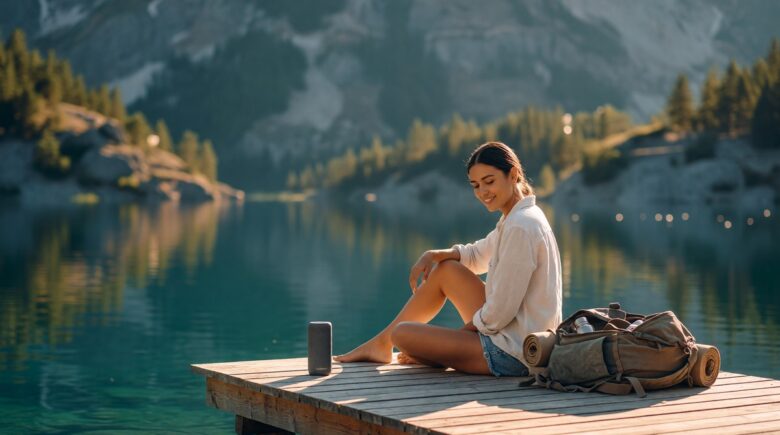
The best portable Bluetooth speakers for travel in June 2025 combine IPX7 waterproofing, battery life of 12–24 hours, and weight under 1 kg. Top picks include the JBL Charge 5, Bose SoundLink Flex, and UE Hyperboom. Choose based on trip type: ultra-compact for backpacking, rugged and waterproof for outdoor adventures.
Finding the right portable bluetooth speakers travel companion is genuinely harder than it should be. Sound quality, durability, and pack size — you’d think nailing all three at once would be straightforward by now. It’s not. According to Statista’s global audio device data, portable Bluetooth speaker shipments surpassed 90 million units in 2024, driven largely by outdoor and travel demand. More choices sounds like a good thing. Mostly it just means more noise to cut through.
That’s exactly what this guide does. Which specs actually hold up on the road, how the top models stack up against each other, and — most importantly — which speaker fits the way you actually travel. Weekend camper? Hardcore backpacker? International wanderer? There’s a real answer here for each.
Key Takeaways
- Battery life is the top purchase driver: 67% of buyers cite runtime as their primary criterion, according to Grand View Research’s 2024 Bluetooth speaker report.
- IPX7 waterproofing means a speaker can survive submersion up to 1 meter for 30 minutes, a standard set by the International Electrotechnical Commission (IEC).
- The JBL Charge 5 weighs 960 grams and delivers up to 20 hours of playtime, making it one of the best value-per-ounce travel speakers available (JBL product specs).
- Bluetooth 5.0 and later versions reduce latency to under 40 milliseconds and extend effective range to roughly 10 meters indoors, per Bluetooth SIG technical documentation.
- The global portable speaker market is projected to reach $12.7 billion by 2028, growing at a CAGR of 8.1%, according to MarketsandMarkets industry analysis.
In This Guide
- What Specs Actually Matter for Travel Bluetooth Speakers?
- Which Portable Bluetooth Speakers Are Best for Travel in 2025?
- What Is the Difference Between Waterproof and Splash-Proof Speakers?
- How Much Battery Life Do You Really Need for Travel?
- How Does Sound Quality Change Outdoors?
- How Should You Pack and Protect Portable Bluetooth Speakers for Travel?
- Frequently Asked Questions
What Specs Actually Matter for Travel Bluetooth Speakers?
Honestly, most spec sheets are full of numbers that won’t make a lick of difference once you’re actually out there. For real-world portable bluetooth speakers travel use, four things consistently separate a speaker you’ll love from one you’ll resent: IP waterproof rating, battery life, Bluetooth version, and total weight. That’s it. Everything else is marketing.
IP Rating and Durability
Here’s the thing about the IP (Ingress Protection) rating — it’s actually a pretty elegant system once you understand it. Defined by IEC standard 60529, it’s a two-digit code where the first number rates dust resistance (scale of 0–6) and the second covers water resistance (0–9). IPX7 means full submersion protection. IPX5 means it can take a jet spray and survive. If you’re camping, boating, or spending any real time near water, don’t even consider anything below IPX7. Just don’t.
Water resistance is only part of the story, though. The JBL Xtreme 3 wraps its internals in a rubberized housing designed to absorb drops, while the Bose SoundLink Flex goes with a tear-resistant silicone exterior that feels almost indestructible in your hands. Drop test data from RTINGS.com’s portable speaker review database backs this up — soft-shell speakers survive 1.2-meter drops onto concrete at significantly higher rates than their hard-plastic counterparts. Concrete parking lots don’t care how expensive your gear was.
Bluetooth Version and Codec Support
Always go with Bluetooth 5.0 or higher. Version 5.0 doubles the data broadcast speed of 4.2 and pushes the usable range further. But here’s what most people miss: codec support matters just as much as version number. aptX or AAC support is what actually determines how good your music sounds over that wireless connection. iPhone users get the most out of AAC; Android folks tend to benefit more from aptX. Worth checking before you buy.
Bluetooth 5.3 — now standard on flagship 2024 and 2025 speakers — reduces connection dropout events by 40% compared to Bluetooth 4.2, according to Bluetooth SIG.
Which Portable Bluetooth Speakers Are Best for Travel in 2025?
Look, the short list for best portable bluetooth speakers travel options in 2025 comes down to five real contenders: the Bose SoundLink Flex, JBL Charge 5, UE Hyperboom, Sony SRS-XB100, and Anker Soundcore Motion X600. Each one wins in a different scenario — which is why picking “the best” in a vacuum is kind of a pointless exercise.
Model Comparison Table
| Model | Battery Life | Weight | IP Rating | Bluetooth Version | Best For |
|---|---|---|---|---|---|
| Bose SoundLink Flex | 12 hours | 590 g | IP67 | 5.3 | Hiking, beach |
| JBL Charge 5 | 20 hours | 960 g | IP67 | 5.1 | Camping, long trips |
| UE Hyperboom | 24 hours | 2,100 g | IPX4 | 5.0 | Group travel, RV |
| Sony SRS-XB100 | 16 hours | 162 g | IP67 | 5.2 | Ultralight backpacking |
| Anker Soundcore Motion X600 | 12 hours | 1,050 g | IPX7 | 5.3 | Budget-conscious travelers |
Top Pick: Bose SoundLink Flex
For the vast majority of travelers, the Bose SoundLink Flex is the answer. It comes in at just 590 grams — light enough to toss in a day pack without really noticing it — and Bose’s PositionIQ technology is one of those features that sounds gimmicky until you actually use it. It reads the speaker’s orientation and automatically adjusts the EQ. Lying on its side on a picnic table? It knows. Standing upright on a shelf? It adjusts. IP67 means dust-tight and fully submersible, so you’re covered from the Sahara to a Balinese beach. If protecting your gear matters to you on the road, it’s also worth looking at our guide on what travel insurance covers and whether you actually need it.
“For most travelers, the sweet spot is a speaker under 700 grams with at least IPX7 certification and a minimum of 12 hours battery life. Anything heavier becomes a burden over multi-day trips, and anything with less protection will eventually fail in the field.”
What Is the Difference Between Waterproof and Splash-Proof Speakers?
“Waterproof” and “splash-proof” get used interchangeably in product listings all the time — and that sloppiness has cost plenty of travelers a perfectly good speaker. Splash-proof typically means IPX4, which handles sprays from any direction. Waterproof (IPX7 or IPX8) means it can go under. Completely different things.
Why IPX4 Is Not Enough for Most Outdoor Travel
An IPX4 speaker handles rain and a careless splash near the sink. That’s about it. Drop it in a lake, leave it poolside during a surprise downpour, or take it on a kayaking trip and you’re rolling the dice. For anything involving real water — actual water sports, beach days, or even just hiking in genuinely unpredictable weather — IPX7 is the floor, not a bonus. Both the JBL Charge 5 and Sony SRS-XB100 carry full IP67 ratings, which means dust-tight and submersion-proof. That’s the combination you want.
IP67-rated speakers account for 38% of all portable speaker sales in 2024, up from 24% in 2021 — reflecting a clear shift toward rugged, travel-ready hardware, according to Grand View Research.
How Much Battery Life Do You Really Need for Travel?
Now, this is where people tend to overthink it. For most travel scenarios, 12 hours of battery life is the real-world minimum — enough to cover a full day outdoors at reasonable volume without hunting for a power outlet. Planning a multi-day backcountry trip or extended camping? That’s when 20-hour-plus models start earning their weight.
Charging Options and Portability
USB-C charging is universal across 2024–2025 models now, which is a genuinely welcome development for anyone already hauling a USB-C cable for their phone and laptop. One cable to rule them all, basically. The JBL Charge 5 takes things a step further with a built-in power bank function — you can charge your phone or smartwatch directly from the speaker itself. For off-grid travel, that’s not a small thing. It pairs naturally with the kind of resourceful thinking covered in our guide to budget travel hacks that still work in 2025.
Solar-charging cases are worth knowing about too. Third-party brands like BigBlue and Solgaard now make compatible solar sleeves for cylindrical speakers in the JBL Charge family, reportedly adding 4–6 hours of runtime per day in direct sunlight. Not a replacement for a wall outlet, but on a week-long trail trip? That extra buffer matters.
Lower your speaker’s volume to 60–70% of maximum instead of pushing it to full blast. According to RTINGS.com’s battery test methodology, this single adjustment can extend actual battery life by 25–35% compared to manufacturer claims tested at maximum volume.
How Does Sound Quality Change Outdoors?
Here’s something the product listings never tell you: a speaker that sounds incredible in your living room can sound shockingly thin the moment you take it outside. No walls means no reflective surfaces, and without those natural acoustics bouncing sound back at you, audio engineers call it acoustic diffusion loss. It’s real, and it changes everything about how you should evaluate a speaker for travel.
What to Look for in Outdoor Audio Performance
360-degree dispersion designs are your friend outdoors. The Ultimate Ears (UE) Wonderboom 3 and the cylindrical JBL Flip 6 both fire audio in all directions, which compensates for what walls normally do for you. Higher wattage matters too — 20W or above keeps things audible past 10 meters in open air. The Anker Soundcore Motion X600 punches hard here with 50 watts of peak output from a 1.05 kg body. Unusually powerful for its size.
Bass is always the first thing that disappears outdoors — low frequencies just don’t travel the same way without a room to fill. Speakers with passive radiators (secondary membranes that boost low-end response without drawing extra power) handle open-air conditions noticeably better. Both the JBL Charge 5 and the Bose SoundLink Flex use passive radiator designs, which is a big part of why they both perform so well outside.
How Should You Pack and Protect Portable Bluetooth Speakers for Travel?
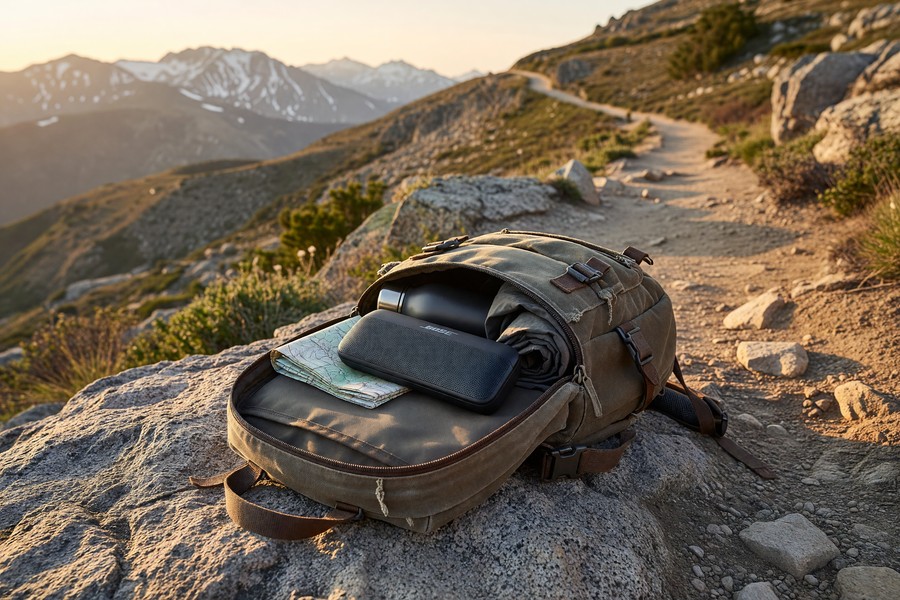
The speaker itself is only half the equation. How you pack your portable bluetooth speakers travel setup can be the difference between a device that lasts three years and one that gets a cracked grille somewhere over the Atlantic. Transit damage — especially to ports and driver grilles — is one of the most common and most avoidable causes of early speaker failure.
Packing Best Practices
Get a dedicated padded sleeve. Seriously — just do it. Both the Bose SoundLink Flex and JBL Charge 5 have official carry cases available for under $30, and third-party options from Hermitshell and ProCase offer comparable protection at even lower prices. Always pack your speaker in carry-on luggage, not checked bags. Pressure changes in cargo holds and the general violence of baggage handling are not things you want your speaker experiencing unprotected.
Airline and Customs Regulations
Lithium-ion batteries in portable speakers fall under International Air Transport Association (IATA) regulations for air travel. Most consumer speakers use batteries comfortably under the 100Wh carry-on threshold. Large party speakers, though? Some of those cross 160Wh, which triggers a whole different set of airline approval requirements. Check with your carrier before you assume you’re fine. If you’re tracking the full picture of travel costs, our guide to hidden costs of travel including transfers and insurance is worth a read alongside this one.
One more thing worth knowing if you travel internationally: some countries restrict the importation of radio-frequency devices. The Federal Communications Commission (FCC) certification mark on U.S.-sold speakers covers you across North America and most of Europe. Parts of Southeast Asia and the Middle East are a different story — regulations vary and are worth checking before you pack.
The average portable Bluetooth speaker is replaced every 2.4 years by frequent travelers — significantly shorter than the 4.1-year replacement cycle seen among home users, according to Statista consumer electronics lifecycle data. Investing in a rugged, well-protected model reduces this churn.
Traveling solo or trying to keep costs down? The right gear paired with smart financial habits makes a real difference. Our guide on solo travel on a budget — destinations, safety tips, and reward hacks covers exactly that. And for families heading outdoors with kids in tow, international travel with kids on a family budget includes practical packing guidance that covers portable electronics.
Related reading: How to Use a Multi.
Frequently Asked Questions
What is the best portable Bluetooth speaker for travel under $100?
The Sony SRS-XB100 is the clear winner under $100 — it retails around $60, weighs a remarkable 162 grams, carries a full IP67 rating, and still manages 16 hours of battery life. Genuinely hard to beat at that price point.
Can I bring a Bluetooth speaker on a plane?
Yes, most portable Bluetooth speakers are allowed in carry-on bags. The battery must be under 100Wh, which covers virtually all consumer speaker models. Always carry speakers in your carry-on rather than checked luggage to comply with most airline lithium-battery policies set by IATA regulations.
How do I know if a Bluetooth speaker is truly waterproof?
A speaker is considered genuinely waterproof only if it carries an IPX7 or higher rating. This means it can withstand submersion at 1 meter for up to 30 minutes. Ratings below IPX7 — such as IPX4 or IPX5 — only indicate splash or spray resistance and should not be trusted around bodies of water.
What is the lightest portable Bluetooth speaker for backpacking?
The Sony SRS-XB100 at 162 grams is among the lightest IP67-rated options available in 2025. The JBL Go 3 is even lighter at 209 grams with IPX7 certification, though it offers a shorter 5-hour battery life — a trade-off worth considering for ultralight trips.
Does Bluetooth version affect sound quality?
Bluetooth version does not directly affect audio quality — codec support does. What Bluetooth 5.0 and above improve are connection stability, range, and pairing speed. For better audio fidelity, look for support for aptX HD or AAC codecs regardless of Bluetooth version number.
How long do portable Bluetooth speakers last?
Most quality portable speakers are rated for 500–1,000 charge cycles before battery capacity drops noticeably. At one charge per day, that equates to roughly 1.5–3 years of daily use. Physical durability varies widely; IP67-rated models with reinforced housings typically survive 2–4 years of active travel use.
Are expensive Bluetooth speakers worth it for travel?
For frequent travelers, yes — and the math actually supports it. A $150 Bose or JBL speaker used 200+ times a year works out to well under $1 per use. Premium models genuinely deliver better sound, more robust waterproofing, and longer battery life than their budget counterparts. It’s not marketing fluff. Pairing smart gear choices with strategies for traveling more often without overspending makes the whole thing even more defensible.
Sources
- Statista — Bluetooth Speaker Unit Shipments Worldwide 2024
- Grand View Research — Bluetooth Speaker Market Analysis Report 2024
- Bluetooth SIG — Bluetooth 5 Technology Overview
- International Electrotechnical Commission (IEC) — IP Rating Standards (IEC 60529)
- RTINGS.com — Best Portable Bluetooth Speakers Tested and Reviewed
- IATA — Lithium Battery Air Transport Regulations
- USA Today Reviewed — Best Portable Bluetooth Speakers
- MarketsandMarkets — Portable Speaker Market Forecast to 2028
- JBL — Charge 5 Official Product Specifications