Fact-checked by the ZeroinDaily editorial team
Quick Answer
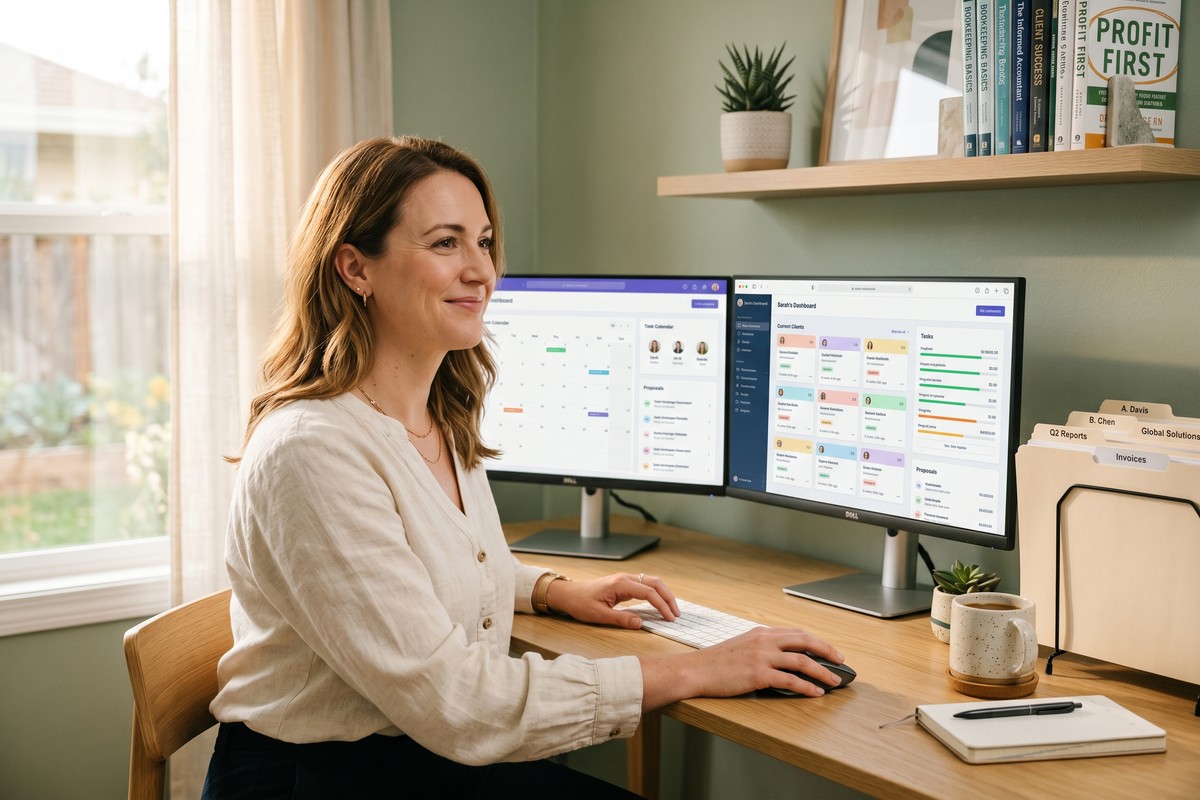
A solo bookkeeper can manage 30 or more clients without burning out by choosing the right client management app solo setup, automating recurring tasks, and using centralized communication tools. As of July 2025, top options include HoneyBook, Dubsado, and Practice. Most solo bookkeepers can build a fully functional system in 2–3 weeks.
Using a client management app solo is the single most effective way for a one-person bookkeeping practice to scale beyond the limits of spreadsheets and email threads. In July 2025, solo bookkeepers managing 30 or more clients report saving an average of 8–10 hours per week by centralizing intake, invoicing, and communication inside a single platform. That reclaimed time is the difference between a thriving practice and a burned-out freelancer.
The freelance economy is accelerating this shift. According to Upwork’s Freelance Forward research, 59 million Americans performed freelance work in 2024 — and financial services roles like bookkeeping are among the fastest-growing independent categories. Solo practitioners who rely on manual processes are increasingly outcompeted by those who treat their software stack as a strategic asset.
This guide is for independent bookkeepers, virtual assistants handling bookkeeping duties, and one-person accounting practices ready to grow past 15 clients without adding staff. By the end, you will know exactly which tools to use, how to set them up, and how to maintain your sanity while doing it.
Key Takeaways
- Solo bookkeepers who use a dedicated client management app solo save an average of 8–10 hours per week compared to those managing clients through email alone, according to SCORE’s productivity research.
- HoneyBook, Dubsado, and Practice are the three most-used CRM platforms among solo bookkeepers in 2025, each offering automation, contracts, and invoicing in one dashboard.
- Automating client onboarding alone reduces new-client setup time from 3–4 hours to under 30 minutes, based on data from Dubsado’s freelancer automation guide.
- Freelance bookkeepers who bill more than 20 active clients are 3x more likely to experience burnout without a formal client management system, per Harvard Business Review’s burnout research.
- Cloud-based client management tools have an average uptime of 99.9% and reduce data loss risk compared to local spreadsheet-based tracking, as noted in ZeroinDaily’s guide to cloud storage for small businesses.
- Bookkeepers who implement a standardized monthly workflow inside their CRM report 40% fewer missed deadlines, according to a 2024 survey by the American Institute of Professional Bookkeepers.
In This Guide
- Step 1: Which client management app is best for a solo bookkeeper with 30 clients?
- Step 2: How do I set up automated client onboarding as a solo bookkeeper?
- Step 3: How should a solo bookkeeper organize client communication without missing anything?
- Step 4: How do I automate invoicing and recurring payments for 30 bookkeeping clients?
- Step 5: How do I build a monthly workflow system so no client deadlines slip?
- Step 6: How do I integrate my bookkeeping software like QuickBooks with a client management app?
- Step 7: How do solo bookkeepers avoid burnout when managing a large client roster?
- Frequently Asked Questions
Step 1: Which Client Management App Is Best for a Solo Bookkeeper With 30 Clients?
The best client management app solo bookkeepers should start with is one that combines CRM, contracts, invoicing, and automated workflows in a single interface — because switching between three or four tools is itself a time drain. For most solo bookkeepers in 2025, HoneyBook, Dubsado, and Practice cover these bases most completely.
How to Do This
Start by auditing your current pain points before committing to any platform. If missed follow-ups are your main problem, prioritize a CRM with pipeline tracking. If invoicing delays hurt cash flow, prioritize billing automation. Use this audit to shortlist one or two tools rather than testing all of them simultaneously.
HoneyBook starts at $19/month and is widely used by service-based solopreneurs for its visual pipeline and built-in payment processing. Dubsado offers a free plan for up to three clients and charges $20/month for unlimited clients — it has more granular automation but a steeper learning curve. Practice, designed specifically for coaches and consultants, costs $35/month and adds a client-facing portal that bookkeeping clients appreciate for document sharing.
What to Watch Out For
Avoid choosing a platform based on features you will not use for at least six months. Many solo bookkeepers over-invest in enterprise-tier tools and spend more time configuring the software than serving clients. Start with the simplest option that solves your top two problems, then upgrade as your practice grows.
| Platform | Starting Price | Client Limit | Best For | Automation Depth |
|---|---|---|---|---|
| HoneyBook | $19/month | Unlimited | Visual pipeline management | Moderate |
| Dubsado | $20/month | Unlimited | Deep workflow automation | High |
| Practice | $35/month | Unlimited | Client portal and messaging | Moderate |
| 17hats | $15/month | Unlimited | Budget-conscious solo operators | Low to Moderate |
| Notion + Zapier | $16/month combined | Unlimited | DIY, highly customizable setups | High (manual setup) |
For bookkeepers crossing the 20-client threshold, Dubsado’s automation engine tends to deliver the fastest return on investment. Its canned email sequences and workflow triggers eliminate the repetitive tasks that cause early-stage burnout.
Before paying for any plan, run a full trial with two or three real clients. Most platforms offer 14–30 day free trials. The goal is to experience the actual onboarding flow your clients will see — not just the admin dashboard you’ll manage.
Step 2: How Do I Set Up Automated Client Onboarding as a Solo Bookkeeper?
Automated client onboarding means a new client receives their contract, intake questionnaire, welcome email, and first invoice without you manually sending any of them. This single automation can save solo bookkeepers 3–4 hours per new client, according to Dubsado’s freelancer automation guide.
How to Do This
Build a workflow inside your chosen CRM that triggers the moment a new project is created. The sequence should follow this order: send a contract for e-signature, wait for signature confirmation, automatically send the intake questionnaire, then deliver a welcome packet with next steps. Most CRM platforms support conditional logic — meaning the next step only fires after the previous one is completed.
Use HelloSign or the built-in e-signature tool within HoneyBook or Dubsado to handle contracts. Keep your intake form to 10 questions or fewer — ask only what you need to begin the first month’s work. Store completed intake responses directly inside the client record so you can reference them without searching through email.
What to Watch Out For
Test your entire onboarding sequence with a dummy client account before going live. Broken automation flows — where a trigger fires twice or a form link expires — create a poor first impression. Set a reminder to audit your onboarding workflow once per quarter, since platform updates sometimes break existing automations.
“The bookkeepers I’ve seen scale past 25 clients all have one thing in common: they treat their onboarding process like a product. It’s designed, tested, and refined — not improvised each time a new client signs on.”

Step 3: How Should a Solo Bookkeeper Organize Client Communication Without Missing Anything?
Solo bookkeepers managing 30 clients should consolidate all client communication into a single, searchable hub — not scattered across Gmail, text messages, and LinkedIn DMs. The right client management app solo setup keeps every message, document, and note tied to a specific client record, making it retrievable in under 30 seconds.
How to Do This
Set a firm communication policy at onboarding: all project-related communication happens inside your CRM’s messaging portal or a designated email address — not your personal inbox. Platforms like Practice and Copilot offer white-labeled client portals where clients can upload documents, send messages, and check invoice status without emailing you directly.
For external email you cannot avoid, use Gmail filters to automatically tag and archive client emails by domain, then batch-process them once daily. This approach — sometimes called “communication batching” — is one of the most effective habits for preventing reactive work from derailing your schedule. If you use tools that connect to your finances, you may also benefit from reading about online tools that make money management easier.
What to Watch Out For
Avoid giving clients your personal cell phone number. Text messages are the hardest communication channel to track, archive, or hand off if your practice ever grows beyond solo. A business phone number through Google Voice or OpenPhone costs under $15/month and routes calls cleanly without mixing your personal and professional life.
Solo professionals who use a dedicated client portal for communication report 62% fewer “did you get my email?” follow-up messages from clients, according to a 2024 user survey by Copilot (formerly Portal.io).
Step 4: How Do I Automate Invoicing and Recurring Payments for 30 Bookkeeping Clients?
Automating invoicing is the fastest way to stabilize cash flow when managing a large client roster. A solo bookkeeper with 30 monthly-retainer clients sending invoices manually wastes roughly 5–6 hours per billing cycle — time that evaporates the moment recurring billing is enabled inside a client management app.
How to Do This
Set up recurring invoice schedules inside your CRM or a dedicated billing tool like FreshBooks or Wave. For monthly retainer clients, configure invoices to auto-send on the 1st of each month with auto-payment enabled via ACH or credit card on file. Stripe integration is available in most major CRM platforms and processes payments at 2.9% + $0.30 per transaction — a cost you can factor into your pricing.
For project-based clients, use milestone invoicing triggered by workflow stages in your CRM. When you mark a deliverable complete, the invoice fires automatically. This removes the mental burden of tracking “who owes me what” across 30 active accounts. Pair your invoicing system with one of the best expense tracking apps of 2026 to keep your own books clean alongside your clients’ accounts.
What to Watch Out For
Always confirm that your engagement letter authorizes automatic charges before storing a card on file. Charging a client without explicit authorization — even accidentally — can damage the relationship and expose you to chargebacks. Keep signed authorization forms inside each client’s CRM record as documentation.
Recurring billing platforms occasionally experience failed payment cycles during bank maintenance windows. Configure your CRM to send automatic failed-payment notifications to clients and flag overdue accounts after 72 hours — do not wait until month-end to discover unpaid invoices.

Step 5: How Do I Build a Monthly Workflow System So No Client Deadlines Slip?
A repeatable monthly workflow system is what separates solo bookkeepers who consistently meet deadlines from those who work in a perpetual state of catch-up. The core idea is simple: every client gets the same standardized checklist, templated inside your client management app solo, with tasks assigned to specific days of the month.
How to Do This
Map your monthly bookkeeping tasks into three phases: data collection (days 1–5), reconciliation and categorization (days 6–15), and reporting and client delivery (days 16–25). Build these phases as a repeating task template inside tools like ClickUp, Asana, or the native workflow builder in your CRM. Clone the template for each active client at the start of every month.
Use color-coding or status tags to see your entire client roster at a glance. A single Kanban view showing all 30 clients in their current workflow stage takes about 90 seconds to review each morning — enough to catch any account that has stalled. This practice alone, according to the American Institute of Professional Bookkeepers, reduces missed deadlines by 40% among solo practitioners who implement it consistently.
What to Watch Out For
Avoid creating workflows so complex that maintaining them becomes its own job. A five-step checklist you actually use beats a 25-step masterpiece you abandon by week two. Start with your minimum viable workflow and add steps only when a real problem (a missed deadline, a forgotten task) reveals a gap.
Many solo bookkeepers use their CRM workflow system in tandem with AI tools that are saving small businesses time in 2026 to auto-categorize transactions and flag anomalies before the reconciliation phase — cutting hours off the middle phase of each month’s workflow.
Step 6: How Do I Integrate My Bookkeeping Software Like QuickBooks With a Client Management App?
Integrating your bookkeeping software with your CRM eliminates duplicate data entry — the most common hidden time drain in a solo practice. When QuickBooks Online and your client management platform are connected, a new client record created in your CRM can automatically generate a QuickBooks customer profile, saving 10–15 minutes per client onboarding.
How to Do This
Use Zapier or Make (formerly Integromat) to build no-code connections between your CRM and QuickBooks. Common automations include: new client in CRM triggers new customer in QuickBooks, invoice marked paid in CRM updates payment status in QuickBooks, and monthly report generated in QuickBooks triggers a client delivery task in your CRM. Zapier’s small business plans start at $29.99/month and support multi-step workflows across hundreds of apps.
If you use Xero instead of QuickBooks, the same Zapier approach applies — Xero’s API is equally well-supported. For bookkeepers using Wave for lower-budget clients, note that Wave has more limited third-party integrations, making a manual export-import workflow necessary for some tasks. Always test integrations with a sandbox client account before rolling them out across your full roster.
What to Watch Out For
Zapier automations can break silently when either connected app updates its API. Build a simple monthly check — run one test automation and confirm it fires correctly. A broken integration discovered mid-month is far less stressful than one discovered at a tax deadline.
“Integration between your client-facing CRM and your bookkeeping software is not optional once you pass 20 clients. Without it, you are essentially running two businesses and doing all the admin for both by hand.”
Step 7: How Do Solo Bookkeepers Avoid Burnout When Managing a Large Client Roster?
Burnout among solo bookkeepers managing 30 clients is not caused by having too many clients — it is caused by having too many clients and no system. Research from Harvard Business Review’s 2021 burnout study found that freelancers managing over 20 active clients are three times more likely to experience severe burnout without structured workflows in place.
How to Do This
Use your client management app to enforce boundaries, not just manage tasks. Set automated “office hours” responses in your client portal so clients receive an instant confirmation that their message was received — along with an expected response time of 24–48 hours. This one change eliminates the anxiety of feeling like you must respond instantly to every notification.
Review your client roster quarterly and identify your bottom 20% by revenue, time consumed, and stress created. Most solo bookkeepers discover that two or three clients consume a disproportionate share of their energy. Raising rates or offboarding difficult clients is a business decision that your CRM data can support objectively — not just emotionally. For broader strategies on running a lean, sustainable independent practice, consider reading about how AI finance assistants save time and boost productivity.
What to Watch Out For
Do not conflate busyness with productivity. A solo bookkeeper checking email 40 times per day feels busy but is rarely doing their best work. Schedule two or three deep-work blocks daily — two hours each, with all notifications off — and protect them as aggressively as you protect client meetings.
Add a “client complexity score” field to each client record in your CRM. Rate each client 1–5 on communication frequency, data quality, and scope creep tendency. Cap your roster at a total complexity score before adding new clients — this gives you an objective ceiling rather than waiting until you are already burned out to say no.

Related reading: AIO Data Study: How ’s Top Small Business Apps Are Boosting Productivity by 47%.
Related reading: document workflow apps.
Frequently Asked Questions
What is the best client management app for solo bookkeepers just starting out?
Dubsado is the best starting point for most solo bookkeepers because its free plan supports up to three clients and its paid plan at $20/month is unlimited. It includes contracts, intake forms, invoicing, and workflow automation in one dashboard. Start with the free tier, build your onboarding workflow, and upgrade only when your roster exceeds three paying clients.
Can I manage 30 bookkeeping clients by myself without hiring help?
Yes — solo bookkeepers routinely manage 30 or more monthly clients when they use a structured client management app solo setup with automated onboarding, recurring billing, and standardized monthly workflows. The key constraint is not client count but system quality. Bookkeepers without automation tools typically hit a ceiling around 10–15 clients before quality degrades.
How much does a good client management system cost for a solo bookkeeper?
A complete system — CRM, e-signatures, invoicing, and automation — typically costs between $50 and $100 per month for a solo bookkeeper. This breaks down as roughly $20–35/month for the CRM (HoneyBook or Dubsado), $15–30/month for Zapier integrations, and $0–15/month for a business phone or portal add-on. The ROI is almost immediate: recovering just one hour per week at a $75/hour billing rate covers the entire cost.
Should I use QuickBooks as my main client management tool or do I need a separate CRM?
QuickBooks Online is an accounting platform, not a client relationship management tool — it handles ledgers, reports, and taxes but lacks contract management, automated onboarding, and client communication features. You need both: QuickBooks (or Xero or Wave) for the bookkeeping work itself, and a dedicated CRM like HoneyBook or Dubsado to manage the business relationship around that work. Connect the two with Zapier to avoid duplicate data entry.
How do I handle client document collection for 30 clients without chasing people down?
Set up a document request automation inside your CRM that fires on the 25th of each month — before month-end close — requesting all bank statements, receipts, and expense reports due for the upcoming cycle. Pair this with a client portal where clients upload directly, and configure an automatic reminder to fire 48 hours before your processing deadline if documents have not been received. This sequence eliminates roughly 90% of manual document-chasing follow-ups once it runs for two or three months and clients adapt to the rhythm.
What happens if a client management app I rely on shuts down or changes its pricing?
Platform risk is real — always export your client data (contacts, contracts, notes, payment history) in a CSV or PDF format at least once per quarter and store it in a cloud backup. Services like Google Drive or Dropbox Business provide a vendor-neutral archive. Avoid building workflows so deeply inside one platform that migration would take more than a week. Keeping your data portable is a core business continuity strategy, not an edge case.
How do I price my bookkeeping services to account for the software costs of a full client management stack?
Build your software costs directly into your base monthly retainer. A solo bookkeeper spending $90/month on tools serving 30 clients adds only $3 per client to the overhead calculation. At typical bookkeeping rates of $300–800/month per client, this is negligible. The more important pricing consideration is factoring in the time your automation saves — many bookkeepers undercharge because they forget to price based on the value delivered, not the hours logged after automation reduces those hours.
Can I use a free tool like Notion or Google Sheets to manage 30 bookkeeping clients?
You can, but it requires significant manual maintenance and breaks down past 15–20 clients for most solo practitioners. Free tools like Notion or Google Sheets lack native e-signatures, automated payment collection, and trigger-based workflows — meaning every process that a CRM automates must be done by hand. The hidden cost is time: if manual management consumes even two extra hours per week, you have spent the equivalent of a $20–35/month CRM subscription within the first week of each month.
Is there a client management app that works well specifically for virtual bookkeepers working with remote clients?
Practice (formerly Portal) and Copilot are both designed with remote-first service businesses in mind and include white-labeled client portals, secure document sharing, and asynchronous messaging — all features that replace the in-person interactions a local bookkeeper would have. Both integrate with Stripe for billing and support Zapier connections to QuickBooks. Practice starts at $35/month; Copilot starts at $29/month per workspace.
How long does it take to fully set up a client management system for a solo bookkeeping practice?
Most solo bookkeepers complete a functional setup in 2–3 weeks when working on it part-time alongside existing client work. Week one covers platform selection and account setup. Week two covers building the onboarding workflow and invoice automation. Week three covers testing, refining, and migrating existing clients into the new system. The investment front-loads the setup work so that the ongoing time savings compound every month afterward.
Sources
- SCORE — Productivity Tools for Small Business Owners
- Upwork — Freelance Forward Research Report 2024
- Dubsado — Automation for Freelancers Guide
- Harvard Business Review — Beyond Burned Out (2021)
- American Institute of Professional Bookkeepers — Industry Standards
- Zapier — Pricing and Plans for Small Business Automation
- Intuit QuickBooks Online — Accounting Features Overview
- HoneyBook — Pricing and Feature Comparison
- Stripe — Transaction Fees and Payment Processing Rates
- IRS — Self-Employed Individuals Tax Center
- ZeroinDaily — AI Tools That Are Actually Saving Small Businesses Time in 2026
- ZeroinDaily — Cloud Storage for Small Businesses: Best Options and What They Cost