Fact-checked by the ZeroinDaily editorial team
Quick Answer
The best noise-canceling headphones for remote workers combine active noise cancellation (ANC) that reduces ambient noise by up to 30 dB, with call clarity rated for environments above 85 dB. Specs like dB reduction rarely reflect real office or home conditions, so fit, microphone placement, and battery life matter as much as the ANC rating itself.
Noise-canceling headphones for remote workers have become standard equipment rather than a luxury, yet the spec sheets companies publish rarely translate cleanly into real-world performance. According to NIOSH’s occupational noise guidelines, the recommended safe exposure limit is 85 dBA averaged over an eight-hour workday, a threshold many home-office environments quietly exceed when neighbors, traffic, and household noise stack up. Choosing a headset based on marketing claims alone means betting your focus and your hearing on numbers measured in anechoic chambers, not living rooms.
, the remote-work headphone market is crowded with options priced from $30 to $450. The performance gap between entry-level and premium models is real, but it is narrower than it was three years ago, and the decision is more nuanced than price alone suggests.
Key Takeaways
- ANC lab ratings overstate real-world results by a meaningful margin; a headset rated at “30 dB reduction” may deliver closer to 20–25 dB in a typical home office, per NIOSH noise exposure guidance.
- Passive isolation adds 15 to 25 dB of noise blocking before ANC electronics activate, making ear-cup seal quality one of the most consequential specs on any headset, according to NIOSH’s occupational noise standards.
- Advertised battery life runs 25–35% higher than real-world figures when ANC and a high-quality Bluetooth codec such as aptX Adaptive operate simultaneously.
- The WHO recommends keeping headphone output below 80 dB to prevent cumulative hearing damage; ANC lowers the risk by reducing the need to raise volume against ambient noise, as detailed in WHO safe-listening guidance.
- Consumer ANC headsets are not certified hearing protection and should not substitute for laboratory-tested PPE in industrial environments, per OSHA’s 2023 interpretation letter.
- Microphone SNR and polar pattern determine call quality on Zoom and Microsoft Teams, yet most headset listings omit both specs entirely.
What ANC Specs Actually Mean for Daily Use
Active noise cancellation ratings are measured under controlled lab conditions, not in a kitchen with a dishwasher running and a dog barking. Most manufacturers test in anechoic chambers at low-to-mid frequency ranges, which is why a headset rated at “30 dB reduction” may feel disappointing against the sharp, high-frequency click of a mechanical keyboard two rooms over.
ANC works best on steady, low-frequency sounds: HVAC hum, airplane cabin rumble, and consistent traffic noise. It performs measurably worse on speech, sudden impact noises, and anything above roughly 1 kHz. Sony’s WH-1000XM5 and Bose QuietComfort Ultra, both flagships as of early 2025, advertise similar dB reduction numbers but handle vocal frequencies differently because of how their microphone arrays process the feedback signal.
Passive Isolation vs. Active Cancellation
Over-ear headphones with dense ear cushions provide 15 to 25 dB of passive isolation before ANC even activates. This physical seal matters enormously for workers on video calls, where mid-range voice frequencies from nearby conversations are the primary disruptor. A headset with strong passive isolation and average ANC will often outperform one with elite ANC but a thin, poorly sealing ear cup.
Open-back headphones, favored by audio engineers for their soundstage, provide zero isolation and are a poor choice for anyone working in a shared or noisy environment. That form factor distinction is more consequential than the ANC dB number printed on the box.
ANC spec ratings are measured in anechoic labs and typically overstate real-world performance. NIOSH’s 85 dBA exposure limit is the practical benchmark to work from; headsets with strong passive isolation plus ANC are consistently more effective than high ANC ratings with a poor physical seal.
Microphone Quality: The Spec Nobody Leads With
Microphone performance is the single most under-specified aspect of headsets marketed to remote workers, yet it determines how you sound on every call. A headset that blocks the world beautifully but transmits your voice as muffled or echo-prone will cost you credibility on client calls regardless of its price tag.
Frequency response, polar pattern, and signal-to-noise ratio (SNR) are the three microphone specs that actually matter. Most consumer headsets publish none of them. Boom microphones (those with an adjustable arm that positions the mic close to the mouth) consistently outperform built-in microphone arrays for voice clarity because proximity to the source matters more than digital processing.
Monaural vs. Binaural Headsets for Call-Heavy Work
Workers on calls for more than four hours a day should consider a monaural (single-ear) design carefully. As audiologist Brian Fligor has cautioned, and as Consumer Reports notes: “when you have it (a headphone) only on one side, it doesn’t feel as loud, so you turn it up. That causes you to listen in that one ear more loudly.” For long call sessions, a binaural over-ear model at moderate volume is the safer choice.
Maria Rerecich, Director of Electronics Testing at Consumer Reports, has pointed out that noise-canceling headphones reduce the need to raise volume against background noise, which directly lowers cumulative ear fatigue during an eight-hour workday. That outcome does not appear anywhere on a spec sheet.
Microphone SNR and polar pattern determine call quality, yet most headset listings omit them entirely. Workers logging more than 4 hours of daily calls should prioritize boom-mic models and binaural designs at moderate volume, per guidance cited by Consumer Reports.
Battery Life and Connectivity for Real Work Schedules
A headset rated at 30 hours of battery life may deliver closer to 20 hours with ANC and a Bluetooth codec like aptX Adaptive running simultaneously. This is not a flaw unique to any one brand; it is a consistent pattern across the category because manufacturers test at 50% volume without ANC active.
For remote workers who move between a home office, a co-working space, and travel, multipoint Bluetooth connectivity (the ability to pair with two devices simultaneously) is a practical necessity, not a feature tier. Switching between a laptop and a phone mid-call without re-pairing is a workflow detail that matters far more after 90 days of daily use than it does in a product review.
USB-C vs. Proprietary Dongles
USB-C charging has become the dominant standard across premium headsets in 2025, which matters for remote workers who already carry a laptop and phone charger. Headsets that still ship with proprietary charging cables or Micro-USB add friction that compounds over time. Connectivity via USB-C audio adapter also provides a latency-free alternative to Bluetooth for workers on platforms like Zoom or Microsoft Teams that penalize audio lag.
If you manage small-business expenses around your remote setup, the IRS home office deduction rules allow business-use headsets to be deducted, which changes the effective cost of a $350 premium model considerably.
| Headset Tier | ANC Reduction (typical real-world) | Battery (ANC on) | Mic Type | Best For |
|---|---|---|---|---|
| Budget ($30-$80) | 8-12 dB | 15-20 hrs | Built-in array | Light call use, quiet rooms |
| Mid-Range ($80-$200) | 15-22 dB | 20-28 hrs | Built-in array or boom | Open-plan offices, mixed use |
| Premium ($200-$350) | 25-30 dB | 25-35 hrs | Boom or adaptive array | Heavy call schedules, loud environments |
| Professional ($350+) | 28-32 dB | 30-40 hrs | Certified boom mic | Contact centers, enterprise teams |
Advertised battery life runs consistently 25–35% higher than real-world figures with ANC and a high-quality codec active. Multipoint Bluetooth and USB-C charging are the connectivity specs that matter most for workers across multi-device remote workflows.
Hearing Safety: What the Marketing Skips Entirely
Almost no headset marketing mentions hearing health, yet long listening sessions at elevated volumes cause cumulative damage that becomes permanent. The risk for remote workers is specific: wearing headphones for eight or more hours a day at volumes intended to mask ambient noise creates sustained exposure that far exceeds casual listening habits.
The World Health Organization advises that sound levels below 80 dB are unlikely to cause hearing damage, and recommends using monitoring tools such as the NIOSH Sound Level Meter app to check both headphone output and environmental noise. Many workers have no idea what volume level they are actually listening at.
The connection between ANC and hearing safety is direct and underappreciated. According to University of Colorado Anschutz research on noise-canceling headphone safety, audiologist Cory Portnuff explains: “Ultimately, what we’re most concerned about is the sound level at your ear in your headphones.” When ANC reduces ambient noise, users naturally lower their listening volume, which is the primary protective mechanism these headphones provide.
ANC headsets also have clear limits. OSHA’s 2023 official interpretation letter concludes that consumer noise-canceling headphones are not recommended as substitutes for laboratory-tested hearing protection devices in industrial environments. Remote workers in home offices rarely face OSHA-regulated noise hazards, but anyone working near construction, machinery, or consistently loud equipment should not rely on consumer headsets as hearing protection.
The WHO recommends keeping headphone output below 80 dB to prevent hearing damage, per WHO safe-listening guidance. ANC headsets lower the risk by reducing the need to raise volume, but they carry no ANSI or NIOSH certification for industrial hearing protection and should not be treated as such in high-noise environments, per OSHA’s 2023 guidance.
How to Choose the Right Headset Without Getting Fooled by Specs
The most useful filter is not the ANC dB rating. It is an honest assessment of your specific noise environment and call volume. A worker in a quiet apartment with occasional street noise needs a different product than someone in a co-working space or a home with school-age children.
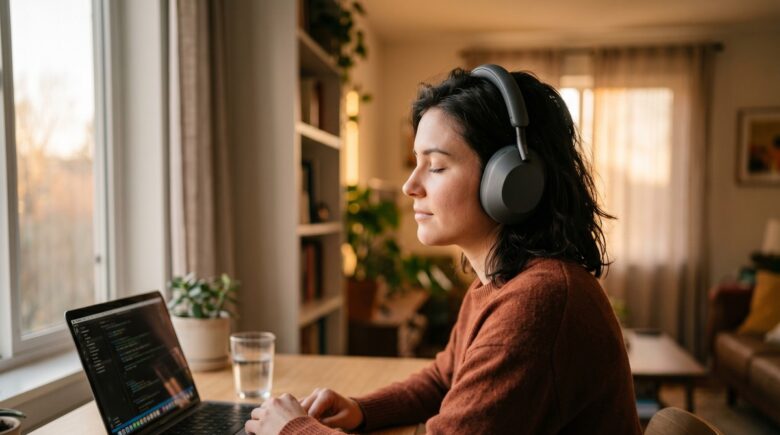
Start with your dominant use case. If your work is primarily solo focus time (writing, coding, analysis), full over-ear ANC is the priority and microphone quality is secondary. If your day is dominated by video calls, reverse that priority: invest in microphone quality and settle for adequate ANC rather than the other way around.
Remote workers who rely heavily on AI productivity tools during calls should also check whether their headset’s software includes meeting transcription integration, a feature that has become common in mid-range and premium models from Jabra, Poly, and Bose in 2025.
What a 30-Day Trial Period Actually Reveals
Most premium headsets come with a 30-day return window, and that window is genuinely useful. Fit comfort, software stability, and call quality on your actual platform (Teams, Zoom, Google Meet) will reveal more in two weeks of real use than any spec sheet.
Ear fatigue during a six-hour call day is a pressure and heat issue, not a frequency response issue. It only shows up after sustained use, which is why the trial period exists and why you should use all of it.
The brands with consistent enterprise-grade reliability in 2025 are Jabra, Poly (now HP Poly), Bose, Sony, and Apple (for Mac-centric workflows). Each targets a distinct use profile, and the best choice shifts depending on whether your priority is audio quality, call hardware certification, or ecosystem integration. For workers managing broader remote-work finances and tool expenses, a resource like expense tracking apps can help categorize equipment purchases correctly from the start.
Match headset type to your dominant use case: focus workers should prioritize ANC and passive isolation, while call-heavy workers should prioritize microphone quality. Use the full 30-day return window to evaluate comfort and platform compatibility; fit-related fatigue only becomes apparent after days of sustained use. Jabra, Poly, Bose, and Sony lead for enterprise-grade reliability.
Frequently Asked Questions
Do noise-canceling headphones actually improve productivity for remote workers?
Yes, with an important caveat. ANC reduces low-frequency distractions like HVAC hum and traffic most effectively, which helps with sustained focus tasks. Research cited by OSHA’s technical manual confirms that noise exposure causes measurable reductions in cognitive performance, so reducing it has a direct productivity benefit. The gain is most pronounced in environments with consistent ambient noise above 60 dB.
What is the difference between active noise cancellation and passive noise isolation?
Passive isolation is the physical blocking of sound by the headset’s ear cups and cushions, typically reducing noise by 15 to 25 dB without any electronics involved. Active noise cancellation uses microphones and signal processing to generate an inverse sound wave that cancels additional noise, primarily in low-frequency ranges. Most over-ear headsets from brands like Sony, Bose, and Jabra use both together, and the combined effect is significantly better than either alone.
Are noise-canceling headphones safe for all-day wear?
Yes, provided volume is kept below 80 dB. The WHO’s safe listening guidance identifies that threshold as the point below which hearing damage is unlikely. ANC headsets reduce the temptation to raise volume to mask ambient sound, which is the primary safety benefit. Extended wear at high volume remains harmful regardless of whether ANC is active.
What headset specs matter most for video calls on Zoom or Microsoft Teams?
Microphone clarity is the top priority: look for headsets with a boom microphone, a frequency response that covers 100 Hz to 8 kHz for voice, and certification for your specific platform. Jabra and Poly both publish certified device lists for Teams and Zoom. ANC rating matters less for call quality than it does for personal focus, because the microphone only picks up your voice, not what you hear.
Can I use consumer noise-canceling headphones as hearing protection at work?
No. OSHA’s 2023 interpretation letter explicitly states that consumer noise-canceling headphones should not substitute for laboratory-tested hearing protection devices in occupationally noisy environments. They can reduce exposure in typical home-office settings, but they carry no ANSI or NIOSH certification for industrial hearing protection. Workers exposed to hazardous occupational noise must use certified PPE.
How much should a remote worker spend on a noise-canceling headset?
For call-light work in a moderately quiet home office, a mid-range headset in the $80 to $200 range provides adequate ANC and acceptable microphone quality. For workers on calls more than four hours a day or in loud shared spaces, a premium model between $200 and $350 is a justifiable business expense and, in many cases, tax-deductible under IRS home office rules. Spending above $350 yields diminishing returns unless enterprise software integration or physical durability requirements apply.
Which Bluetooth codec should I look for in a remote-work headset?
aptX Adaptive is the strongest option available in 2025 for Android and Windows users, offering low latency and high audio quality simultaneously. Apple devices default to AAC, which performs well within the Apple ecosystem but offers less flexibility across platforms. SBC remains the universal fallback codec supported by all Bluetooth devices, but it delivers noticeably lower audio quality. For Zoom or Microsoft Teams calls, a USB-C wired connection eliminates codec-related latency entirely.
Does ANC cause any discomfort during long wear sessions?
Some users report a pressure sensation from ANC, caused by the inverse sound wave the system generates rather than physical clamping force. This varies by individual and by headset design. Sony’s WH-1000XM5 includes adjustable ANC intensity levels specifically to address this. If you notice discomfort during the trial period, reducing ANC strength rather than abandoning the feature entirely is worth testing before returning the headset.
Are there any hearing risks specific to remote workers that office workers avoid?
Remote workers face a distinct risk profile. Without the natural sound floor of a shared office, many workers wear headphones for longer continuous stretches and at higher volumes to compensate for variable home-office noise. NIOSH’s 85 dBA eight-hour exposure limit applies to environmental noise, but the same principle holds for headphone output. Workers who track their exposure using the NIOSH Sound Level Meter app consistently find their listening volumes higher than they expected.
What is the best headset brand for Microsoft Teams certification?
Jabra and Poly (HP Poly) hold the broadest Microsoft Teams certification portfolios among headset manufacturers. Both brands publish certified device lists and offer hardware that integrates directly with Teams call controls, mute status, and presence indicators. Bose and Sony offer Teams-compatible models, but their software integration is less thorough than Jabra’s and Poly’s dedicated business lines.
Sources
- CDC / NIOSH, About Noise and Hearing Loss Prevention
- OSHA, 2023 Standard Interpretation: Consumer Noise-Canceling Headphones and Hearing Protection
- World Health Organization, Safe Listening: Questions and Answers
- Consumer Reports, Headphone Types to Help Prevent Hearing Loss
- University of Colorado Anschutz, Do Noise-Canceling Headphones Help or Hurt Hearing?
- OSHA Technical Manual, Section III, Chapter 5: Noise
- Jabra, Professional Office Headsets Overview