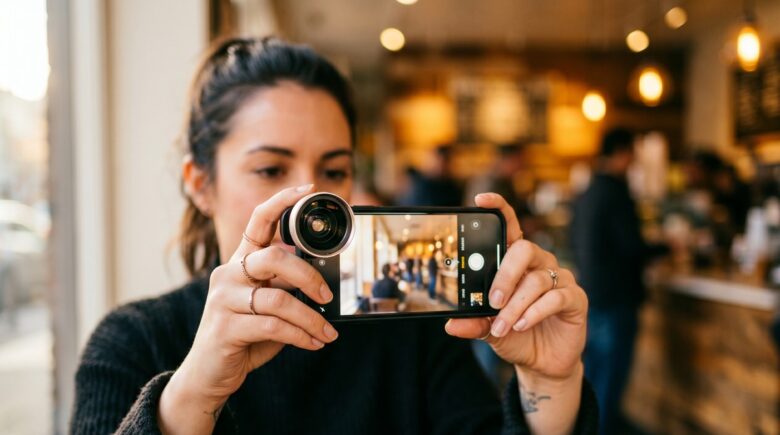
Fact-checked by the ZeroinDaily editorial team
The Verdict
A clip-on phone lens is usually worth it if your phone lacks a dedicated macro or telephoto option and you spend at least $40 on quality glass. It is not worth it if your phone already has three or more rear cameras, you shoot mostly in low light, or you are unwilling to deal with alignment issues that cheaper clip mounts reliably cause.
Updated August 2026
, 91% of U.S. adults own a smartphone, according to the Pew Research Center (2025), making mobile photography a near-universal activity. Yet despite this widespread adoption, many users still encounter hardware limitations, especially in focal length versatility. The single factor that swings this decision is how many usable focal lengths your current phone already covers. A clip-on phone lens adds genuine value when your hardware has a gap; it adds almost nothing when it duplicates what a built-in ultrawide or periscope telephoto already does better. According to Digital Camera World’s guide to add-on lenses, premium case-mount systems like Moment’s T-Series are now designed specifically for modern smartphones with larger sensors and wider apertures, which means the accessories themselves have had to improve just to keep pace with native optics.
As of mid-2026, flagship phones from Apple, Samsung, and Google ship with computational photography pipelines that close the gap on optical weaknesses. The question of whether to attach glass to your phone is more consequential than it sounds. For context, 98% of U.S. adults own some kind of cellphone, underscoring how deeply embedded mobile imaging has become in daily life. Yet even with this penetration, users still seek ways to expand their creative range, especially when native capabilities fall short.
| Factor | Reasons to Buy a Clip-On Lens | Reasons to Skip It |
|---|---|---|
| Focal Length Coverage | Adds true macro (minimum focus distance under 10 mm) or 3x–10x optical zoom your phone lacks | Flagship phones with 3–5 cameras already cover most focal ranges natively |
| Image Quality | High-quality glass (Moment, Sandmarc) measurably sharpens edges vs. digital crop | Cheap clip lenses ($10–$15) introduce chromatic aberration and soft corners |
| Cost | $40–$100 is far cheaper than upgrading a $900+ phone for one missing feature | Quality glass for a case-mount system runs $80–$150 per lens plus case cost |
| Alignment & Stability | Case-mount systems align precisely with the native lens every time | Universal clip mounts shift under pressure and ruin sharpness across the frame |
| Low-Light Performance | No meaningful degradation in daylight with quality glass | Any add-on lens reduces light transmission, hurting Night Mode performance noticeably |
| Portability | Lenses weigh 20–60 g and fit in a jacket pocket | Carrying a case-mount system plus two extra lenses rivals a compact camera in bulk |
Key Takeaways
- Your phone has fewer than 3 rear cameras, meaning at least one focal length (macro, telephoto, or ultrawide) is missing entirely.
- You are willing to spend at least $40 on the lens; anything under that threshold produces noticeably soft, distorted images in most real-world tests.
- You shoot primarily outdoors or in well-lit spaces, since add-on glass costs you roughly 1/3 to 1 stop of light transmission versus native optics.
- You choose a case-mount system (Moment T-Series, Sandmarc, or equivalent) rather than a universal clip, because clip mounts misalign under the slightest pressure.
- Your primary use case is macro photography, close-up product shots, or extended telephoto beyond 5x, where built-in cameras on mid-range phones still fall short.
- You own a mid-range phone priced between $300 and $600 where the manufacturer cut camera hardware to hit a price point.
- You are not planning a phone upgrade within the next 12 months, making the accessory investment worthwhile before it becomes incompatible with a new model.
Does a clip-on lens actually improve image quality?
Quality matters enormously here, and the gap between a $15 clip and a $90 Moment lens is not subtle. How-To Geek’s analysis of smartphone add-on lenses concludes that clip-on lenses are not a blanket recommendation for modern smartphone users, but are genuinely worthwhile when a phone’s built-in lens options fall short of specific needs such as true macro or extended telephoto. The key word is “specific.” Buying a wide-angle clip-on for a phone that already has a 13 mm ultrawide built in is a waste of money.
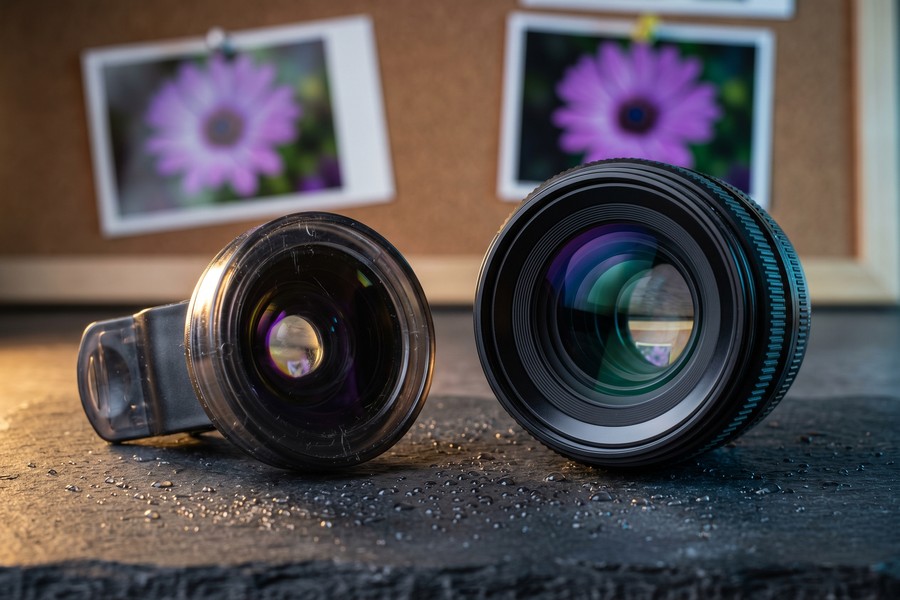
The optics on budget add-ons are the problem. Glass quality, coating, and barrel construction all affect sharpness. Cheap lenses introduce chromatic aberration (color fringing around high-contrast edges) and soft corners that are hard to fix in post-processing. A well-made lens from Moment or Sandmarc, by contrast, uses multi-element glass with anti-reflective coatings that hold up against the native sensor’s resolution. The difference shows clearly at 100% crop on any screen larger than a phone display.
Why does the mounting system matter more than the glass?
The mounting system determines whether even expensive glass performs well. Tom’s Guide’s iPhone lens review advises directly that bespoke lens cases are generally superior to universal clip mounts because clip mounts can shake or misalign and ruin shots, and that spending more on quality glass yields measurably better results. That is not a minor caveat; it is the central practical issue for anyone choosing between a $20 universal clip and an $80 case-mount setup.
Universal clips work by gripping the edge of the phone and centering over the camera module. The problem is that camera module positions vary by millimeters across different phone models, and the clip’s gripping pressure shifts slightly the moment you tap the shutter or change your grip. Case-mount systems avoid this entirely because the lens thread is machined into a case molded for a specific phone model. The alignment is fixed. For anyone serious about consistent results, the case-mount approach is not optional; it is the minimum viable setup.
The practical cost of this is that you are locked into buying lenses for one phone’s mount system. When you upgrade your device, the lenses may not transfer to the new model’s case. Moment, for instance, updates its T-Series cases when major phone lines refresh, so compatibility is not guaranteed across generations. This trade-off is worth considering, especially given that global digital camera shipments in 2025 reached 9.44 million units across CIPA member companies, suggesting sustained interest in dedicated imaging devices, despite the dominance of smartphones.
Where do built-in cameras still fall short?
Computational photography has closed many gaps, but two areas remain where add-on optics deliver something a software algorithm cannot: true macro and long telephoto beyond 10x. The iPhone 16 Pro’s macro mode uses a wide-angle lens stopped down and relies heavily on computational depth processing. It performs well, but it still cannot match the working distance flexibility of a dedicated macro lens that lets you get within 5–10 mm of a subject.
On the telephoto side, mid-range phones like the Google Pixel 8a or Samsung Galaxy A55 (both still widely in use) max out at 2x optical zoom before switching to digital crop. A 3x or 4x telephoto clip-on adds genuine optical magnification that the sensor cannot replicate through cropping, especially for outdoor subjects where detail resolution matters. According to Digital Camera World, the best add-on lenses remain the most practical option for budget phone users wanting to expand creative possibilities without replacing the device.
Low light is where add-on glass unambiguously loses. Every additional lens element reduces light transmission. On a phone already working hard with a small sensor, that loss is felt immediately in Night Mode performance, which depends on capturing enough photons over a multi-frame exposure. An add-on lens that costs you one stop of light essentially cuts the sensor’s sensitivity in half for those shots. For users relying on low-light imaging, this degradation can outweigh any perceived benefit.
When is upgrading your phone smarter than buying an accessory?
If your phone is more than three years old and lacks optical image stabilization, a new mid-range device will outperform any clip-on lens investment across nearly every shooting condition. The computational photography improvements between a 2022 and a 2025 mid-range phone are substantial: multi-frame processing, improved night algorithms, and larger sensor sizes collectively produce better results than any glass attachment on older hardware. Spending $90 on a Moment lens for a four-year-old device is rarely the right financial decision.
The math changes for people on a limited budget who own a relatively recent phone with a specific capability gap. If you have a 2024 or 2025 mid-range phone that simply lacks a macro mode and you need it for product photography or close-up content, a $50–$80 macro clip-on is a far better option than a $700 upgrade. For content creators and small business owners who rely on visual content, the right accessory can extend a phone’s useful life by 12 to 18 months. If you are already thinking about how technology can work harder for your workflow, you might also find value in reading about AI tools that are saving small businesses time in 2026, since the same budget-efficiency logic applies.
Who should and who should skip a clip-on lens?
Good candidates
These are the scenarios where a clip-on lens pays for itself in noticeable image quality gains.
- Mid-range phone owners with a 2023–2025 device priced under $500 who need macro capability for product listings, food photography, or nature close-ups.
- Content creators who shoot short-form video outdoors and need a wider field of view than their phone’s native lens without the distortion of a cheap ultrawide.
- Budget photographers who want to experiment with telephoto compression for portraits but cannot justify a flagship phone purchase for that one feature.
- Travel photographers on older devices who need extended telephoto for wildlife or architecture shots where digital zoom produces unacceptable grain.
Who should skip it
For these readers, the money and hassle will not produce a meaningful improvement.
- Owners of flagship phones (iPhone 16 Pro, Samsung Galaxy S25 Ultra, Google Pixel 9 Pro) that already cover ultrawide, standard, 3x, and 5x–10x telephoto natively.
- Anyone who shoots primarily in low light or indoors, where the light transmission loss from an add-on lens actively degrades results compared to the native Night Mode.
- Casual photographers who would not notice or use the quality difference, and for whom a $50–$100 spend is better directed toward cloud backup or an editing app.
- People who regularly switch between phones or plan an upgrade in the next six months, making a model-specific case-mount system a poor investment immediately.
Related reading: Which Smart Packing Cubes Actually Sync With Your Phone in 2026?.
Frequently Asked Questions
Are clip-on phone lenses worth it in 2026?
They are worth it only when your phone lacks a dedicated macro or telephoto option and you invest in quality glass from a brand like Moment or Sandmarc. For flagship models with multiple native lenses, they offer little to no benefit.
, 91% of U.S. adults own a smartphone, according to the Pew Research Center, meaning most users already have powerful imaging tools in their pockets. Yet hardware limitations persist, especially in niche use cases like macro or extended telephoto.
Do clip-on lenses work with the iPhone 16 Pro?
Technically yes, but practically they add little for most users. The iPhone 16 Pro already covers 0.5x, 1x, 2x, and 5x optical focal lengths natively. A clip-on beyond 5x may still be useful for specialized shooting, but alignment precision is critical.
According to GSMArena, the iPhone 16 Pro includes multiple lens systems, including a periscope telephoto, which minimizes the need for add-ons in most scenarios.
What is the best clip-on lens for Android phones?
Moment’s T-Series lenses paired with their phone-specific cases consistently rank at the top of third-party lens tests for sharpness and color accuracy. Sandmarc is a strong alternative with slightly more affordable pricing.
These systems are best suited for users with specific needs who are willing to commit to a case-mount setup, which ensures consistent alignment and optical performance.
Can a clip-on lens replace a dedicated camera?
No. Add-on lenses improve on specific limitations of your phone, but they do not change the sensor size, dynamic range, or processing pipeline. A dedicated mirrorless or compact camera still produces materially better results in challenging conditions.
Even with advances in computational photography, the physical constraints of a smartphone sensor remain a hard limit. For professional-grade work, dedicated cameras are still the standard.
Do clip-on lenses affect video quality on phones?
Yes. Any clip mount that shifts slightly will produce wobble in video that electronic stabilization cannot fully correct. A case-mount system eliminates most of that risk.
For vloggers or creators, secure mounting is essential. The same goes for video in low-light conditions, where even small misalignments degrade stability and sharpness.
Is it better to spend $50 on a clip-on lens or put it toward a new phone?
If your phone is under two years old and the issue is a single missing focal length, the clip-on is the smarter short-term spend. If your phone is three or more years old and shows weaknesses in multiple areas, saving that $50 toward a device upgrade will deliver better results across the board.
, 98% of U.S. adults own a cellphone of some kind, highlighting how critical mobile devices have become, but also how much users are willing to invest in improving them.
Why do cheap clip-on lenses produce blurry images?
Cheap clip-ons use low-quality glass, poor coatings, and loose mounting systems. These flaws cause chromatic aberration, soft corners, and misalignment, especially under pressure or when capturing fast motion.
Even minor shifts in focus or alignment can ruin a shot. High-end systems like Moment or Sandmarc mitigate this with precision-machined cases and multi-element optics.
Are case-mount systems compatible across different phone models?
No. Case-mount systems are designed for a specific phone model and are not interchangeable. Upgrading your device may require buying new lenses or a new case.
This is a key trade-off: you gain optical consistency and reliability, but lose flexibility and future-proofing. Consider your upgrade timeline before investing.
Do add-on lenses work with Night Mode?
No. Every additional lens element reduces light transmission, which directly impacts low-light performance. Night Mode depends on capturing enough light over time, and a clip-on lens can cost you up to one stop of exposure, making it less effective.
For users who shoot frequently in dim environments, this loss is often unacceptable. The native Night Mode on newer phones is optimized to work without additional glass.
Sources
- Pew Research Center, U.S. Smartphone Ownership (2025)
- Pew Research Center, U.S. Cellphone Ownership (2025)
- Camera & Imaging Products Association (CIPA), Global Digital Camera Shipments (2025)
- Digital Camera World, Best Add-On Lenses for iPhone and Android Phones
- Tom’s Guide, Best iPhone Lenses Review
- How-To Geek, Are Smartphone Camera Lenses Worth Buying?
- GSMArena, Apple iPhone 16 Pro Full Specifications






