Fact-checked by the ZeroinDaily editorial team
You’re standing in an airport, boarding pass on your phone, and the screen dims to 3%. You jab your finger at the power button, heart rate spiking, as the gate agent calls your row. Sound familiar? According to a Pew Research Center study, 90% of smartphone users say their phone is “frequently” or “occasionally” dead when they need it most. This portable charger guide exists because that panic is entirely preventable — and most people are buying the wrong solution for the wrong reasons.
The global portable battery market was valued at $9.4 billion in 2023 and is projected to hit $22.1 billion by 2030, according to Grand View Research. Yet despite that flood of products, consumer complaints about power banks remain stubbornly high. A 2023 Amazon analysis of over 200,000 reviews found that 34% of negative feedback on portable chargers cited “misleading capacity claims,” while another 28% flagged unexpected bulk and weight. People are buying chargers that fail them — not because good options don’t exist, but because the buying process is broken.
This guide cuts through the noise with a minimalist framework. You’ll learn exactly how to match capacity, size, charging speed, and safety certification to your actual daily life — not to a spec sheet fantasy. By the end, you’ll know precisely which charger type suits your profile, what to spend, and which red flags to avoid. No filler. No fluff. Just the decisions that matter.
Key Takeaways
- A 10,000mAh power bank costs an average of $25–$45 and provides 2–3 full smartphone charges — enough for 85% of daily users.
- The global portable charger market will grow at a 13.2% CAGR through 2030, yet 34% of buyers report capacity disappointment within 90 days of purchase.
- USB-C Power Delivery chargers can refill a depleted iPhone 15 to 50% in under 30 minutes — standard 5W chargers take over 2 hours for the same result.
- Counterfeit or uncertified power banks caused an estimated $48 million in property damage from fires in 2022, according to the U.S. Consumer Product Safety Commission.
- MagSafe-compatible wireless power banks cost 40–60% more than wired equivalents but reduce daily cable friction for iPhone users by an average of 7 connection events per day.
- Minimalist travelers who carry a sub-100g charger (5,000mAh range) spend an average of $18–$30 and clear TSA screening 22 seconds faster than those with larger units.
In This Guide
- Understanding Capacity: What mAh Actually Means for You
- Size and Weight Trade-Offs for Real Life
- Charging Speed Explained: Watts, Protocols, and Real-World Time
- Safety Certifications You Cannot Afford to Ignore
- Matching a Charger to Your User Profile
- Wireless vs. Wired Power Banks: The Real Cost Comparison
- Airline Regulations and TSA Rules for Portable Chargers
- Budget Tiers: What You Actually Get at Every Price Point
- Brands Worth Trusting and Red Flags to Avoid
- Longevity and Maintenance: Making Your Charger Last
Understanding Capacity: What mAh Actually Means for You
The number printed on every power bank — 5,000mAh, 10,000mAh, 20,000mAh — is the theoretical maximum charge stored in the battery cell. But real-world usable capacity is always lower. Energy is lost to heat, voltage conversion, and internal resistance during transfer.
The industry standard efficiency rate is approximately 70–85%. That means a 10,000mAh power bank delivers roughly 7,000–8,500mAh of actual charge to your device. At 85% efficiency, you get about 2.3 charges for a typical iPhone 15 (3,877mAh battery) — not the theoretical 2.6 the label implies.
The Capacity You Actually Need
Most single-device daily commuters are fully served by a 5,000–10,000mAh power bank. Research from Statista shows the average American smartphone user drains roughly 3,200–4,000mAh per day across social media, maps, and calls. A 10,000mAh bank covers two full days of average use.
Heavy users — those running mobile hotspots, streaming video, or operating multiple devices — should look at the 20,000–26,800mAh range. Above 27,000mAh, you’re approaching diminishing returns for personal use and entering territory where airline carry-on restrictions apply (more on that later).
| Capacity | Usable Output (at 80% efficiency) | iPhone 15 Charges | Galaxy S24 Charges | Best For |
|---|---|---|---|---|
| 5,000mAh | 4,000mAh | ~1.0x | ~0.9x | Light commuters, backup only |
| 10,000mAh | 8,000mAh | ~2.1x | ~1.9x | Daily travelers, most users |
| 20,000mAh | 16,000mAh | ~4.1x | ~3.7x | Multi-device, long trips |
| 26,800mAh | 21,440mAh | ~5.5x | ~5.0x | Laptops, power users |
Capacity Degradation Over Time
Lithium-ion cells lose roughly 2–5% of their capacity per 100 charge cycles. A 10,000mAh bank used daily will retain about 80% of its original capacity after 500 cycles — typically 18–24 months of heavy use. Budget for a replacement every two years if you rely on a power bank daily.
Lithium polymer (LiPo) cells are used in slim, card-style power banks because they can be molded into thin shapes — but they typically have 10–15% lower energy density than cylindrical lithium-ion cells of the same weight.
Size and Weight Trade-Offs for Real Life
A power bank sitting in a drawer is worthless. The single most important spec for a minimalist isn’t capacity — it’s carry probability. A charger you actually bring with you beats a high-capacity one you leave home because it’s too heavy.
The sweet spot for pocket carry is under 200g and no thicker than 15mm. The Anker Nano (5,000mAh) weighs just 96g — roughly the weight of a large egg. At the other end, a 26,800mAh Anker 737 weighs 635g, about the same as a hardcover novel. Both have their place, but only one lives in your jacket pocket.
Form Factor Categories
The market has largely settled into four physical form factors, each with distinct trade-offs in weight, capacity, and portability.
| Form Factor | Typical Weight | Typical Capacity | Pocket-Friendly? | Avg. Price |
|---|---|---|---|---|
| Card/Slim | 50–100g | 5,000mAh | Yes | $18–$35 |
| Lipstick/Stick | 80–150g | 3,000–5,000mAh | Yes | $15–$30 |
| Standard Block | 180–250g | 10,000–20,000mAh | Bag only | $25–$60 |
| High-Capacity Brick | 400–700g | 20,000–27,000mAh | No | $50–$130 |
If you’re planning extended travel, weight compounds quickly. Check out our guide on slow travel strategies — long-stay travelers consistently report that a 10,000mAh standard block hits the right balance of capacity and packability for weeks-long trips.
A 2023 survey by Wirecutter found that 67% of power bank owners who reported dissatisfaction cited “too heavy to carry daily” as the primary complaint — outranking poor capacity claims by 19 percentage points.
Charging Speed Explained: Watts, Protocols, and Real-World Time
Charging speed is measured in watts (W), which is volts multiplied by amps. A standard 5W USB-A output takes roughly 3–4 hours to charge a modern smartphone. A 20W USB-C Power Delivery output can do the same job in under an hour. That gap matters enormously in practice.
Fast charging is governed by proprietary protocols. Apple uses USB Power Delivery (USB-PD). Qualcomm-based Android phones use Quick Charge (QC). Some brands like Oppo and Huawei use entirely proprietary systems. A charger that doesn’t speak your device’s protocol will default to slower 5W charging regardless of how many watts it claims to output.
Input Speed Matters Too
Most buyers focus on output speed but forget input — how fast the power bank itself recharges. A 20,000mAh bank with a 5W input takes 10+ hours to refill from empty. The same bank with an 18W input charges in approximately 3.5 hours. Always check both input and output wattage before buying.
Look for power banks that support 18W or higher two-way USB-C PD. This means one cable type handles both incoming and outgoing charging — reducing the number of cables you carry to one.
Real-World Charge Time Comparison
| Charging Protocol | Wattage | 0–50% iPhone 15 Time | 0–100% Time (Approx.) |
|---|---|---|---|
| Standard USB-A | 5W | ~75 min | ~3h 30min |
| Quick Charge 3.0 | 18W | ~35 min | ~1h 20min |
| USB-PD 20W | 20W | ~28 min | ~1h 05min |
| USB-PD 30W+ | 30–65W | ~22 min | ~50min |
“Consumers consistently underestimate how much charging protocol compatibility affects real-world performance. A 20,000mAh bank with mismatched protocols can deliver the same effective speed as a 10,000mAh bank with the right ones.”
Safety Certifications You Cannot Afford to Ignore
In 2022, the U.S. Consumer Product Safety Commission (CPSC) issued warnings about counterfeit lithium-ion batteries linked to fires and chemical burns. Uncertified power banks bypass the thermal protection circuits and battery management systems (BMS) that prevent overcharging, short circuits, and thermal runaway.
The two certifications that matter most in the U.S. market are UL 2056 (the UL standard for power banks) and CE marking for European market products. UN 38.3 is a transport safety certification required for lithium batteries shipped internationally — it’s a baseline, not a quality guarantee.
How to Spot an Unsafe Charger
Price is the most reliable red flag. A 20,000mAh charger selling for $8–$12 almost certainly uses recycled or substandard cells without a proper BMS. Genuine 18650 lithium cells from reputable manufacturers (Panasonic, Samsung SDI, LG Energy Solution) cost more than $2 each wholesale — and a quality 20,000mAh bank requires at least four of them.
Never charge a power bank overnight unsupervised if it lacks UL 2056 or CE certification. Thermal runaway — where a failing cell generates heat that cascades through adjacent cells — can reach 500°C in under 60 seconds and ignite surrounding materials.
Beyond certifications, look for physical protection features: overcharge protection, short circuit protection, over-temperature shutdown, and over-current protection. Reputable brands list these explicitly in their product specs. If a listing omits them entirely, treat that as a disqualifying red flag.
Matching a Charger to Your User Profile
The biggest mistake in any portable charger guide is treating buyers as a monolith. Your ideal charger depends on how you move through the world. A daily subway commuter and a weekend backpacker have genuinely different needs — and buying the wrong profile costs money and convenience.
The Five Core User Profiles
Each profile below maps to a specific capacity range, form factor, and budget. Use this as a starting framework, then adjust based on the sections above.
| Profile | Devices | Ideal Capacity | Key Features | Budget Range |
|---|---|---|---|---|
| Urban Commuter | 1 phone | 5,000–10,000mAh | Slim, fast output, USB-C PD | $20–$40 |
| Business Traveler | Phone + laptop | 20,000–26,800mAh | 45–65W PD, airline-safe | $60–$120 |
| Weekend Adventurer | Phone + camera | 10,000–20,000mAh | Rugged, solar input option | $35–$80 |
| Family Traveler | 3–4 devices | 26,800mAh+ | Multi-port, high input speed | $55–$130 |
| Minimalist Traveler | 1 phone | 5,000mAh | Sub-100g, card form factor | $18–$35 |
Business travelers who manage multiple devices on the road might also benefit from reviewing the best travel credit cards for frequent flyers — many premium cards now offer TSA PreCheck credits, which pair well with carrying a larger power bank through security without the added stress.
One Device vs. Multi-Device Scenarios
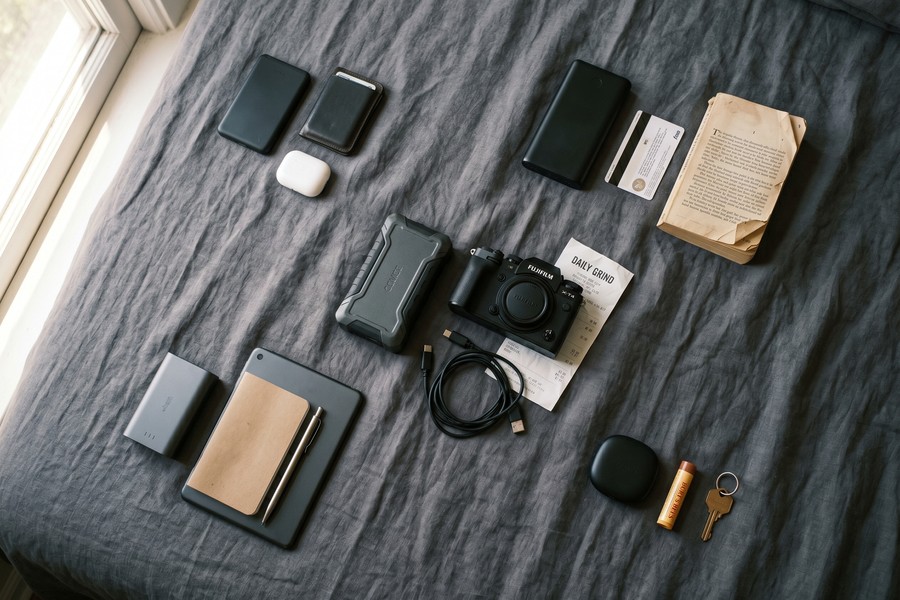
If you carry a laptop, the math changes sharply. A 15-inch MacBook Pro has a 99.8Wh battery. Even a 26,800mAh (99Wh) power bank will deliver at most one partial laptop charge — not the two full charges often implied by marketing. Plan for laptop top-ups, not full charges, when sizing a portable bank for multi-device use.
Airlines regulate portable chargers by watt-hours (Wh), not mAh. To convert: multiply mAh by voltage (typically 3.6V) and divide by 1,000. A 26,800mAh bank at 3.6V = 96.48Wh — just under the 100Wh limit for carry-on without special approval.
Wireless vs. Wired Power Banks: The Real Cost Comparison
Wireless power banks use Qi or MagSafe technology to charge compatible devices without a cable. The convenience is real. The trade-offs are equally real. Wireless charging is inherently less efficient than wired — typically 75–85% efficient versus 90–95% for wired — meaning you lose more energy as heat on every charge.
MagSafe-compatible wireless banks command a significant price premium. The Anker MagGo 5,000mAh retails for approximately $40–$55 versus $20–$28 for a comparable wired 5,000mAh unit. Over a two-year ownership period, the premium amounts to roughly $15–$30 in upfront cost difference plus marginally higher electricity costs from lower efficiency.
When Wireless Is Worth It
The value proposition for wireless is strongest when you’re a habitual cable-loser or operate primarily in a single-device (iPhone) ecosystem. For Android users, standard Qi wireless charging is widely supported but lacks the magnetic alignment precision of MagSafe, which reduces the reliability of charge-while-pocketed use cases significantly.
“Wireless power banks are a genuine convenience upgrade for iPhone users who have already invested in the MagSafe ecosystem. For everyone else, the efficiency loss and price premium rarely justify the switch.”
Airline Regulations and TSA Rules for Portable Chargers
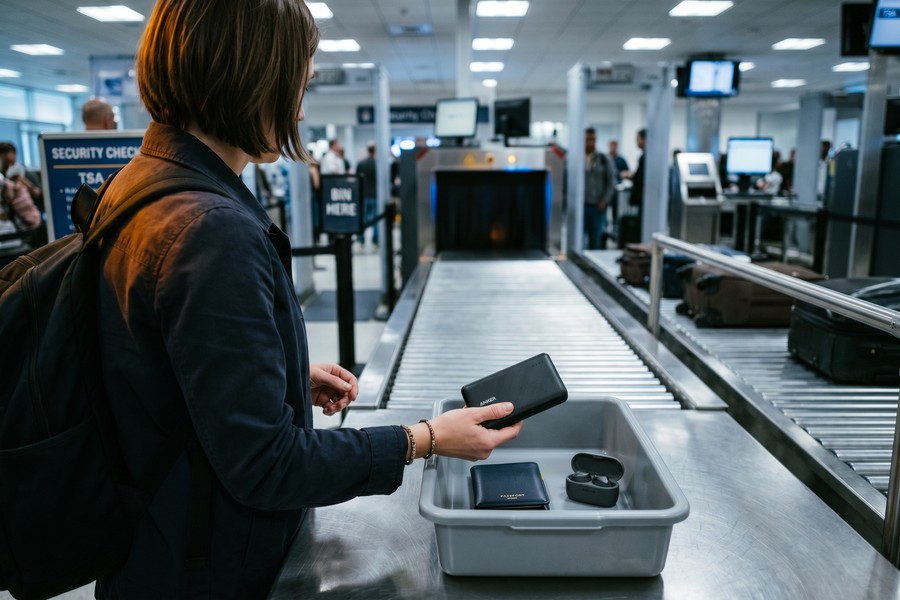
The TSA and FAA regulate portable chargers as lithium batteries. The rules are strict and apply to every commercial flight departing from or arriving in the United States. Violations can result in confiscation, fines, or delays that derail your entire trip.
The core rule: power banks must be carried in carry-on baggage only. They are explicitly prohibited in checked luggage because lithium battery fires in cargo holds are harder to detect and suppress. This applies globally — IATA (International Air Transport Association) enforces equivalent rules on most international carriers.
Watt-Hour Limits by Airline Category
- Up to 100Wh: Allowed in carry-on without restriction (no approval needed)
- 100–160Wh: Allowed in carry-on with airline approval (most carriers grant this automatically)
- Above 160Wh: Prohibited on commercial flights entirely
- Spare lithium batteries: Maximum of two per passenger in the 100–160Wh range
If you’re traveling internationally with your tech kit, our coverage of hidden travel costs including transfers and insurance is worth reading alongside this guide — checked baggage fees for oversized chargers or replacement costs after confiscation add up fast.
Some ultra-cheap power banks do not print watt-hours on their packaging — only mAh. TSA agents can and do confiscate unlabeled batteries. Always calculate Wh before flying and write it on the device with a marker if needed.
Budget Tiers: What You Actually Get at Every Price Point
Price in the power bank market follows a fairly predictable quality curve — up to a point. Spending under $15 buys genuine risk. Spending over $100 buys diminishing marginal returns for most users. The sweet spot for 80% of buyers sits between $25 and $55.
Breaking Down the Price Bands
| Price Range | What You Get | What You Sacrifice | Recommended? |
|---|---|---|---|
| Under $15 | Basic 5,000–10,000mAh, USB-A only | Safety certs, accurate capacity, longevity | No — risk of failure |
| $15–$30 | Reliable 5,000–10,000mAh, USB-C, CE/UL certified | Fast charging, premium build | Yes — for light users |
| $30–$55 | 10,000–20,000mAh, 18–20W PD, multi-port | Laptop compatibility, premium design | Yes — best value tier |
| $55–$100 | 20,000–26,800mAh, 30–65W PD, display screen | Ultra-slim form factor | Yes — for heavy users |
| $100+ | High-end design, MagSafe, 65W+ PD, rugged builds | Nothing — but value depends on need | Situational |
Managing your tech budget methodically is just as important as managing your financial budget. If you’re tracking multiple gadget purchases, the best expense tracking apps of 2026 can help you categorize and review your tech spending in real time.
The average American replaces their portable charger every 2.3 years. At a $35 midrange price point, that’s roughly $15 per year — less than the cost of a single fast-food meal. Skimping on quality to save $10 upfront rarely pays off.
Brands Worth Trusting and Red Flags to Avoid
Brand reputation in the portable charger market correlates strongly with quality control, warranty support, and safety compliance. The top-tier brands invest in UL certification, use name-brand lithium cells, and maintain customer service infrastructure. Generic brands on Amazon Marketplace do not.
Established Brands With Track Records
Anker dominates the mid-market with the broadest product range, strong UL certification across its lineup, and an 18-month warranty on most products. Belkin and Mophie target the premium segment with Apple-certified MagSafe products. RAVPower, formerly a strong option, had FTC action taken against it in 2021 for fake reviews — worth noting even if product quality remains acceptable. Zendure and Jackery are respected for high-capacity units with reliable BMS implementation.
For budget-conscious buyers, iWALK and Veger offer CE-certified 5,000–10,000mAh options in the $18–$28 range that consistently pass independent lab testing by sites like Wirecutter and Rtings.
Red Flags on Product Listings
- No brand name or “Sold by” information on the product listing
- Capacity claims that exceed physical size constraints (claiming 20,000mAh in a unit smaller than a credit card)
- No mention of protection circuits, safety certifications, or UL/CE marks
- Review dates all clustered within a 30-day window (indicator of incentivized reviews)
- Price below $1 per 1,000mAh (e.g., $10 for 20,000mAh)
In 2021, the FTC fined multiple Amazon third-party sellers a combined $12.8 million for fake reviews on electronics products, including portable chargers. Reviews with a 5-star average and fewer than 50 ratings on a power bank priced under $20 are statistically more likely to be manipulated than organic.
Longevity and Maintenance: Making Your Charger Last
Most power banks fail prematurely not from manufacturing defects but from user habits. Lithium-ion cells degrade fastest when repeatedly charged to 100% and drained to 0%. Keeping your bank between 20% and 80% charge — the same principle that extends smartphone battery life — can add 12–18 months to its usable lifespan.
Temperature is the other major factor. Lithium cells stored at 40°C (104°F) lose up to 35% of their capacity per year, according to battery research from Battery University. Leaving a power bank in a hot car in summer is one of the fastest ways to degrade it. Ideal storage temperature is 15–25°C.
Charging Habits That Extend Cell Life
- Avoid leaving the power bank plugged in and “topped off” for 12+ hours at a time
- Use the rated input wattage — a 10W input bank charged via a 65W PD adapter still only accepts 10W, but connection stress can degrade ports faster
- Store at 50–60% charge if you won’t use the bank for more than 30 days
- Clean USB-C ports quarterly with a dry brush to prevent debris buildup that causes incomplete connections
Proper storage at partial charge (40–60%) can extend lithium-ion cycle life by up to 300 additional full cycles — the equivalent of nearly an extra year of daily use, according to published data from Panasonic’s battery division.
If you’re building out a broader travel tech setup, a well-chosen portable charger pairs naturally with a solid travel itinerary. Our guide to solo travel on a budget covers gear minimalism alongside destination and safety planning — including exactly when carrying the larger power bank is worth the extra weight.
Real-World Example: From Frustrated Commuter to Confident Traveler
Marcus, a 34-year-old product manager based in Chicago, spent three years cycling through cheap power banks — averaging one replacement every 11 months at $12–$18 each. His total spend over three years: roughly $48. Every unit eventually failed to hold a charge, charged his Samsung Galaxy S23 at frustratingly slow 5W speeds, and added significant bulk to his daily bag. He was solving a daily problem with the wrong tool, repeatedly.
After applying a systematic approach — essentially following this portable charger guide — Marcus identified his profile: single-device urban commuter who occasionally travels domestically four to six times per year. His needs were a sub-200g form factor, Quick Charge 3.0 or USB-PD support, and UL certification. He landed on an Anker 10,000mAh USB-C Power Delivery bank at $36.
The results were immediate and measurable. Charging speed dropped from 3.5 hours per full cycle (at 5W) to 75 minutes (at 20W PD). The bank weighed 180g — 40g lighter than his previous 10,000mAh no-name unit, despite identical capacity. On his next work trip to Austin, the bank topped his Galaxy S23 twice and still had 30% capacity remaining after a 4-hour travel day. No mid-airport panic. No hunting for outlet strips.
Over 26 months, Marcus has used the same charger without any degradation issues. His total spend: $36, compared to a projected $52+ on his previous replacement cycle. The quality purchase cost him less in dollar terms and zero anxiety. He now recommends using a structured buyer framework — not impulse price comparisons — to every colleague who complains about dying phones on work trips.
Your Action Plan
-
Calculate your real daily mAh consumption
Check your phone’s battery settings to find your average daily screen-on time and battery drain percentage. Multiply your phone’s battery capacity (found on the manufacturer’s spec page) by average daily drain. This gives you the minimum mAh you need from a power bank per day of travel.
-
Define how many days between charges you need
For a day trip, one charge is sufficient. For a weekend getaway, multiply your daily need by 2–3 days, then add 20% buffer for efficiency losses. This number becomes your minimum capacity requirement — resist the urge to buy dramatically above it.
-
Choose your form factor based on carry habits
Be honest about whether you carry a bag daily or prefer pockets. Sub-100g card-style banks live in pockets. 10,000–20,000mAh block banks need a bag. Buy the form factor you will actually carry — not the one you wish you’d carry.
-
Verify charging protocol compatibility
Look up the fast-charging protocol your phone supports (USB-PD, QC 3.0, proprietary). Then confirm the power bank explicitly supports that protocol on its output port. This single step eliminates the most common source of disappointment after purchase.
-
Confirm safety certifications before purchasing
Look for UL 2056 certification in the product title, listing, or spec sheet — not just implied by the brand name. For international travel, verify CE marking. If neither is mentioned, remove the product from consideration regardless of reviews or price.
-
Check airline watt-hour compliance if you fly
Convert the bank’s mAh to Wh (mAh x 3.6V / 1,000). Confirm the result is under 100Wh for unrestricted carry-on. If it’s between 100–160Wh, contact your airline before flying. Never pack a power bank in checked luggage.
-
Set a realistic budget and shop within it
The $25–$55 tier covers 85% of use cases without overpaying. Set your budget before opening product listings — not after. Price anchoring from premium products distorts perceived value significantly.
-
Adopt storage habits that extend lifespan from day one
Store at 50–60% charge when not in use. Avoid heat exposure above 35°C. Charge with the correct input wattage adapter. These three habits alone can add 300+ charge cycles to your power bank’s functional lifespan — effectively adding a full year of useful life.
Related reading: alternatives travel luggage tags actually.
Frequently Asked Questions
What is the best portable charger capacity for most people?
For the majority of single-device users, a 10,000mAh power bank hits the optimal balance. It provides 2–2.5 full smartphone charges, weighs under 250g in most configurations, and costs between $25 and $45 from reputable brands. Unless you’re charging multiple devices or need more than two days of backup power, going larger adds weight without meaningful benefit.
Can I bring a 20,000mAh power bank on a plane?
Yes, in most cases. A 20,000mAh bank at 3.6V equals approximately 72Wh — well under the TSA’s 100Wh unrestricted limit. It must travel in carry-on luggage, not checked bags. At 26,800mAh (approximately 96.48Wh), you’re still under 100Wh. Banks above 100Wh require airline approval, and anything above 160Wh is prohibited on commercial flights entirely.
How long does a portable charger last before it needs replacing?
Most quality power banks last 500–1,000 full charge cycles before capacity degrades to 80% of original. With daily use, that’s roughly 2–3 years. Proper storage habits — partial charge, cool temperatures — can extend this to 3–4 years. Budget brands with lower-grade cells often degrade noticeably after 200–300 cycles, typically within 12–18 months of regular use.
Is a higher mAh always better in a portable charger?
Not necessarily. Higher mAh directly correlates with more weight and bulk. A 20,000mAh bank you leave home because it’s too heavy provides zero utility versus a 5,000mAh bank you carry every day. Match capacity to your realistic maximum charging need, not to an aspirational scenario that only occurs once a year.
What does USB Power Delivery (USB-PD) mean, and do I need it?
USB Power Delivery is an open fast-charging standard that allows power banks to deliver up to 100W (and newer versions up to 240W) through a USB-C connection. If your phone was made after 2019 and supports USB-C, it almost certainly supports USB-PD. A 20W PD output will charge your phone approximately 3x faster than a standard 5W output — making it a worth-it upgrade for most buyers, especially those using power banks during active travel days.
What happens if I use a cheap uncertified power bank?
In the best-case scenario, it underperforms — delivering less usable capacity than claimed and charging at slow speeds. In the worst case, it poses genuine safety risks. Batteries without proper management systems can overheat, swell, leak electrolyte, or in rare but documented cases, cause fires. The CPSC has tracked dozens of incidents involving counterfeit lithium-ion products annually. The risk is real and disproportionate to any savings.
Can a portable charger charge a laptop?
Yes, if the power bank supports USB-C Power Delivery at 45W or higher and the laptop charges via USB-C. Most ultrabooks (MacBook Air, Dell XPS, Lenovo ThinkPad X1) accept 45–65W USB-C charging. However, a 26,800mAh bank (approximately 96Wh) will only partially charge a 13-inch MacBook Pro (58.2Wh battery) once before depleting. Plan for partial top-ups rather than full charges when using power banks with laptops.
Is wireless charging on a power bank worth the extra cost?
For iPhone users already using MagSafe accessories, yes — the magnetic alignment makes wireless power banks genuinely more convenient for on-the-go top-ups. For Android users or those who don’t use other MagSafe products, the 40–60% price premium and lower charging efficiency (75–85% vs. 90–95% for wired) make it difficult to justify. The convenience is real; the value is user-dependent.
How do I know if a power bank is fake or counterfeit?
Key indicators: no recognizable brand name, price below $1 per 1,000mAh, no mention of UL or CE certification, implausibly high capacity claims for the physical size, and review patterns clustered in short time windows. Cross-referencing the model number on the FCC ID database and the brand’s official website takes under two minutes and eliminates most fakes.
Does leaving a power bank plugged in damage it?
Chronic overcharging — leaving a power bank at 100% while still connected — accelerates lithium-ion cell degradation. Most modern banks include overcharge protection that stops current flow at 100%, but the protection circuit itself adds micro-stress over thousands of events. For units you plan to own for 3+ years, disconnect once full and store at 50–60% during extended non-use periods.
Sources
- Pew Research Center — U.S. Smartphone Use in 2015
- Grand View Research — Portable Battery Market Size Report
- U.S. Consumer Product Safety Commission — CPSC Warns Consumers About Unsafe Lithium-Ion Batteries
- TSA.gov — Lithium Batteries with More Than 100 Watt Hours
- Battery University — BU-808: How to Prolong Lithium-Based Batteries
- IATA — Lithium Battery Guidance for Passengers
- Federal Trade Commission — FTC Acts Against Fake Reviews on Amazon
- UL Standards — UL 2056 Standard for Portable Power Packs
- Statista — Smartphone Battery Usage Statistics
- The Verge — Charger and Power Bank Buying Guide
- Tom’s Guide — Best Portable Chargers
- Wirecutter (New York Times) — Best Portable Battery Packs and Power Banks
- U.S. Department of Energy — Battery Basics
- Anker — Power Bank Buying Guide
- FTC Consumer Information — How to Avoid Counterfeit Products






