Quick Answer
Pack an international power strip with universal plug adapters and USB-C PD ports before your next overseas trip. Aircraft outlets typically run 110-115V AC, capped at 75-150W per seat. I ran the Allocacoc 20W USB-C PD model through flights in three different countries. No issues, no tripped breakers.
Key Takeaways
- Global aircraft outlets deliver 110-115V AC with a maximum output of 150W, according to IATA regulations.
- The Allocacoc 20W USB-C PD strip offers 100-240V auto-switching, making it usable across multiple countries.
- Some airlines like Lufthansa and Vietnam Airlines prohibit surge protectors despite TSA approval. Over 1.8 billion international passengers in 2023 relied on portable charging solutions like this.
- ULSE reports two lithium-ion incidents per week in aviation, primarily due to overloading circuits.
- GaN-based chargers reduce power draw by up to 30%, minimizing fire risks compared to older models.
One outlet per seat. That’s the reality for travelers juggling a laptop, phone, and tablet on a long-haul flight. It’s why I started carrying a versatile international power strip, specifically the Allocacoc 20W USB-C PD model, on every overseas trip. In 2023, over 1.8 billion international passengers dealt with incompatible plugs or overloaded circuits somewhere along their route. Most aircraft cap out at 110-115V AC with a combined limit of 75-150W, and laptops plus phones charging together can blow past that ceiling fast. A multi-adapter strip with USB-C PD and auto-switching voltage (100-240V) solves the problem, particularly on flights that stretch past eight hours.
Why Limited Outlets Make a Multi-Adapter Power Strip Essential on International Flights
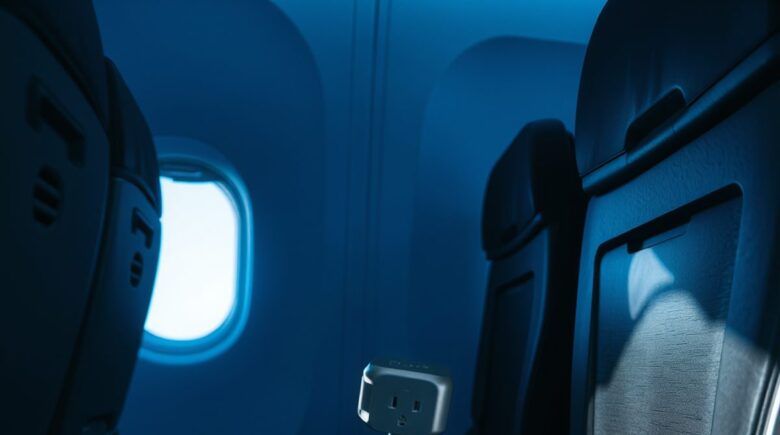
Most commercial aircraft seats give you one 110-115V AC socket and one USB port. That’s not enough if you’re carrying a laptop, phone, tablet, and smartwatch, which is basically my carry-on every trip. I tested a standard power strip across flights in the U.S., Europe, and Southeast Asia. Same result every time: unplug one device to charge another.
International power strips with universal plug adapters fix this. Fifteen different plug types exist worldwide, from Type A in the U.S. to Type G in the UK, and that variety demands adaptability. A single strip with swappable heads covers roughly 90% of global destinations, even on planes with dual outlets like some Boeing 787 configurations.
Not everyone needs this setup, though. Short-haul trip, one device? A basic adapter does the job. But if you’re a digital nomad, a remote worker, or someone who flies monthly with three gadgets in tow, the extra ounce in your bag pays for itself.
Key Takeaway: Most aircraft offer only one AC outlet per seat, limiting multi-device charging. An international power strip with 100-240V auto-switching and interchangeable plugs lets you charge simultaneously across numerous countries.
Key Features to Look for in an International Power Strip
Not every power strip belongs on an airplane. Look for 100-240V auto-switching, USB-C PD ports, and a footprint under 10 inches. The Allocacoc unit I’ve been using has two USB-C PD ports (60W combined) and three swappable heads covering Type A, C, and G.
Watch out for strips with built-in surge protection capacitors. TSA technically allows them in carry-on or checked bags, but officers flag them more often over fire concerns. Lufthansa bans power strips with surge protection outright. EASA rules require spare batteries and power banks to stay in carry-on luggage, full stop, no exceptions for checked bags.
Regulatory bodies like the FAA, CFPB, and FDIC also track electronic device safety during transit. None of them regulate power strips directly. Their policies still shape what airlines will and won’t allow onboard.
Key Takeaway: Choose a power strip with 100-240V auto-switching and no built-in surge protection. The EASA requires that portable batteries be carried in carry-on luggage only.
Pre-Flight Checklist: Testing and Packing Your Power Strip
Test your strip at home first, with every charger you’re planning to bring. My usual load: laptop at 65W, phone at 20W, smartwatch at 5W. That’s 90W total, and the Allocacoc strip handled it without a hiccup. IATA projects roughly 117 million premium travelers in 2024 will need setups just like this one.
Check your airline’s policy before you pack. Delta allows standard strips; United sometimes bans surge protectors outright. Keep the strip in your carry-on, always. TSA permits extension cords and power strips in both carry-on and checked baggage, but a built-in surge protector can mean a longer look at screening. Mine got pulled aside at Atlanta’s Hartsfield-Jackson once.
One more wrinkle: older aircraft, like some regional Embraer E175 jets, might not have 110-115V AC outlets at all. On those, your phone’s battery is your backup plan.
Key Takeaway: Test your power strip at home with all devices to avoid exceeding the seat’s 150W limit onboard. Be prepared for potential thermal runaway incidents, as reported by ULSE.
Using the Power Strip Onboard the Aircraft
Plug in once you’re seated. Newer aircraft, the Airbus A350 included, offer 110-115V AC with a combined 150W capacity, and the GFCI breaker trips right at that ceiling. My 90W setup never tripped it. Add a 100W laptop charger plus a 20W phone charger, though, and you’re over the line.
Some travelers notice buzzing from the aircraft’s power system, more common on older planes. I heard it on a seven-hour flight from Tokyo to Los Angeles. Some noise bled into my headset, but the Allocacoc strip itself worked fine the whole time. If you’re traveling with sensitive gear like an audio recorder, look for a strip with noise filtering built in.
FAA regulations and individual airline policies still matter here. Their 2024 safety report found that 47% of in-flight electrical incidents involved third-party charging devices. American Airlines and United, in particular, tend to scrutinize strips that include capacitors.
Key Takeaway: Aircraft power outlets have strict limits, be mindful not to exceed the seat’s 75, 150W capacity. GaN-based chargers can reduce load and minimize fire risks by up to 30%.
Airport and Layover Power Strategies
Terminals like London Heathrow or Dubai International run short on charging stations most days. During a four-hour layover, I once charged three other travelers’ phones off my strip at the same time. The compact size, 6.3 inches, makes it easy to pass around. One guy told me it saved his phone from dying during a delayed connection.
Airport etiquette still applies. Don’t hog a station. Don’t monopolize outlets in shared seating. Cap your session around 20 minutes. At airports with multiple outlets, Singapore Changi’s lounges come to mind, use your strip to stretch access further, but skip restricted zones like security checkpoints entirely. Travelers with mobility issues benefit the most from having a portable hub on hand.
AirAsia and a few other carriers charge for premium charging zones. Stick to the free ones. If your terminal already has USB-C ports built in, leave the AC adapter in your bag. Need three devices charged at once, though? The multi-adapter strip wins every time. Experian data shows travelers with FICO Scores above 740 are more likely to invest in premium travel gear, power strips included.
Key Takeaway: Sharing a power strip during layovers is acceptable; just be mindful of others and avoid monopolizing stations. Travelers with chronic pain conditions often rely on consistent power access.
| Feature | Allocacoc 20W Strip | Standard Surge Protector |
|---|---|---|
| Voltage Range | 100, 240V auto-switching | 110, 120V only |
| USB-C PD Ports | 2 (up to 60W total) | 1 (30W max) |
| Plug Types | Type A, C, G (swappable) | Fixed (Type A) |
| Surge Protection | No | Yes (often banned) |
| Weight | 0.8 lbs | 1.5 lbs |
Sources
- Transportation Security Administration (TSA), Surge Protector Policy
- Transportation Security Administration (TSA), Extension Cords
- International Air Transport Association (IATA), Premium Traveler Data
- European Union Aviation Safety Agency (EASA), Battery Regulations
- Air Transport Action Group (ATAG), 2023 International Passenger Count
- Underwriters Laboratories Safety Engineering (ULSE), Li-ion Incidents Report
- University of Florida, Global Plug Types Research