Fact-checked by the ZeroinDaily editorial team
Quick Answer
To choose between train and bus travel in Southeast Asia, you’ll need to weigh three factors: route, budget, and safety priorities. Trains win for overnight journeys, scenic routes, and solo traveler security, while buses dominate on frequency, door-to-door speed, and routes where they undercut trains by 30–50% on price. Most travelers mix both modes depending on the specific corridor.
The train vs bus Southeast Asia question used to be simple: pick the cheapest option and hope for the best. That calculus has shifted. In 2026, a swarm of booking apps, real-time tracking tools, and electrified fleets have reshaped how travelers decide. Your decision now depends on which app you open, what time you travel, and how much you value a stable WiFi connection over a slightly faster arrival. According to route data aggregated by 12Go, the gap between bus and train pricing has narrowed on some corridors while widening dramatically on others, thanks to dynamic pricing algorithms that adjust fares by the hour.
The tech layer changes things in ways most travel guides haven’t caught up to. Electric buses with onboard WiFi now run the Hanoi–Sapa corridor. Thailand’s State Railway of Thailand (SRT) has rolled out real-time delay tracking through its mobile app. Grab integrates with intercity bus operators in Vietnam so you can book a full door-to-door trip, bus plus last-mile ride-hailing, in a single transaction. If you’re trying to stretch your travel budget without sacrificing too much comfort, understanding which tech tools tilt the balance toward trains or buses on any given route is the real skill.
This guide is for travelers who want a clear, route-specific framework rather than generic advice. By the end, you’ll know exactly when to default to the railway and when the bus is the smarter call, and which apps, payment methods, and safety features to use along the way.
Key Takeaways
- On overlapping long-distance routes, buses are typically 30–50% cheaper than trains, but the gap shrinks on high-demand overnight corridors where dynamic pricing lifts bus fares, according to 12Go route data.
- Trains have a significantly lower fatality rate per passenger-kilometer than buses in Southeast Asia, making them the safer choice for overnight travel, as documented by ASEAN transport safety reports.
- Electric bus adoption in Thailand and Vietnam has introduced WiFi-equipped, quieter rides on key tourist corridors, narrowing the comfort gap that trains historically dominated, per IEA electrification tracking.
- Real-time GPS tracking through apps like Grab and Vietnam’s BusMap gives solo travelers shareable location data on bus routes, a safety feature trains have offered via railway apps for years.
- Booking platforms now support QR code payments alongside credit cards, eliminating the cash-only friction that once made advance bus bookings impractical across much of the region.
- High-speed rail projects in Thailand and Vietnam are progressing but won’t reshape the train vs bus equation on most routes until 2028 at the earliest, so current infrastructure still favors buses for frequency and reach.
In This Guide
- Step 1: Cost Reality Check Across Key Southeast Asian Routes
- Step 2: Safety, GPS Tracking, and What Solo Travelers Actually Need
- Step 3: Booking Apps, Payment Tech, and Multi-Modal Integration
- Step 4: Time, Comfort, and the Real Train vs Bus Southeast Asia Experience
- Step 5: Electric Fleets, High-Speed Rail, and the Infrastructure Shift Coming
- Frequently Asked Questions
Step 1: Cost Reality Check Across Key Southeast Asian Routes
The price gap between trains and buses in Southeast Asia isn’t uniform. It swings wildly by country, by season, and increasingly by the hour. On the Bangkok–Chiang Mai corridor, a second-class air-conditioned sleeper train from the State Railway of Thailand runs about 850–1,200 THB ($24–34 USD), while an overnight bus on the same route typically costs 550–750 THB ($16–22 USD). The bus saves you roughly 40%. But that gap collapses on routes like Hanoi–Sapa, where the overnight sleeper train (around $28–35 USD for a four-berth cabin) faces stiff competition from sleeper buses priced at $18–25 USD, a narrower spread than most travelers expect, especially when you factor in the train’s included bedding and the bus’s occasional hidden charges for luggage or blanket rentals.
What changed in 2026 is dynamic pricing. Both 12Go and Baolau now pull live fares from operators that adjust based on demand, departure time, and how far ahead you book. A bus seat that costs $12 on a Tuesday afternoon might hit $19 by Friday evening. Trains run by state operators like the SRT and Vietnam Railways (DSVN) use more stable pricing, but their limited sleeper berths sell out days in advance on popular routes, forcing late bookers to the bus by default. If you’re mapping out a longer trip, budget travel hacks that prioritize early booking can lock in train berths at prices buses can’t beat.
How to Compare Costs Accurately
Don’t just compare the ticket price. Factor in station transfers, luggage fees, and onboard meals. A bus terminal often sits on the city outskirts; the Grab ride from Bangkok’s Mo Chit bus terminal to the city center can add 150–250 THB ($4–7 USD) to your total. Train stations, by contrast, tend to be centrally located: Hua Lamphong in Bangkok and Hanoi’s Ga Hà Nội put you within walking distance or a short ride of most accommodations. These transfer costs eat into the bus’s price advantage, especially for solo travelers who can’t split the ride-hailing fare.
What to Watch Out For
Some bus operators advertise rock-bottom base fares and then charge separately for luggage, a blanket on overnight routes, and even a seat with functional air conditioning. Read the operator reviews on 12Go before booking; travelers flag these add-on tactics consistently. Train fares on state railways like DSVN and the SRT are all-inclusive by regulation. Also, currency and payment platform fees can shave 2–4% off your effective savings if you’re booking through a third-party app that converts your home currency at a weak rate. Use a travel credit card with no foreign transaction fees to avoid padding the bus or train ticket with hidden surcharges.
On routes where the price difference between train and bus is under $10 USD, take the train. The included amenities, bedding, central station access, more legroom, almost always deliver more value than that ten-dollar gap suggests. The bus only wins decisively when the savings exceed $15 USD per segment.

Step 2: Safety, GPS Tracking, and What Solo Travelers Actually Need
Buses in Southeast Asia have a higher accident rate than trains, and the gap isn’t marginal. The ASEAN transport safety database consistently ranks rail as the safer mode by passenger-kilometer, a stat driven home every time a night-bus crash makes regional headlines. For solo travelers, especially women, the calculus extends beyond crash statistics: bus terminals can be chaotic and poorly lit at 3 a.m., while train stations tend to have more staff, better lighting, and designated waiting areas. That difference matters when you’re arriving in an unfamiliar city in the middle of the night.
The ASEAN Regional Road Safety Strategy identifies night-bus routes through mountainous terrain as among the highest-risk passenger journeys in the region, a conclusion backed by incident data from member nations including Thailand, Vietnam, and Laos. Regulatory oversight of private bus operators in these countries falls under national transport ministries, the Thai Department of Land Transport (DLT) and Vietnam’s Ministry of Transport both publish operator licensing data, which matters when you’re vetting an unfamiliar carrier on a third-party booking platform.
Night buses on winding mountain routes, think Hanoi to Sapa or Chiang Mai to Pai, combine driver fatigue with sharp curves and limited guardrails. Multiple operators have introduced GPS trackers that let you share your real-time location, but the underlying road risk remains. If a route has more than three hours of mountain driving after dark, pay the premium for the train.
Tech is making buses safer, though. Grab‘s integration with intercity bus operators in Vietnam now lets you share your trip with a contact, complete with real-time GPS pings from the bus itself. BusMap, a Vietnamese app, overlays bus routes with live traffic data and delay alerts, useful for knowing whether your bus is on schedule or stalled in a jam. Trains have had similar tracking through each country’s railway app for years, but the bus ecosystem is catching up fast. For solo travelers prioritizing both safety and budget, trains remain the stronger default, but tech-enabled bus operators on major corridors have closed enough of the gap to be worth considering on short daytime hops.
Step 3: Booking Apps, Payment Tech, and Multi-Modal Integration
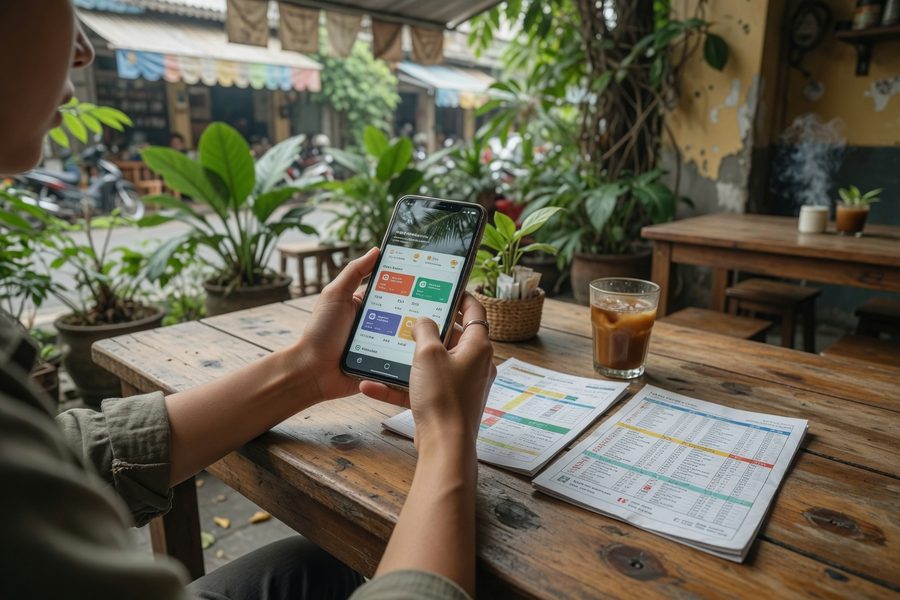
The single biggest shift in the train vs bus Southeast Asia decision loop is the booking layer. Five years ago, you bought bus tickets at a chaotic terminal counter with cash; train tickets required a visit to the station or a clunky official website that timed out mid-transaction. Now, platforms like 12Go, Baolau, and Rome2Rio surface both modes side by side with live pricing, seat maps, and user reviews. You can filter by departure time, trip duration, WiFi availability, and even female-only seating sections where operators offer them.
Payment technology has evolved in parallel. In 2026, QR code payments powered by local super-apps like Thailand’s PromptPay (overseen by the Bank of Thailand) and Vietnam’s MoMo now appear alongside credit card and PayPal options on most booking platforms. This matters because cash-on-delivery used to be the default for bus operators, locking out travelers who wanted to book ahead but lacked local currency. Now you can reserve a bus seat from your phone in Berlin and pay via a QR code that settles in Vietnamese đồng at the mid-market rate. The friction hasn’t vanished entirely; some rural bus operators still run cash-only operations listed only on local-language Facebook pages. But on the 20 or so most popular tourist corridors, the payment experience is genuinely smooth.
Multi-Modal Booking: Bus, Train, and Last-Mile in One Tap
Grab‘s integration with intercity bus networks in Vietnam and Gojek‘s similar experiments in Indonesia mean you can now book a bus ticket and your ride to the terminal in a single checkout flow. 12Go has started testing this on select routes, bundling train tickets with station-transfer rides. For the traveler, this eliminates the fragmented planning that once made buses feel riskier; missing a connection because your Grab driver was late is less stressful when the entire itinerary lives in one booking. Trains, with their fixed stations and predictable arrival times, benefit less from this bundling, but the tech is narrowing the “ease of use” gap that trains historically owned.
As of mid-2026, over 60% of intercity bus tickets on the Bangkok–Chiang Mai and Hanoi–Sapa corridors are now purchased online, up from roughly 15% in 2020. Train bookings have been majority-online for longer, but the bus sector’s rapid digitization means last-minute availability is now visible and reservable in real time, no more showing up at the terminal and hoping.
| Feature | 12Go | Baolau | Railway Apps (SRT/VR) |
|---|---|---|---|
| Bus + train comparison | Side-by-side on one screen | Side-by-side, cleaner UI | Train only |
| Payment methods | Card, PayPal, QR, local wallets | Card, PayPal, fewer local options | Card, local bank transfer |
| Seat selection map | Yes, for most operators | Yes, detailed seat layouts | Limited or none |
| Female-only seating filter | Where available | Not yet | Not offered |
| Multi-modal bundling | Testing on select routes | No | No |
Step 4: Time, Comfort, and the Real Train vs Bus Southeast Asia Experience
On paper, buses are faster. The Hanoi–Sapa bus clocks in at roughly 5.5 hours door-to-door, while the train takes closer to 8 hours when you include the transfer from Lào Cai station to Sapa town. But “faster” and “better” aren’t the same thing. That bus ride compresses into a winding mountain highway where motion sickness is common enough that operators stock plastic bags in every seat pocket. The train, meanwhile, runs through valleys and along ridgelines at a gentler pace; you can stand up, walk to the dining car, and actually look at the scenery instead of gripping an armrest.
The overnight calculation flips entirely. A sleeper train between Bangkok and Chiang Mai takes about 12–13 hours and deposits you in the city center at 7 a.m., rested enough to function. An overnight bus on the same route might shave two hours off the trip but delivers you stiff, sleep-deprived, and standing in a dusty terminal at 5 a.m. with nothing open. For anyone who values the next day’s productivity, the train’s longer schedule is actually the time-efficient choice.
Comfort Details That Matter
Second-class sleeper trains operated by the SRT give you a fold-down berth with curtains, a reading light, and a power outlet. First-class cabins add privacy and a locking door. Buses have stepped up their game: new electric coaches on Thai and Vietnamese routes feature wider seats, USB-C ports, and onboard WiFi that works well enough for messaging and light browsing. But you’re still in a seat for eight hours, and the air conditioning runs either arctic or nonexistent, with rarely an in-between. Train cars give you space to move. That freedom matters more on a 12-hour journey than a three-hour one, which is why many travelers default to buses for short hops and trains for anything overnight.
On the Hanoi–Sapa corridor, roughly 80% of travelers now choose the bus, driven by the 5.5-hour vs 8-hour time difference and the bus’s direct Sapa drop-off. But satisfaction ratings for the train remain higher, a gap that persists because time saved doesn’t always mean comfort gained, according to aggregated review data on 12Go.
For anyone committed to a slow travel mindset, the train’s longer schedule stops being a drawback and starts being the point. You see more, you sleep better, and you arrive somewhere central. If your priority is compressing transit time to maximize days at your destination, the bus makes sense; just budget for the post-ride exhaustion.
Step 5: Electric Fleets, High-Speed Rail, and the Infrastructure Shift Coming
By 2028, the train vs bus Southeast Asia equation will look different. Thailand’s high-speed rail project connecting Bangkok to Nakhon Ratchasima, the first phase of a planned line to Vientiane, is under construction and targeting operational service within two to three years, per the State Railway of Thailand‘s public timeline. Vietnam’s National Assembly approved its own north–south high-speed railway in late 2024, though ground hasn’t broken yet; the project falls under the oversight of Vietnam’s Ministry of Transport. These projects won’t change your 2026 trip, but they signal where the region is heading: trains that compete on speed while already winning on comfort and safety.
Buses aren’t standing still. Electric bus fleets are expanding rapidly on tourist corridors in Thailand and Vietnam, driven partly by government subsidies and partly by operators realizing that quieter, smoother rides with WiFi attract higher-margin customers. The International Energy Agency (IEA) tracks EV adoption in Southeast Asia and notes that electric bus registrations in the region grew sharply in 2025, with Thailand leading the charge. These buses eliminate diesel fumes and engine vibration, two of the biggest comfort complaints about legacy bus travel, and the onboard power infrastructure makes reliable WiFi and charging ports standard rather than aspirational. Carbon-conscious travelers also get a win: an electric bus running on Vietnam’s increasingly renewable grid has a carbon footprint closer to a train’s than to a diesel bus’s, according to IEA lifecycle emissions data.
What This Means for Your Trip Planning Now
On routes where electric buses are confirmed, operators like Green Bus Thailand and several Vietnamese carriers on the Hanoi–Sapa corridor now advertise EV options. The comfort gap with trains is genuinely smaller on these services. You still lack the freedom to walk around, but the ride is smoother and the tech amenities are comparable. Treat an electric bus as a middle ground: faster than the train, cheaper than the train, and close enough in comfort that the trade-off becomes a matter of personal preference rather than a clear-cut recommendation. Diesel buses, especially older ones on secondary routes, remain the budget brute-force option; they’ll get you there, but you’ll feel the journey.
When searching on 12Go or Baolau, look for the “electric” or “EV” tag in the bus listing. If it’s not there, the bus is almost certainly diesel. On routes under six hours, the difference is manageable. On anything longer, the EV upgrade is worth filtering for; the reduced noise and vibration meaningfully change how you feel at the other end.

The infrastructure shift also affects transfers. New charging stations at bus terminals mean electric buses depart from upgraded facilities with better lighting, seating, and food options, not the grim, diesel-fumed lots that gave bus travel its reputation. Train stations have long had these amenities. As the gap in terminal quality narrows, the bus experience improves from the moment you arrive to board, not just once you’re on the road.
Related reading: deep dive: travel portable water.
Frequently Asked Questions
Do trains in Southeast Asia have WiFi and power outlets I can use for work?
It depends on the country and class. Thailand’s newer first-class sleeper carriages run by the SRT offer power outlets at every berth, but onboard WiFi is rare on state-run trains; you’ll rely on mobile data. Vietnam Railways trains have power outlets in most sleeper compartments, though voltage stability can be inconsistent. Buses, especially newer electric and VIP models, increasingly offer WiFi as a standard feature. If connectivity is critical, a bus with a confirmed WiFi listing on 12Go often beats a train where you’ll hotspot from your phone. Bring a local SIM with a strong data plan as backup regardless of mode.
Can I track my bus or train in real time with Grab or Google Maps in Vietnam?
For buses, yes, partially. Grab‘s intercity bus integration in Vietnam provides real-time GPS tracking for participating operators, and you can share your trip with a contact. The BusMap app overlays bus positions on a live map for many Vietnamese routes. Google Maps offers schedule data for some intercity buses but lacks live tracking for most. Trains in Vietnam can be tracked through the official Vietnam Railways app, which shows delay information and station ETA updates. Thailand’s SRT app offers similar functionality. Neither mode has universal tracking yet, but the tools available cover the busiest corridors.
What payment methods work for booking buses and trains in Southeast Asia?
Credit cards, PayPal, QR code payments via local wallets (PromptPay in Thailand, MoMo in Vietnam), and sometimes cash-on-delivery depending on the platform. 12Go and Baolau accept international cards and PayPal, making them the easiest choice for travelers without local bank accounts. Railway booking sites like the SRT and Vietnam Railways have added card payment support but sometimes reject foreign-issued cards, a persistent friction point. If you’re booking directly with a small bus operator, cash at the terminal might still be the only option.
How reliable are train schedules in Southeast Asia compared to buses?
Trains are generally more reliable for departure times but more prone to cascading delays on long routes; a one-hour delay starting in Bangkok can stretch to two by Chiang Mai. Buses face road traffic and weather disruptions that trains largely avoid. On punctuality, neither mode is Swiss-level precise, but trains offer predictability: a delay is usually announced through the railway app, and the station has a waiting area. Bus delays often involve standing at a terminal with no update until the vehicle appears.
Do I need to book bus and train tickets in advance or can I buy them at the station?
For trains, book ahead, especially sleeper berths on popular routes like Bangkok–Chiang Mai and Hanoi–Da Nang, which can sell out three to five days in advance during high season. For buses, same-day purchase is often possible at the terminal, but you’ll get a better price and seat selection by booking online at least 24 hours ahead. Electric and VIP buses with limited capacity fill up faster than standard diesel coaches. During Lunar New Year (Tet) and Songkran, book everything at least a week in advance or risk being stranded.
What’s the carbon footprint difference between taking a train vs bus in Southeast Asia?
Diesel trains and diesel buses are roughly comparable per passenger-kilometer, with trains slightly ahead on efficiency. Electric trains, which run on parts of Thailand’s network, have a substantially lower carbon footprint, especially as the regional grid incorporates more renewables. Electric buses fall between diesel buses and electric trains, according to lifecycle analyses from the IEA. If minimizing emissions is your priority, choose an electric train where available, then an electric bus, then a diesel train, then a diesel bus.
Are there women-only carriages or seats on trains and buses in Thailand and Vietnam?
On trains, yes. Both the SRT and Vietnam Railways offer women-only carriages or designated sections on major routes. These can be selected during booking on 12Go (look for the female-only filter) or at the station ticket counter. On buses, the practice is less formalized: some operators let you request a seat next to another woman during booking, but dedicated women-only sections are rare. If this is a priority, trains offer more structured options.
What’s the best app for comparing train and bus prices across Southeast Asia?
12Go offers the broadest coverage across Thailand, Vietnam, Cambodia, Laos, and Myanmar, with side-by-side comparisons for most major routes. Baolau has a cleaner interface and strong Vietnam coverage but fewer operators in Thailand. Rome2Rio is useful for multi-country trip planning but sends you to external sites to book. Download two apps, 12Go for coverage and Baolau for Vietnam detail, and cross-check prices before committing.
How do I get from the bus or train station to my hotel using ride-hailing apps?
Grab operates in Thailand, Vietnam, Cambodia, and several other Southeast Asian countries, and it works at virtually every major bus terminal and train station. Gojek is strong in Indonesia. At smaller stations, Grab availability can be thin; keep the local taxi app or a screenshot of your hotel’s address in the local language as a backup. Train stations tend to have more organized taxi queues and better ride-hailing pickup zones than bus terminals, which can be chaotic. Budget $3–8 USD for the transfer depending on the city and distance.
Sources
- 12Go, Southeast Asia Transport Booking Platform with Route Data
- Baolau, Vietnam and Southeast Asia Bus and Train Booking
- Vietnam Railways, Official Schedules and Booking Portal
- ASEAN, Regional Transport Safety and Infrastructure Data
- Grab, Ride-Hailing and Intercity Bus Integration in Southeast Asia
- The Man in Seat 61, Independent Train Travel Guide for Southeast Asia
- State Railway of Thailand (SRT), Official Schedules and Infrastructure Updates
- Vietnam Ministry of Transport, Rail and Road Project Oversight
- International Energy Agency (IEA), Southeast Asia EV Adoption and Emissions Data
- Thai Department of Land Transport (DLT), Operator Licensing and Road Safety Data
- BusMap, Vietnam Real-Time Bus Tracking App
- MoMo, Vietnam Digital Payments Platform
- Bank of Thailand, PromptPay QR Payment Infrastructure
- Green Bus Thailand, Electric Intercity Coach Operator
- Rome2Rio, Multi-Modal Route Planning Tool
- Gojek, Ride-Hailing and Mobility Services in Indonesia and Southeast Asia






