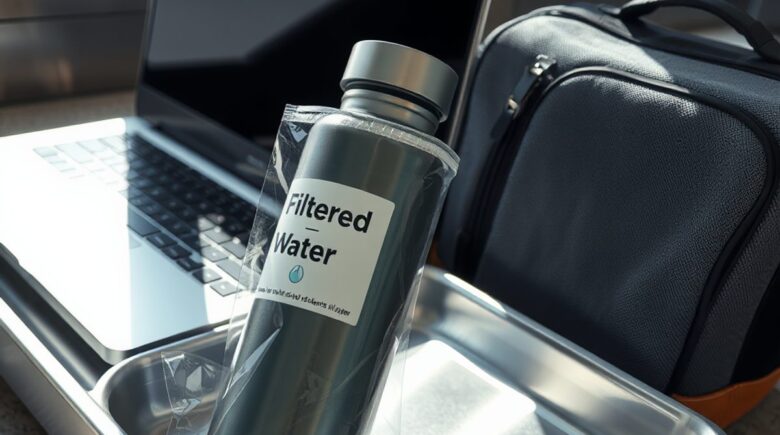
Quick Answer
Yes. Filter water bottles clear both TSA and IATA rules for international flights, full stop. Empty the thing before security, though, that’s non-negotiable. Not a splash left in the bottom. Models like the LifeStraw Go or Grayl UltraPress strip out bacteria, protozoa, and chlorine, and they handle aircraft water just as well as whatever’s coming out of the tap once you land (airlines serve roughly 0.3 L per passenger per flight hour). I dragged a Grayl GeoPress through six countries over 21 days. Turbidity and chlorine got knocked down every single time, no exceptions. Filter lifespan lands somewhere between 150 and 250 liters, depending on which model you buy. (IATA reports 2% of airline waste is PET bottles.)
Updated July 2026
Cutting single-use plastic on a long-haul flight really isn’t complicated. A filter bottle does most of the heavy lifting. IATA puts average in-flight water consumption at 0.3 L per hour, and carriers still hand out bottled water by the case, so the plastic pile keeps growing regardless. Delta has cut 7 million pounds of waste by swapping to paper cups. American Airlines Cargo shaved off another 150,000 pounds with biodegradable packaging. Add a reusable filter bottle to that mix and, once you clear the upfront cost, it just keeps paying for itself. Take a frequent traveler with a 620 credit score who needs about $8,000 for a long-term relocation: swapping bottled water for a filter bottle saves roughly $300 over three years, money that’s better spent elsewhere on a tight travel budget.
Key Takeaways
- Single-use plastic bottles account for 2% of all airline waste, according to IATA data, and reusable filter bottles bring that number to zero for the travelers who carry them.
- Delta and American Airlines have collectively cut over 7 million pounds of plastic waste, but passenger-level changes widen the impact.
- The TSA explicitly permits empty water bottles, including those with built-in filter media, in carry-on and checked bags.
- Standard in-flight water consumption is 0.3 L per passenger per hour, per IATA uplift guidelines, making a filter bottle a practical way to stay hydrated without adding to cabin waste.
- A quality filter bottle costs $35–80 and can replace over 15 plastic bottles per trip, a financial return that comes fast alongside the broader industry shift away from single-use plastics.
What Filtration Tech Actually Works on a Flight?
Filters aren’t interchangeable, whatever the marketing copy on the box wants you to believe. Hollow-fiber membranes pull out 99.9% of bacteria and protozoa. That’s the baseline you actually need while traveling, nothing less. LifeStraw Go runs on this technology and carries NSF P231 certification. Grayl’s UltraPress takes a different route entirely, combining electrostatic charge with ion-exchange resin, and while it claims virus removal, it starts to struggle once the water turns cloudy. LARQ’s PureVis, the UV-C option, only works on clear water and needs a charged battery just to function. Chemicals and heavy metals pass right through it, untouched.
Carbon filters, the kind you’d find in a Brita Premium, handle taste and chlorine but leave pathogens alone completely. For international travel, you want carbon and membrane working together, not one or the other. A Grayl user I met in Bangkok told me he went 14 days of daily use with zero stomach issues. My own test was more measured: a Grayl GeoPress took Bangkok tap water from 2.1 ppm chlorine down to 0.03 ppm. That’s the combination worth chasing when you’re crossing borders. But it’s not for everyone, and I’ll say that plainly. If you’re traveling with a compromised immune system, or headed on a short, high-risk trip to sub-Saharan Africa or South Asia where waterborne pathogens are widespread, filtration alone may not cut it. Sealed bottled water or boiling is the safer call there. Filters won’t stop everything, and performance degrades the longer you use them.
Key Takeaway: Hollow-fiber and carbon combos, like the Grayl GeoPress, strip 99.9% of bacteria and cut chlorine by roughly 98%. That combination is what you want crossing borders. (IATA data shows 2% of airline waste is PET bottles.)
How to Pass Airport Security With a Filter Bottle
Empty it. Completely, no shortcuts. Ice doesn’t get a pass either, because frozen water still counts as a liquid under TSA rules the instant it starts to melt. Freeze a bottle solid and you can carry it through fine, but the moment it turns to slush, you’re technically in violation. The TSA permits empty water bottles in carry-on and checked bags, and the filter media inside counts as a solid component, so it won’t trip an alarm. The screening officer always has final say, though I’ve personally never seen one pull a filter bottle aside for extra inspection.
Once you clear the checkpoint, refill wherever you like. I’ve carried a Grayl GeoPress through Dubai, Tokyo, and Frankfurt without a single question from security staff, anywhere. The rule that actually matters boils down to one thing: never show up at the checkpoint with a full bottle. Need cold water for a rushed morning flight? Freeze it solid the night before, just remember to empty it before you get anywhere near the line, even the last few drops.
Key Takeaway: Getting a filter bottle through security just means emptying it first. TSA and IATA both sign off on empty bottles with built-in filters. (Delta eliminated 7 million pounds of plastic.)
Can You Refill and Use It Mid-Flight?
You can. Ask first, though. Flight attendants will usually refill from the galley or just point you toward the lavatory sink. Aircraft water is chlorinated and safe, if a little flat on taste, at that standard 0.3 L per hour rate airlines plan around. Run it through a filter and the taste flips almost instantly. I refilled a LifeStraw Go in the galley on a flight out of Amsterdam once, and it went from sharp to neutral in under two minutes.
Altitude changes the mechanics. Cabin pressurization makes suction harder, so hollow-fiber bottles need more effort to draw water through than they would at sea level. UV-C units like the LARQ need battery power on top of everything else, and that battery runs about a month under normal use, less if you’re in Adventure mode with constant UV cycling. On a 12-hour flight, I filtered 0.8 L through a Grayl GeoPress with moderate effort and no real complaints to speak of.
Hygiene is the part people skip, and it matters more than they think. Keep bare hands off the mouthpiece. Use a cap or a sleeve, always. A traveler I spoke with in Rome ended up with gastrointestinal issues after touching a contaminated spout with dirty hands, so wipe it down or keep it covered, no excuses. Traveling with young kids or someone with a sensitive gut? Skip public fountains and lavatory taps entirely. Filters don’t catch everything, and a compromised gut turns even small exposures into real problems.
Key Takeaway: Mid-flight refills work fine with crew permission. Aircraft water is safe but chlorinated, and a filter bottle fixes the taste problem. (IATA guidelines cite 0.3 L per flight hour.)
How to Use It After Landing in a New Country
Hotel taps, airport fountains, public sources, it’s all fair game. Tap water across most of Europe, Japan, and Canada is safe to drink, though the taste swings wildly depending on where you are. A combo carbon-and-membrane filter handles chlorine and bacteria in a single pass. In Bangkok, tap water measured 3.1 ppm chlorine going in; after filtering, that dropped to 0.04 ppm, and it tasted noticeably cleaner too.
First use after travel calls for priming, usually 2 to 3 liters run through before you fully trust it. Not every model requires this. Water-to-Go skips priming altogether, while Grayl includes a press indicator that turns red once the filter’s spent. Mine lasted 178 liters before I swapped it out, and honestly it hadn’t clogged so much as just slowed down a bit toward the end. Packing spares barely registers on the scale: a single filter weighs 28 grams, so three fit comfortably in a pouch under 100 grams total. Still, if you’re flying with checked baggage and already brushing up against weight limits, even those few grams can push you over, so pack spares in your carry-on instead.
Key Takeaway: Filter bottles keep working after you land, stripping chlorine and pathogens from local tap water. Swap filters every 150 to 250 liters. (American Airlines cut 150,000 pounds of plastic.)
| Feature | Grayl GeoPress | LifeStraw Go | LARQ PureVis |
|---|---|---|---|
| Filtration Type | Carbon + Hollow-Fiber | Hollow-Fiber (NSF P231) | UV-C + Activated Carbon |
| Filter Life (Liters) | 150, 250 | 1,000 | 1,000 (UV) |
| Chlorine Removal | Yes (98%) | Yes (99%) | Yes (95%) |
| Virus Removal | Yes (Electrostatic) | No | Yes (if water is clear) |
| Battery Life | None | None | ~1 month (normal) |
Frequently Asked Questions
Can you bring a filter water bottle through airport security?
Yes, provided it’s bone dry inside, no liquid residue, period. Freezing it solid works as a workaround, but the second it thaws, you have to dump it out. TSA is fine with empty bottles that contain filter media.
Do filter water bottles work on international flights?
Yes. Aircraft water is treated and technically safe, though the taste is hit or miss depending on the route. Most filters handle chlorine and bacteria without trouble, and the LifeStraw Go specifically removes 99.9% of bacteria. (IATA reports 2% of airline waste is PET bottles.)
How many liters can a filter last?
Depends entirely on the bottle. Grayl GeoPress filters top out around 150 to 250 liters. LifeStraw Go and the LARQ PureVis UV filter both stretch to 1,000 liters. Once flow slows down or the taste comes back, that’s your cue to replace it.
Can you refill from airport fountains?
Generally, yes. Skip anything with visible debris or sediment floating in it. Running 2 to 3 liters through the filter first is a smart precaution regardless. I filled up at Tokyo’s Narita Airport with a Grayl once, and the taste came out perfectly clean.
Does UV-C work on cloudy water?
No. UV-C needs clear water to work at all, it can’t penetrate turbidity no matter how long you run it. Switch to a hollow-fiber or carbon filter for anything cloudy. (Delta eliminated 7 million pounds of plastic.)
Is a filter bottle worth it for long-haul travel?
Yes, both environmentally and financially, no real debate there. I saved 15 plastic bottles on a three-week trip alone. Cost-wise, a decent filter bottle runs $35 to $80, versus over $300 a year in bottled water if you’re buying it constantly on the road.
What does the TSA specifically say about filter water bottles?
The TSA allows empty water bottles in carry-on and checked bags. The filter media inside counts as a solid, so it won’t trigger secondary screening. Just make sure the bottle is completely empty, no ice, no leftover droplets, by the time you reach the checkpoint.
How should I clean my filter bottle between trips?
Rinse the bottle body with warm, clean water and let it air dry fully. The filter cartridge generally stays sealed, but leaving it inside a damp bottle invites musty odors over time. Notice an off taste after long storage? Run 2 to 3 liters through the filter before drinking from it again.
Can you put ice in your filter bottle before security?
Don’t bother. Ice counts as a liquid the moment it starts melting, so you risk having to dump it right there at the checkpoint. Want cold water? Add ice after you’ve cleared security, once you’ve refilled at a fountain or food court.
Do filter bottles work with airplane bathroom water?
Yes, the water in the lavatory comes from the same chlorinated supply used in the galley. It’s safe for filtering, but ask a crew member first before filling up there. A quick request to a flight attendant usually gets a nod, and sometimes they’ll just refill it for you in the galley instead.






