Fact-checked by the ZeroinDaily editorial team
Quick Answer
For most drivers and casual travelers, a smartphone navigation app is sufficient. Dedicated GPS devices are worth the cost (typically $150 to $400) when you need offline maps, reliable battery life, or operate in areas with no cell signal. Phones win on convenience and map updates; dedicated units win on resilience and focus.
The dedicated GPS vs phone debate has a clear answer for most people: your phone already does the job. Google Maps and Apple Maps cover over 220 countries and territories with real-time traffic data, and both apps are free. The question is whether the edge cases where dedicated GPS hardware outperforms a smartphone apply to your specific situation.
That edge is narrowing every year, but it has not disappeared. Battery drain, cellular dead zones, and driver distraction research all point to scenarios where purpose-built hardware still earns its place.
Where a Dedicated GPS Device Still Wins
Dedicated GPS units outperform smartphones in three specific conditions: no cell signal, no power outlet, and extended off-road use. These are not hypothetical edge cases for every traveler, but they are decisive when they apply.
Garmin, the dominant manufacturer in the consumer GPS category, identifies offline preloaded maps as the primary functional advantage of a dedicated device. According to Garmin’s official guidance on GPS devices versus smartphones, dedicated units come with maps stored onboard that work without any cell signal, connect directly to a power cable so battery drain is a non-issue, and feature larger purpose-built screens sized for windshield mounting. Garmin also notes that it does not sell users’ location or travel history, a meaningful privacy distinction from app-based navigation.
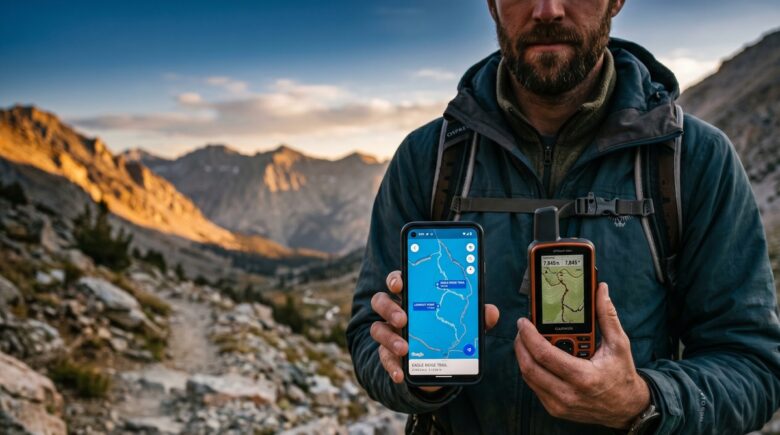
For hikers and backcountry travelers, the durability argument is equally strong. A detailed comparison published by SectionHiker.com concludes that dedicated GPS handhelds are rugged and waterproof with longer battery life, making them the more reliable choice when you cannot afford a device failure miles from a trailhead. The same analysis acknowledges that smartphone apps have largely replaced dedicated GPS receivers among most casual hikers due to superior map variety and update frequency.
Battery and Connectivity Realities
A typical smartphone running navigation continuously drains its battery in 3 to 5 hours, depending on screen brightness and signal conditions. A dedicated automotive GPS unit plugged into a 12V outlet runs indefinitely. For long-haul driving or international trips where roaming data is expensive, the wired connection alone removes a persistent anxiety that phone-based navigation introduces.
Key Takeaway: Dedicated GPS devices from Garmin and similar manufacturers excel in three areas: offline maps, continuous power via a 12V connection, and rugged waterproof builds. For travelers in dead zones or on remote trails, these advantages are functionally decisive.
Where Your Phone Is the Better Choice
For urban and suburban driving, smartphone navigation apps are objectively better in several measurable ways. Real-time traffic rerouting, construction alerts, speed trap warnings, and map updates that reflect road changes within days give apps a significant operational edge over dedicated units, which often require paid map subscription updates.
Google Maps and Waze (both owned by Alphabet) refresh their mapping data continuously through a combination of satellite imagery, Street View, and millions of user-reported incidents. Apple Maps has closed the gap substantially since 2020, now offering detailed indoor maps and real-time transit data in major cities. None of these services charge for navigation or map updates.
The cost differential is also real. A mid-range Garmin automotive GPS retails between $150 and $400, while navigation on a smartphone you already own costs nothing beyond data usage. For travelers managing trip budgets carefully, that matters. If you are already thinking about hidden costs of travel like transfers and insurance, adding a dedicated GPS device to your packing list is worth scrutinizing before purchase.
Offline capability, once the clearest win for dedicated devices, is now available on both Google Maps and Apple Maps. Users can download regional map packages for offline use, covering most domestic road trips without a data connection. The coverage is not as granular as a dedicated unit’s preloaded maps for back roads, but it handles the vast majority of consumer travel scenarios.
Key Takeaway: Google Maps and Apple Maps offer free real-time rerouting and offline map downloads, covering over 220 countries. For most urban and suburban drivers, these apps eliminate the practical need for a separate device, as confirmed by navigation comparisons across consumer use cases.
| Feature | Dedicated GPS Device | Smartphone Navigation App |
|---|---|---|
| Offline Maps | Preloaded, full coverage, no setup | Downloadable regions; less granular on back roads |
| Map Updates | Periodic; often requires paid subscription | Continuous, free (Google Maps, Apple Maps) |
| Battery / Power | Wired to 12V outlet; indefinite runtime | 3 to 5 hours on battery; requires charger |
| Screen Size | 5 to 7 inches, purpose-built for dash mounting | Varies; typically 6 to 6.7 inches on modern phones |
| Real-Time Traffic | Limited; some models use FM traffic or subscription | Live, crowd-sourced (Google Maps, Waze) |
| Durability (Hiking) | Rugged, waterproof (IPX7 on Garmin inReach) | Consumer-grade; most are water-resistant, not waterproof |
| Upfront Cost | $150 to $400 | $0 (app on existing device) |
| Data Privacy | No location data sold (Garmin) | Location data used for ad targeting (Google, Apple) |
Driver Distraction: The Safety Case for Dedicated Hardware
Safety research presents the strongest non-obvious argument for dedicated GPS units. Programming a destination into a phone while driving is among the most dangerous in-vehicle tasks documented in controlled studies.
A 2017 study by the AAA Foundation for Traffic Safety found that programming a GPS navigation system was the most cognitively demanding in-vehicle task tested, taking drivers an average of 40 seconds to complete. That is longer than composing a text message. The study, detailed in AAA’s 2017 infotainment distraction research, also found that Apple CarPlay and Android Auto generated less cognitive demand than native vehicle infotainment systems but still produced potentially unsafe distraction levels.
“By following NHTSA’s voluntary guidelines to lock out certain features that generate high demand while driving, automakers can significantly reduce distraction.”
The National Highway Traffic Safety Administration (NHTSA) addressed this directly in its Phase 1 Visual-Manual Driver Distraction Guidelines, published in the Federal Register in April 2013. NHTSA recommends locking out manual text entry and complex displays while a vehicle is in motion, while explicitly permitting simple two-dimensional map displays for navigation. A dedicated GPS device mounted on the dash, programmed before departure, satisfies these guidelines more cleanly than a phone that doubles as a messaging and entertainment device within arm’s reach.
The practical implication is simple: a dedicated unit reduces the temptation to interact with a multipurpose screen while moving. That behavioral separation has measurable safety value.
Key Takeaway: Programming GPS on a phone takes an average of 40 seconds of eyes-off-road time, longer than texting, according to AAA Foundation for Traffic Safety research. Entering a destination before driving, on any device, is the single most effective safety step.
Who Should Actually Buy a Dedicated GPS Device?
The answer depends on four variables: how often you drive in areas with unreliable cell coverage, whether you hike or travel off-road, how much you value data privacy, and whether you are disciplined about not touching your phone while driving.
The clearest cases for buying a dedicated unit are commercial truck drivers, overlanders, backcountry hikers, and international travelers who face expensive roaming data charges. Garmin’s automotive lineup (the DriveSmart series) and handheld lineup (the GPSMAP and inReach series) are the category benchmarks. TomTom remains a credible alternative, particularly in European markets where its map data has historically been strong.
For families planning international road trips, the offline map advantage is material. Downloading a country’s map on Google Maps before departure works, but preloaded Garmin maps with turn-by-turn voice guidance that requires zero data are genuinely more reliable in rural areas of Southern Europe, Southeast Asia, or Central America. If you are planning a trip where navigation reliability is critical, it pairs naturally with thinking through your travel insurance decisions and other trip dependencies before you leave.
For the majority of North American and Western European urban drivers, the phone is the objectively better tool. It is free, always updated, and handles 95 percent of navigation scenarios without friction. Paying $200 for a dedicated unit to solve a problem you encounter twice a year is hard to justify.
If you do travel frequently and want to optimize costs, tools like strategies for traveling more without overspending can help frame where a dedicated GPS purchase fits relative to other travel investments.
Key Takeaway: Dedicated GPS units priced at $150 to $400 make financial sense for commercial drivers, backcountry hikers, and frequent international travelers. For urban drivers in connected regions, a smartphone app delivers equal or better navigation with no additional cost, as confirmed by category comparisons of GPS handhelds vs. smartphone apps.
Making Either Option Work Better
Whichever device you use, setup discipline matters more than the hardware choice. Program your destination before moving. Mount your device at eye level rather than in your lap. Use voice guidance and resist the urge to look at the screen while the route is active.
For phone users, a quality windshield or vent mount eliminates the holding-the-phone problem entirely. Paired with Apple CarPlay or Android Auto, a phone becomes functionally similar to a dedicated navigation screen for a fraction of the cost of a dedicated unit. Both systems mirror navigation to a vehicle’s infotainment screen with simplified interfaces designed around NHTSA’s distraction guidelines.
For dedicated GPS users, keeping maps updated is the most commonly neglected maintenance task. Garmin’s Garmin Express desktop application handles this, but many users skip updates for months, which means their device may route through roads that no longer exist or miss new interchanges. Set a calendar reminder to update maps every 90 days.
Whichever tool you rely on for navigation, the same discipline applies to broader technology choices: the best tool is the one that fits your actual workflow, not the most feature-rich option. That logic applies equally to how you pace your travel and how you configure your gear before leaving home.
Key Takeaway: Apple CarPlay and Android Auto reduce smartphone distraction demand below native infotainment systems according to AAA Foundation testing, making them the recommended interface for phone-based navigation when a compatible vehicle display is available.
Frequently Asked Questions
Is a dedicated GPS device better than Google Maps?
For most drivers in urban or suburban areas with reliable cell service, Google Maps is the better choice because it offers free real-time traffic updates and continuous map improvements. A dedicated GPS device is better in areas without cell signal, for drivers who want preloaded offline maps without any setup, or for backcountry hiking where waterproofing and battery life are critical.
What is the main disadvantage of using your phone for GPS navigation?
Battery drain is the most common practical disadvantage: continuous navigation can deplete a smartphone battery in 3 to 5 hours without a charger. A secondary concern is cellular dependency, since most phone navigation apps require a data connection for live traffic and rerouting, though offline map downloads have reduced this significantly.
Do dedicated GPS devices work without internet?
Yes. Dedicated GPS devices from manufacturers like Garmin and TomTom use preloaded maps stored on the device, so they work entirely without an internet connection. They receive positioning signals from GPS satellites, which are free and do not require data. Internet is only needed for optional services like live traffic or software updates.
Is it safer to use a dedicated GPS or a phone while driving?
Both present distraction risks if you interact with them while driving. AAA Foundation for Traffic Safety research found that programming any GPS device takes an average of 40 seconds of hands-on interaction, which is dangerously long. The safest practice with either device is to enter your destination before the vehicle moves and use voice guidance throughout the trip.
Which GPS device is best for hiking?
Garmin dominates the hiking GPS category with its GPSMAP and inReach series, which offer waterproof builds rated to IPX7 or higher and battery life measured in days rather than hours. For most casual day hikers, a smartphone with an offline map app like Gaia GPS or AllTrails is sufficient. Serious backcountry travelers benefit from a dedicated handheld unit.
Does a dedicated GPS device use data?
Standard route navigation on a dedicated GPS unit uses no data at all, relying entirely on preloaded maps and satellite positioning. Some models offer optional subscription services, such as Garmin’s live traffic feature via FM receiver or an LTE-connected service, but these are add-ons rather than requirements for basic navigation functionality.
Sources
- AAA Foundation for Traffic Safety — New Vehicle Infotainment Systems Create Increased Distractions Behind the Wheel (2017)
- NHTSA — Visual-Manual Driver Distraction Guidelines for In-Vehicle Electronic Devices, Federal Register (2013)
- Garmin — Seven Reasons to Use a GPS Device Instead of a Smartphone in the Car
- SectionHiker.com — GPS Handhelds vs. Smartphone Navigation Apps: A Detailed Comparison